Question-bank sessions
Use deliberate blocks for QBank work, then review the exact traps and concept failures that showed up.
Medical students already deal with enough intensity. Stuon keeps the study environment clean while helping you run longer review blocks, hold onto recall-heavy work, and make big prep days feel more sustainable.
When the workload is huge, the tool should not make it heavier. Stuon works best as the clean focus layer around the resources you already use.
Use deliberate blocks for QBank work, then review the exact traps and concept failures that showed up.
Stay with one topic long enough to actually reproduce the chain, not just recognize it on the page.
Alternate intensity and reset without making the full day feel fragmented or chaotic.
Cardio, renal, neuro, pharm, or one tight question-bank theme.
Stay inside a real work window instead of jumping between five disconnected tasks.
Capture what you could not retrieve, not just the material you reviewed.
Use the next session to revisit the gap directly instead of restarting the whole chapter.
Medical study runs on question banks, card reviews and long recall-heavy days. Stuon does not replace those resources. It times the work, shows what you could not retrieve, and keeps a record of how steady your prep really is.
Time QBank blocks at exam pace and log each one with a note on the systems covered and the questions you missed. The notes become a short list of weak topics for the next day.
Blurt a pathway, a drug class or a disease mechanism from memory for ten minutes, then compare it with your source. Whatever you could not reproduce becomes the next session.
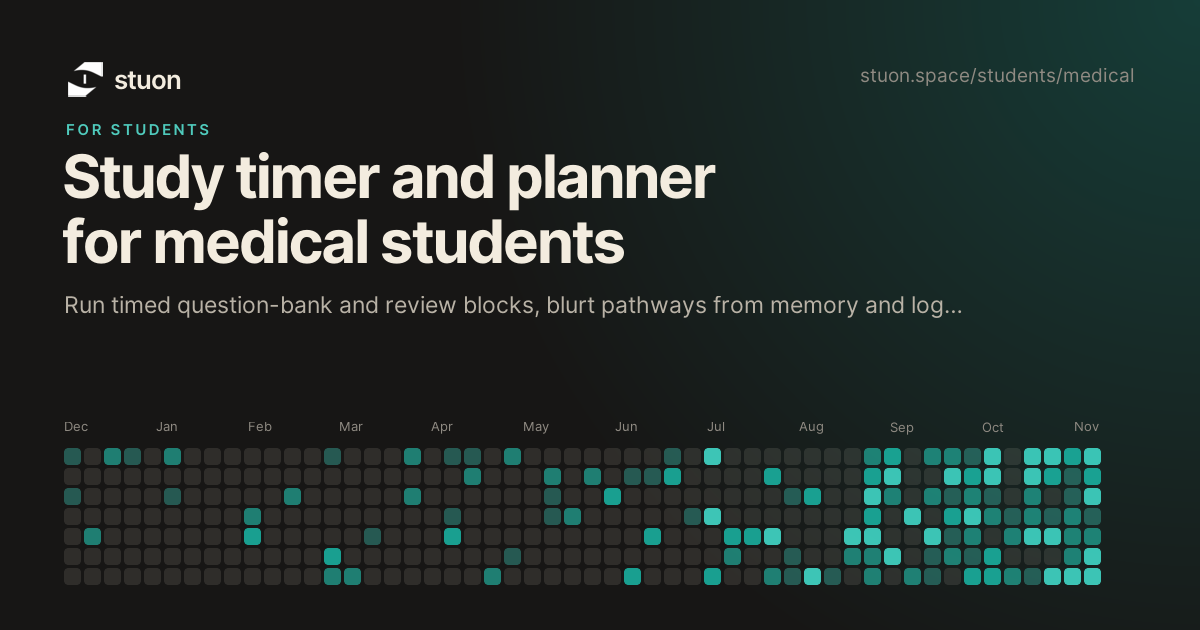
Use the spaced repetition scheduler for topics that need return visits, alongside Anki for card-level review. The heatmap shows whether a dedicated study period is holding steady week to week.
Yes. It works especially well for disciplined question-bank and review blocks where recall matters.
Yes. Stuon does not replace those tools. It gives them a focus structure and a log of what you covered.
Yes. Stuon Pro includes flashcards with spaced repetition, plus blurting and a drawing tool for diagrams. If you already have an Anki deck, keep it and let Stuon handle timing and logging.
Yes. Use the free Pomodoro timer for 25-minute blocks with short breaks and a 15-minute long break, or the stopwatch for full QBank blocks. Logging each block shows how the day actually went.
A phone timer counts time and then forgets it. Stuon keeps session notes, a streak and a heatmap, so you can see what you reviewed and how consistently.
High yield works better when the system stays clean.