free study tool
Acronym generator for studying
how do you make an acronym to memorise a list?
Take the first letter of each item and join them into one word or a sentence. The planets Mercury, Venus, Earth and Mars give MVEM, or a sentence such as "My Very Easy Method". If the order of the list does not matter, rearrange the items until the letters spell something you can say.
by Vusal Imranli updated 10 Oct 20264 min read
acronym in your order
orders that are easier to say
sentence mnemonic
The suggested orders use a simple rule: alternating vowels and consonants are easier to say. The sentence words come from a small built-in list. Nothing is uploaded.
use this result
Keep a focus timer and site blocker in your Chrome toolbar.Add to Chrome, free
How to use the generator
- Write the list, one item per line. Up to 12 items. Use the word you need to recall, not a description of it.
- Say whether the order matters. Stages of mitosis and the order of the planets have a fixed order. A list of causes or examples usually does not.
- Pick an acronym. The tool shows the letters in your order. If the order is free and the list has up to 7 items, it also shows the orders whose letters are easiest to say.
- Pick or write a sentence. A sentence mnemonic gives each letter a word. Press New sentence for another, or write your own; the tool checks that its first letters match.
- Test it. Close the page and write the full list from the acronym. A mnemonic only helps if you can turn each letter back into the item.
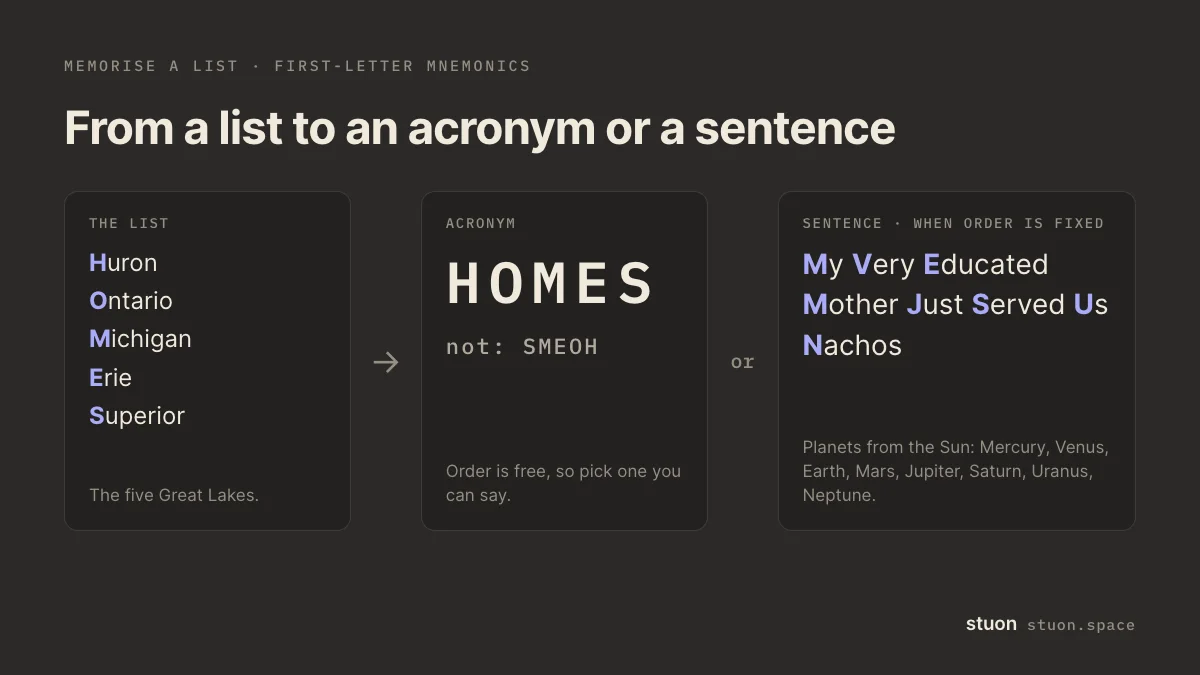
Acronym or sentence?
An acronym is one word, so it is fast to recall: ROY G BIV for the colours of the rainbow. It works best when the letters can be said as a word. When they cannot, and the order is fixed, a sentence such as "My Very Educated Mother Just Served Us Nachos" for the planets is easier to remember than eight loose letters.
Your own sentence usually sticks better than a generated one. Funny, odd or personal sentences are easier to recall than neutral ones. Use the generated sentence as a starting point.
What a mnemonic does and does not do
First-letter mnemonics help you retrieve a list in the right order. They do not teach you what the items mean. The University of Kansas first-letter mnemonic strategy, for example, has students find the lists worth learning, label each one, choose a mnemonic and then study it with cards.
- Learn the items first. A letter only helps if you already know the word it stands for.
- Use mnemonics for lists, not for understanding. For concepts, use the Feynman technique or active recall.
- Keep the number small. Five to eight items per mnemonic is easier than one for 15.
- Review it like any other fact: from memory, after a gap. See spaced repetition.
Frequently asked questions
How are the "easier to say" orders chosen?
By a simple rule: letter sequences that alternate vowels and consonants score higher, and runs of three or more consonants or vowels score lower. It does not check a dictionary, so read the suggestions and pick one you can say.
Why are new orders not shown for long lists?
Eight items have more than 40,000 possible orders, and long acronyms are hard to say anyway. Split a long list into two shorter mnemonics.
What is the difference between an acronym and an acrostic?
An acronym joins the first letters into one word, such as HOMES for the Great Lakes. An acrostic turns each letter into a word of a sentence.
Is my text uploaded?
No. The tool runs in your browser. Nothing you type is sent anywhere, and anything saved stays in this browser only.
Sources
Related pages
Turn studying into a game
Stuon logs your sessions, builds your streak and draws your heatmap, so progress stays visible.
Continue in StuonAdd to Chrome, freeor use the free version without an account