study method
Blurting method
what is blurting?
Blurting is an active recall study method where you close your notes and write down everything you can remember about a topic, then compare it with the original material to find gaps.
by Vusal Imranli updated 14 Nov 20264 min read
How blurting works
Blurting turns one pass of studying into a test. The first attempt shows holes that you could not see while reading, and the comparison step marks them so your next session goes to the right place.
"Blurting" is the name students use. In research the same activity is called free recall, a form of retrieval practice. It sits under the wider habit of active recall.
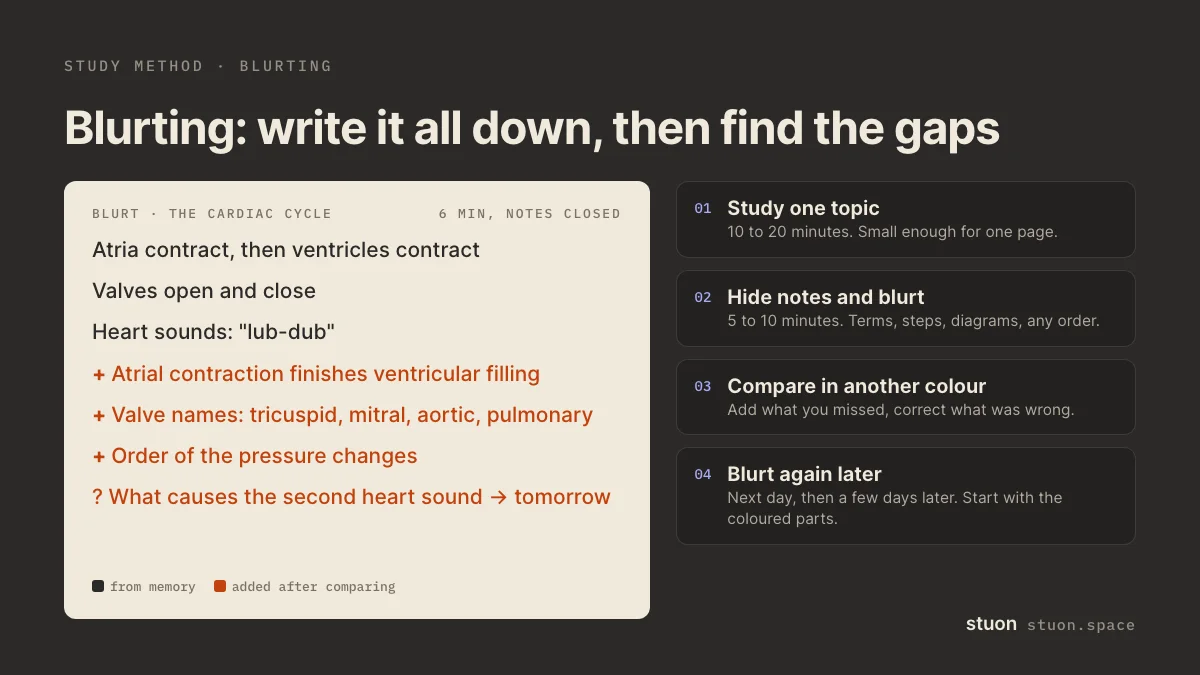
How to do blurting, step by step
- Study one topic. Spend 10 to 20 minutes with the material. Keep the topic small enough to cover on one page.
- Hide your notes. Close the book. Take a blank sheet and start a timer for 5 to 10 minutes.
- Blurt. Write everything you can: terms, definitions, steps, formulas, simple diagrams. Order and neatness do not matter.
- Compare. Open your notes. With a different colour pen, add what you missed and correct what was wrong.
- Blurt again later. Repeat the same topic the next day, then a few days later. Concentrate on the colour-pen parts.
When to use blurting
- Topics with many connected ideas, such as a biological process, a historical period or a legal doctrine.
- At the end of a study session, as a five-minute check on what stuck.
- Before an exam, to find the topics that are still weak.
Benefits of blurting
- No setup. A blank page and a timer are enough.
- It exposes gaps quickly because you must produce the content, not recognise it.
- The marked-up page is a ready-made list of what to revise.
Common mistakes with blurting
- Looking at the notes mid-way. Finish the blurt first, then compare.
- Copying your notes from memory in the same order. Write whatever comes up, then organise.
- Choosing a topic that is too large. A full course in one blurt is not usable.
- Stopping after the comparison. The gains come from retesting the gaps later.
Blurting example
First blurt (6 minutes): atria contract, ventricles contract, valves open and close, heart sounds. You write four lines.
Comparison: you missed that atrial contraction finishes ventricular filling, the names of the valves, and the order of the pressure changes. These go on the page in red.
Next day: you blurt again and now include the valves and the pressure order, but still forget what causes the second heart sound. That goes on tomorrow's list.
Blurting in Stuon
Stuon Pro includes a blurting workspace where you write what you remember right after studying. You can try the idea first with the free blurting tool.
Frequently asked questions
Is blurting the same as active recall?
Blurting is one way of doing active recall. Active recall also includes flashcards, practice questions and explaining a topic aloud.
How long should a blurting session take?
Five to ten minutes of writing for one topic, plus a few minutes to compare. Longer than that usually means the topic is too large.
How often should I blurt a topic?
Blurt right after studying, again the next day, then at growing gaps. See spaced repetition.
Does blurting work for maths and science problems?
Use it for methods and concepts: write the steps and when each applies. Then solve problems, which is the better test of the skill.
Is there evidence for blurting?
The name is informal, but the activity is free recall. In one well-known study, retrieval practice produced more learning than making concept maps (Karpicke and Blunt, 2011). Direct tests of the exact "blurting" routine are limited.
Sources
More on Stuon about this topic
Related methods
Practice it, then keep a record
Stuon has a timer, a blurting space and flashcards, and it logs the time you spend on each.
Track this in StuonAdd to Chrome, freeor use the free version without an account