study method
Feynman technique
what is the feynman technique?
The Feynman technique is a study method where you explain a concept in plain language, as if teaching a beginner, then return to your sources to fix the parts you could not explain. It is named after physicist Richard Feynman, but the four-step form is a modern summary, not a method he published.
by Vusal Imranli updated 14 Nov 20264 min read
How the Feynman technique works
Explaining forces you to turn recognition into understanding. You can nod along to a textbook paragraph and still be unable to say it in your own words. The moment you stall is the gap.
Plain language is the test. If you have to use the jargon from the book, you may be repeating words without the idea behind them.
The technique tests understanding of concepts. For memorising facts, pair it with active recall.
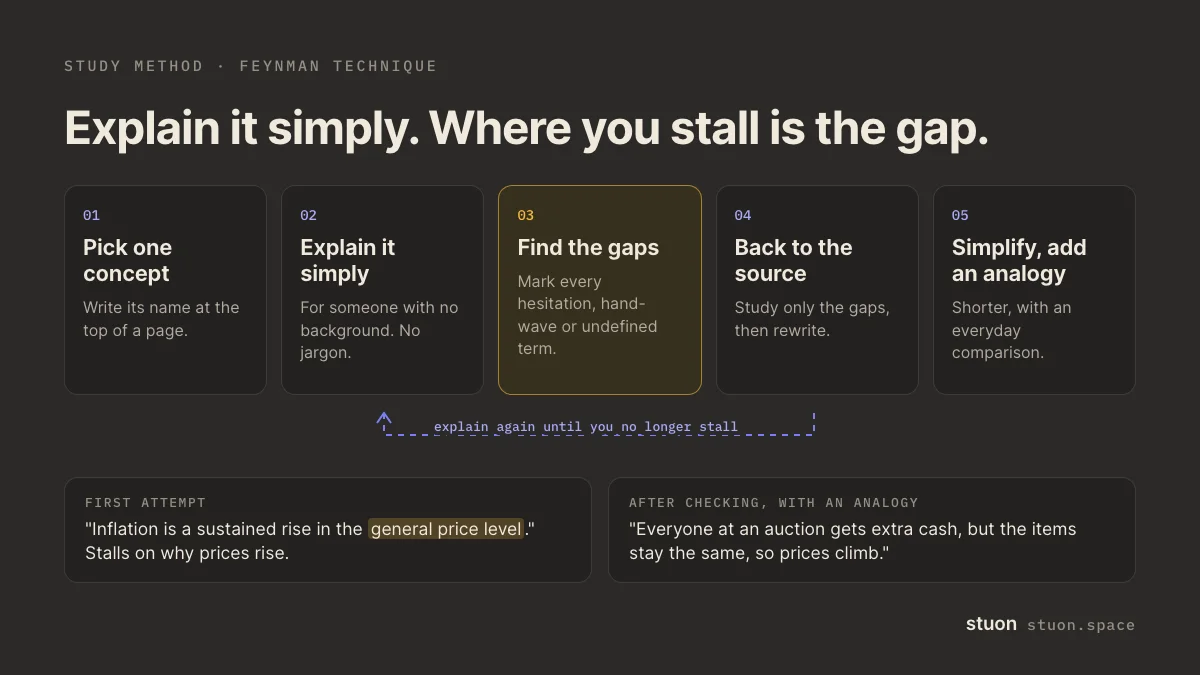
How to do the Feynman technique, step by step
- Pick one concept. Write its name at the top of a page.
- Explain it simply. Write or say an explanation for someone with no background. Avoid jargon, or define each term in plain words.
- Find the gaps. Mark every place where you hesitated, hand-waved or used a term you cannot define.
- Go back to the source. Study only those gaps, then rewrite the explanation.
- Simplify and use an analogy. Shorten the explanation and add an everyday comparison.
When to use the Feynman technique
- Concepts and processes: how something works, and why.
- When a topic feels familiar but you cannot explain it.
- Before a seminar, oral exam or any assessment that asks you to explain.
Benefits of the Feynman technique
- It finds understanding gaps that rereading hides.
- It leaves you with an explanation in your own words that you can reread before the exam.
- It works without any tools: a page, or a willing listener.
Common mistakes with the Feynman technique
- Explaining to yourself in jargon and calling it done.
- Skipping the gap hunt because the explanation "sounded fine".
- Using it on pure facts, such as dates, where recall is the better tool.
- Never retesting the simplified version later.
Feynman technique example
First attempt: "Inflation is a sustained rise in the general price level." You stall when you try to say why prices rise and what "general" means.
After checking your notes: "Prices of most things go up over time, so the same money buys less. This happens when there is more money chasing the same amount of goods, or when costs of making things rise."
Analogy: "If everyone at an auction gets extra cash but the number of items stays the same, prices climb."
Where the name comes from
Richard Feynman was a Nobel Prize-winning physicist known as an unusually clear teacher. The steps above are a student summary of how he is said to have worked, and they are often shared under his name. Treat the label as a convenient one.
Stuon has a Feynman workspace in the app, built around three steps: explain, find gaps, simplify.
Frequently asked questions
Is the Feynman technique scientifically proven?
Not under that name. It uses explaining and self-testing, which are supported by research on retrieval and self-explanation, but the exact four-step routine has had little direct testing.
How is the Feynman technique different from blurting?
Blurting recalls content to find missing facts. The Feynman technique explains a concept in plain words to find missing understanding. See blurting method.
Do I need another person?
No. Writing or speaking to an imaginary beginner works. A real listener can ask questions that expose more gaps.
What subjects suit the Feynman technique?
Any subject built on concepts: science, economics, law, philosophy, computer science.
Related methods
Practice it, then keep a record
Stuon has a timer, a blurting space and flashcards, and it logs the time you spend on each.
Track this in StuonAdd to Chrome, freeor use the free version without an account