study method
Pomodoro technique
what is the pomodoro technique?
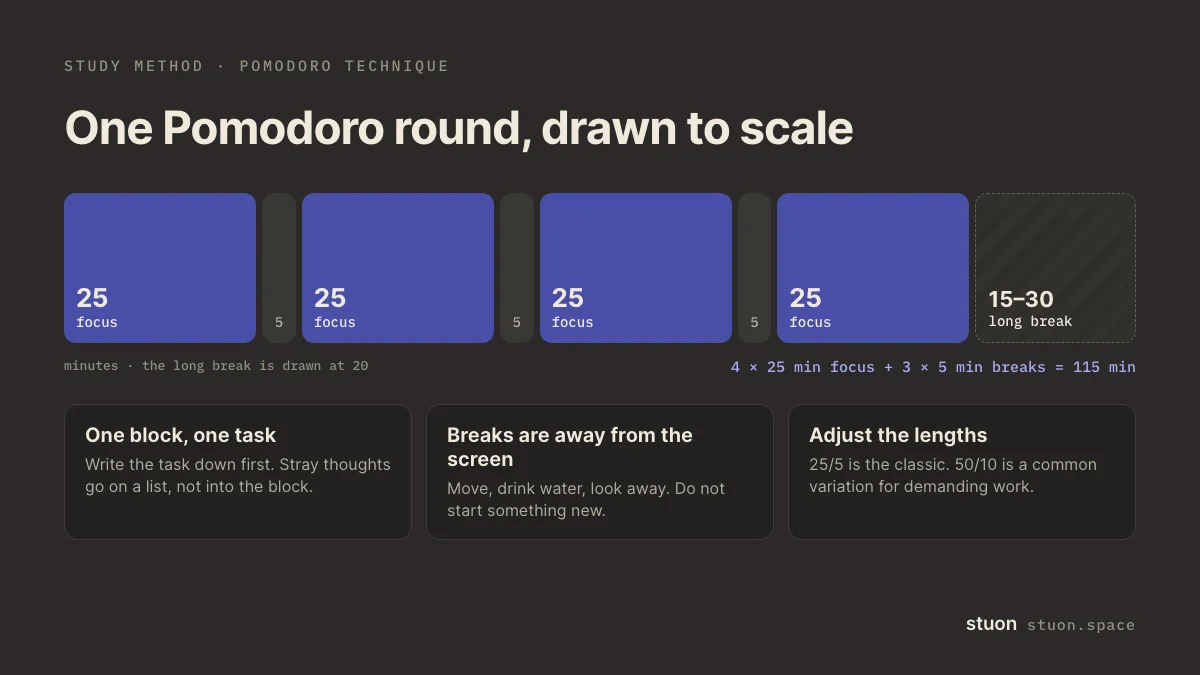
The Pomodoro technique is a time management method that splits work into 25-minute focus blocks separated by 5-minute breaks, with a longer break after four blocks. Francesco Cirillo developed it in the late 1980s and named it after a tomato-shaped kitchen timer.
by Vusal Imranli updated 14 Nov 20263 min read
How the Pomodoro technique works
The method works by giving every block a fixed end. Starting is easier when you only commit to 25 minutes, and the break at the end gives your attention a reset.
The technique manages time and attention. It does not decide what you do inside a block, so pair it with a method that makes the time count, such as active recall.
How to do the Pomodoro technique, step by step
- Choose one task. Write it down. Make it specific enough to finish or advance within a block.
- Set a timer for 25 minutes. Use the Pomodoro timer or any timer.
- Work until it rings. If a distraction appears, note it on a list and return to the task.
- Take a 5-minute break. Step away from the screen. Do not start something new.
- After four blocks, take a longer break. Rest for 15 to 30 minutes, then start a new round.
When to use the Pomodoro technique
- Starting a task you are putting off.
- Reading, problem sets and revision that benefit from regular pauses.
- Days when you need a visible structure to your time.
Benefits of the Pomodoro technique
- A small commitment lowers the effort of starting.
- Counting finished blocks gives you a record of the day.
- Scheduled breaks make you less likely to drift into a break you did not plan.
Common mistakes with the Pomodoro technique
- Multitasking inside a block. One block is one task.
- Skipping breaks when the work is going well, then running out of energy later.
- Using the break for a feed or short videos. Move, drink water, look away.
- Treating 25 minutes as sacred. If it does not fit the task, adjust the lengths. 50/10 is a common variation.
Pomodoro technique example
Block 1: read and note chapter 6. Block 2: blurt chapter 6 from memory. Block 3: practice questions. Block 4: mark and fix mistakes.
Then a 20-minute break. Four blocks are about two hours of focused work, plus short breaks.
Pomodoro and other timing methods
A plain study timer, longer deep work blocks and the Pomodoro technique each suit different tasks. See study timer vs Pomodoro and deep work for students.
In the classic rules a Pomodoro that gets interrupted is abandoned and restarted. Many students relax this, but the idea is to protect the block.
Frequently asked questions
How long is a Pomodoro?
25 minutes of work, followed by a 5-minute break. After four Pomodoros comes a longer break of 15 to 30 minutes.
Is the Pomodoro technique good for studying?
It helps with starting and with taking regular breaks. It matters more what you do inside the block, so use it with recall and practice, not only reading.
Can I use 50 minutes instead of 25?
Yes. Many students use 50/10 for demanding tasks. It is a variation on the original technique.
Where does the name come from?
Pomodoro is Italian for tomato. Francesco Cirillo used a tomato-shaped kitchen timer as a university student.
Sources
Related methods
Save your study sessions
Stuon Pro has a Pomodoro mode with adjustable lengths, and every block is logged to your streak and heatmap.
Save your study sessionsAdd to Chrome, freeor use the free version without an account