guide
How many hours should I study?
how many hours should i study?
There is no single number. Many universities suggest about two hours of work outside class for each hour in class, but this varies by institution and course. Set a weekly total from your course load and exam date, then check that the hours are focused.
by Vusal Imranli updated 14 Nov 20264 min read
How to set your own number
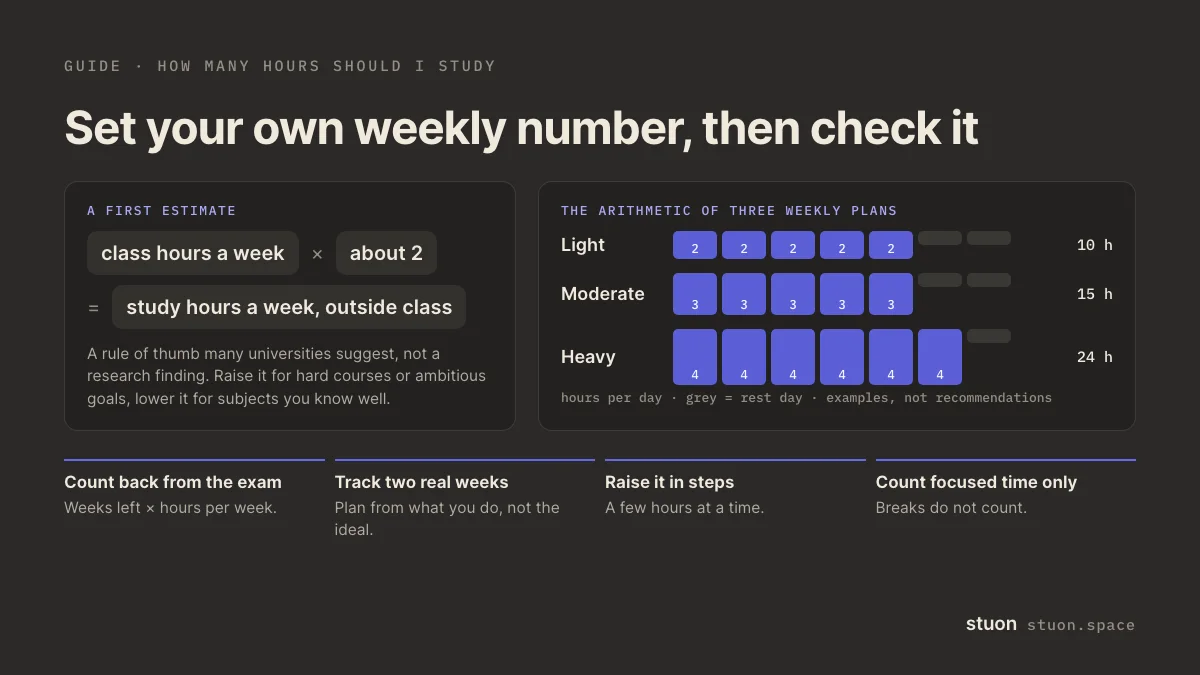
- Start with your course load. Add up class hours per week. As a rough first estimate, plan about twice that for study outside class. This is a rule of thumb, not a research finding. Check your institution's own guidance.
- Adjust for difficulty and goal. Raise the number for hard courses or ambitious grades, lower it for subjects you already know well.
- Work from the exam date. Count the weeks left and decide how many total hours the exam needs. The study hours calculator shows the hours per day required.
- Track real hours for two weeks. Use a study time tracker to see what you actually do. Plan from that, not from the ideal.
- Raise it in steps. If you studied 9 hours last week, do not jump to 25. Add a few hours at a time.
Illustrative weekly plans
| Criteria | Plan | Weekly total |
|---|---|---|
| Light | 2 hours x 5 days | 10 hours |
| Moderate | 3 hours x 5 days | 15 hours |
| Heavy | 4 hours x 6 days | 24 hours |
Hours matter less than what you do in them
Two hours of recall practice can teach you more than four hours of rereading and highlighting. Count focused time on a specific task, and spend it on methods that work. See best study methods and how to stop fake studying.
Signs your number is wrong
- Too high: you regularly miss it, your sessions are mostly passive, or you are tired through the week.
- Too low: you finish topics early, your practice scores are low, or you leave topics untouched before an exam.
Include rest days. A plan you can repeat for weeks is better than one that breaks after one.
What Stuon users log
Aggregated and anonymised figures from Stuon. They describe how people use the app, not what works best for learning.
| Measure | Value |
|---|---|
| Median logged hours per active week | 5.1 hours |
| Median sessions per active week | 5 sessions |
Based on 145 Stuon users, updated 2026-10-12. Calculated from 4,316 aggregated Stuon sessions across users with at least 5 logged sessions. Excludes sessions under 5 minutes and known synthetic/test identifiers. An active week is a week in which a user logged at least one session. Aggregated, no individual data.
Frequently asked questions
How many hours a day should a student study?
It depends on the course load and the goal. Think in weekly totals, then divide by the days you can study. Many students find 2 to 4 focused hours a day workable, but this is an observation, not a requirement.
Is 4 hours of studying a day enough?
Four focused hours on a specific plan is a substantial amount of work. Whether it is enough depends on your course and the time left. Compare it with the total you need.
Do breaks count as study time?
No. Count only the time you spend on the task.
How many hours should I study for finals?
Work backward from the exam date and the topics you need to cover. See how to study for exams.
More on Stuon about this topic
Related pages
Track this automatically
Stuon records the time for you and turns it into a streak, a heatmap and weekly totals.
Start tracking for freeAdd to Chrome, freeor use the free version without an account