guide
How to study for exams
how do you study for exams?
To study for exams, work backward from the exam date, list every topic, and spend most of your time practicing recall on questions and past papers instead of rereading. Review each topic several times over the weeks, starting with the weakest.
by Vusal Imranli updated 14 Nov 20264 min read
A step-by-step exam plan
- Find out what is tested. Get the syllabus, the exam format and the mark scheme. Know whether it asks for facts, problems or essays.
- Count the weeks and set weekly hours. Work out how many weeks remain and how many hours you can study. The study hours calculator does the arithmetic.
- Rate every topic. Mark each as red (weak), amber (unsure) or green (secure). Start with red.
- Learn, then test. After studying a topic, close your notes and recall it with blurting or questions. Mark gaps.
- Schedule reviews. Return to each topic after a day, a few days and a week or more. See spaced repetition.
- Mix practice. In the later weeks, mix topics in problem sets, as described in interleaving.
- Do timed past papers. Do them under exam conditions, mark them honestly and write an error log of the mistakes.
- Taper in the last days. Review the error log and summary pages, and sleep. Do not start new topics the night before.
How to split the weeks
| Criteria | Focus | Main activities |
|---|---|---|
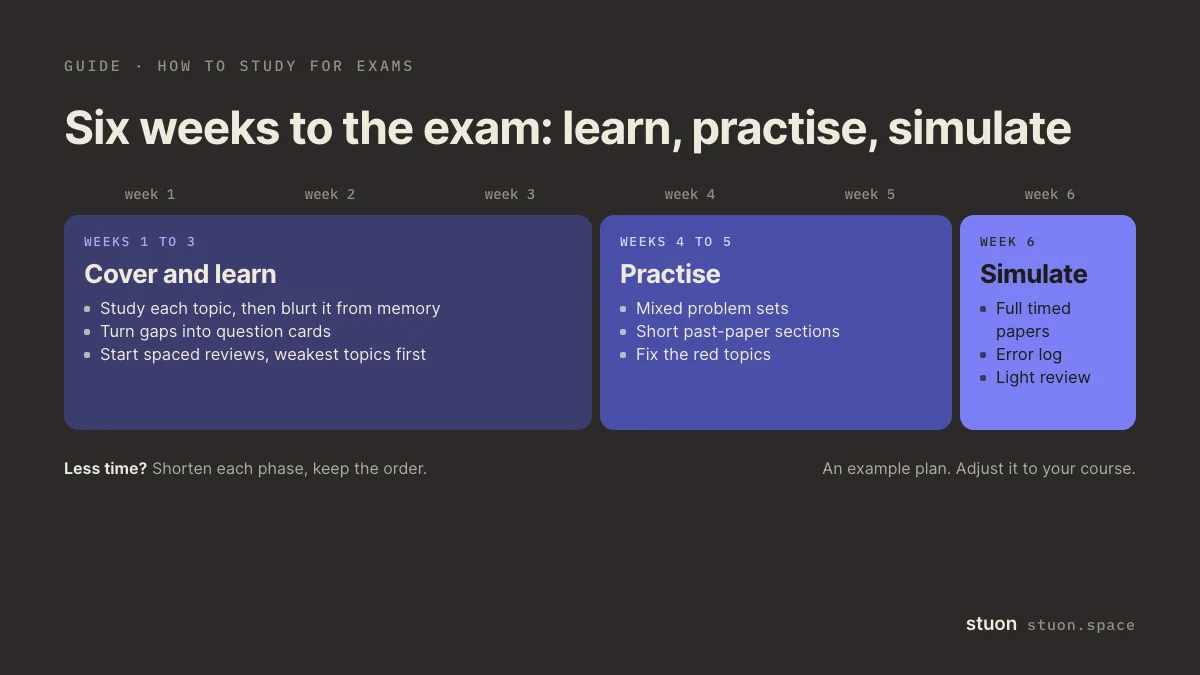
| Weeks 1 to 3 | Cover and learn | Study each topic, blurt it, make question cards, start spaced reviews |
| Weeks 4 to 5 | Practice | Mixed problem sets, short past-paper sections, fix red topics |
| Week 6 | Simulate and refine | Full timed papers, error log, light review of summaries |
With less time, shorten each phase but keep the order: learn, test, then simulate.
If you only have a few days
- Prioritise topics that carry the most marks and that you can improve fastest.
- Use past papers and questions from day one, not rereading.
- Accept that you will not cover everything. Cover the high-value parts well.
Common exam-prep mistakes
- Spending weeks on notes and leaving no time for practice.
- Rereading and highlighting because it feels productive. See active recall vs rereading.
- Studying favourite topics and avoiding the weak ones.
- Not measuring. Log your sessions with a study tracker so the plan matches what you really do.
Frequently asked questions
How many weeks before an exam should I start studying?
As early as the syllabus allows. Four to eight weeks gives room for several review rounds in most courses. Adjust for the size of the course and how much you already know.
Is it better to study a little every day or a lot at once?
Spreading study over several days generally produces longer-lasting memory than massing it into one session. See spaced repetition.
What is the most effective way to revise?
Practice testing: questions, past papers and recall from memory. Reviews of research rate it among the most useful techniques. See best study methods.
How many hours should I study for exams?
It depends on the course and your starting point. See how many hours should I study for a way to set your number.
Sources
Related pages
Turn your study time into progress
Levels, streaks and a heatmap give your hours a visible shape.
Turn your study time into progressAdd to Chrome, freeor use the free version without an account