study method
Spaced repetition
what is spaced repetition?
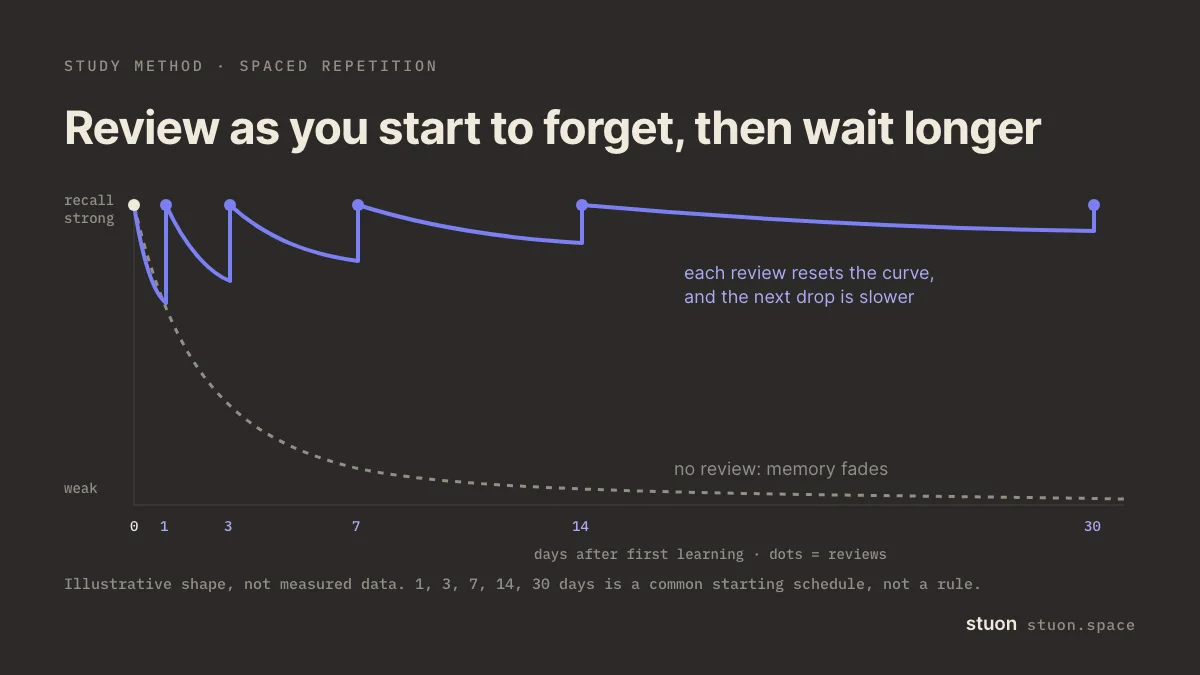
Spaced repetition is a study method where you review material at increasing intervals, such as after one day, three days, a week and a month, instead of cramming it in one sitting. Each review happens as you start to forget, which makes the memory last longer.
by Vusal Imranli updated 14 Nov 20264 min read
How spaced repetition works
Memory fades unless it is used. Hermann Ebbinghaus described this "forgetting curve" in 1885. A review resets the decay, and the next one can wait longer.
Reviewing across several days, rather than massing the same time into one session, has been shown to improve long-term retention across many experiments (reviewed in Cepeda et al., 2006). The best gap depends on how long you need to remember the material.
Spaced repetition works best when each review is an act of recall, so combine it with active recall.
How to do spaced repetition, step by step
- List what you need to learn. Split the material into cards or small topics, each with a clear question.
- Review the first time within a day. Test yourself on the same day or the next one.
- Choose the next gap by how it went. If you recalled it, wait longer. If you missed it, bring it back sooner.
- Record the due dates. Use a calendar, a notebook box system or a flashcard app so you do not have to remember what is due.
- Mix due items into your sessions. Start each study day with what is due, then add new material.
When to use spaced repetition
- Vocabulary, definitions, formulas, dates and anything else you must store in memory.
- Courses that run for weeks or months, where you have time for several reviews.
- Exams where the material built up over a term, such as anatomy or law.
Benefits of spaced repetition
- You spend more time on weak items and less on those you already know.
- Short, regular reviews fit around other work better than long catch-up sessions.
- It protects early material from being forgotten while you learn later topics.
Common mistakes with spaced repetition
- Treating the schedule as fixed. Adjust the gap by how well you recalled the item.
- Making cards that are too large. One card, one idea.
- Reviewing by flipping the card and nodding. Answer before you look.
- Starting too late. With an exam in three days there is time for little spacing.
Spaced repetition example
Learn on day 0. Review on day 1, day 3, day 7, day 14 and day 30.
If you miss an item on day 7, review it again on day 8, then return to a longer gap.
These intervals are a common starting point, not a rule. For an exam in two weeks, compress them.
Spaced repetition in Stuon
Stuon has a spaced repetition planner and Pro includes flashcards with review tracking. You can also use the free spaced repetition tool to plan reviews.
Frequently asked questions
What is the best spaced repetition schedule?
There is no single best one. A common start is 1, 3, 7, 14 and 30 days. Shorten the gaps when the exam is near or when you miss items.
Do I need Anki for spaced repetition?
No. Software schedules cards for you, but a calendar or a box system works too.
How is spaced repetition different from cramming?
Cramming puts all study into one sitting just before the test. Spaced repetition spreads reviews over days or weeks, which tends to give longer-lasting memory.
Does spaced repetition help with understanding?
It is strongest for facts and vocabulary. For concepts, add problems and explanations, such as the Feynman technique.
Sources
- Cepeda et al. (2006), Distributed practice in verbal recall tasks: a review and quantitative synthesis. Psychological Bulletin.
- Dunlosky et al. (2013), Improving students' learning with effective learning techniques. Psychological Science in the Public Interest.
- Hermann Ebbinghaus (1885), Über das Gedächtnis (On Memory). Original description of the forgetting curve.
More on Stuon about this topic
Related methods
Practice it, then keep a record
Stuon has a timer, a blurting space and flashcards, and it logs the time you spend on each.
Track this in StuonAdd to Chrome, freeor use the free version without an account