guide
Best study methods
what are the best study methods?
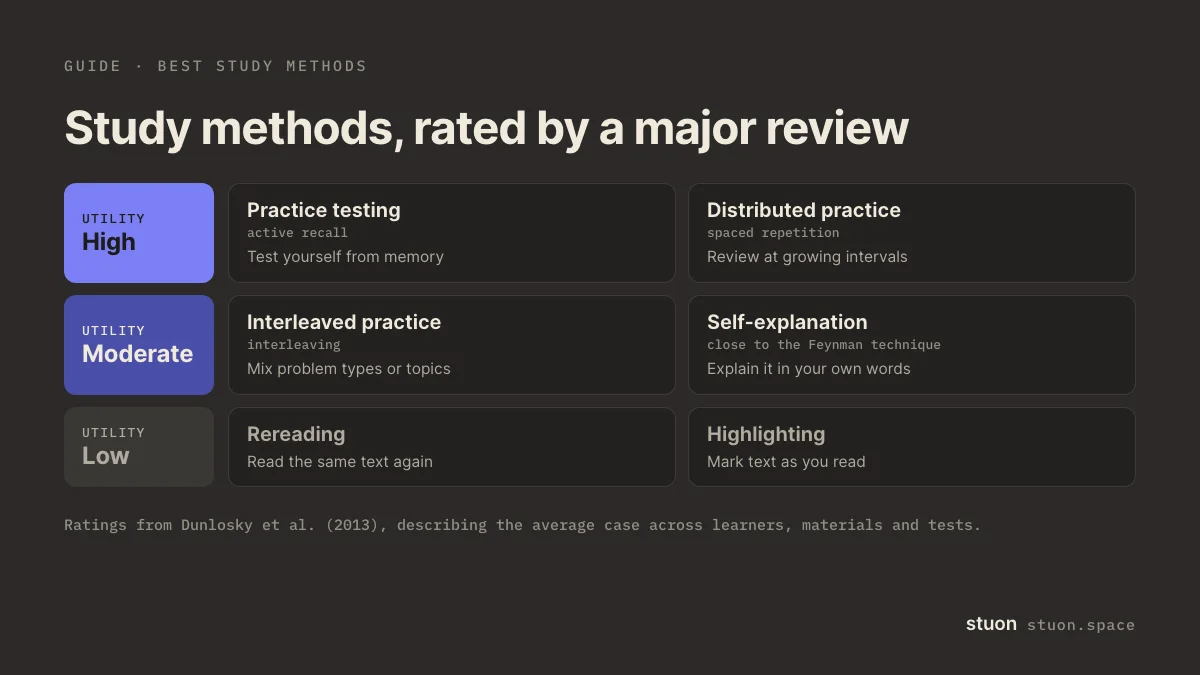
The study methods with the strongest research support are practice testing, also called active recall, and distributed practice, also called spaced repetition. Interleaving and self-explanation also help in many cases. Highlighting and rereading rate lowest for learning.
by Vusal Imranli updated 14 Nov 20263 min read
Study methods compared
| Criteria | What it is | Rating in Dunlosky et al. (2013) | Best for |
|---|---|---|---|
| [Active recall](/active-recall) (practice testing) | Test yourself from memory | High utility | Almost everything you must produce in an exam |
| [Spaced repetition](/spaced-repetition) (distributed practice) | Review at growing intervals | High utility | Facts, vocabulary, long courses |
| [Interleaving](/interleaving) | Mix problem types or topics | Moderate utility | Maths and science problem solving |
| [Feynman technique](/feynman-technique) (self-explanation) | Explain it in plain language | Moderate utility (self-explanation) | Concepts and processes |
| [Pomodoro technique](/pomodoro-technique) | Timed focus blocks | Not a learning technique, not rated | Starting and pacing work |
| Rereading | Read the same text again | Low utility | Little, apart from a first pass |
| Highlighting | Mark text as you read | Low utility | Little, apart from marking for later questions |
The 2013 review rated each technique for how broadly it helps across learners, materials and tests. Ratings describe the average case.
How to combine them
- Learn the material once, in a focused block (timer or Pomodoro).
- Close your notes and recall it (blurting or questions).
- Put the gaps on a review schedule (spaced repetition).
- Mix problem types as you get comfortable (interleaving).
- Explain the hard concepts in plain words (Feynman technique).
- Finish with timed practice papers.
How to choose
- Facts and vocabulary
- Active recall with spaced repetition.
- Concepts
- Feynman technique, then recall.
- Problem solving
- Practice problems with interleaving.
- Essay subjects
- Recall the argument and evidence, then write timed plans from memory.
Methods work only if you do them. Pick the one that gets you to start, and use a study tracker to see whether you are keeping it up.
Frequently asked questions
What is the most effective study method?
Active recall, in a spaced schedule. Large reviews rate practice testing and distributed practice highest.
Is the Pomodoro technique a study method?
It is a time management method. It helps you start and pace, but it does not decide how you learn. Use it with recall.
Does highlighting help?
Reviews rate it low for learning. It can help you mark text for a later recall pass, but it is not a learning method by itself.
Which method is best for exams?
Practice testing with past papers, supported by spaced review. See how to study for exams.
Sources
More on Stuon about this topic
Related pages
Practice it, then keep a record
Stuon has a timer, a blurting space and flashcards, and it logs the time you spend on each.
Track this in StuonAdd to Chrome, freeor use the free version without an account