study method
Active recall
what is active recall?
Active recall is a study method where you pull information out of your memory without looking at it, instead of rereading. You test yourself with questions, flashcards or a blank page, then check your answer against your notes.
by Vusal Imranli updated 14 Nov 20264 min read
How active recall works
Trying to remember something is a learning event in itself. Each successful retrieval makes the memory easier to reach next time, and each failure shows you exactly what you do not know yet.
Rereading feels easier because the material is in front of you, which can make you feel familiar with it without being able to produce it. Experiments on the "testing effect" found that students who practiced retrieving material remembered more after a delay than students who spent the same time rereading (Roediger and Karpicke, 2006).
Active recall is the habit. Methods such as blurting, flashcards and practice questions are ways to do it. The research term is retrieval practice.
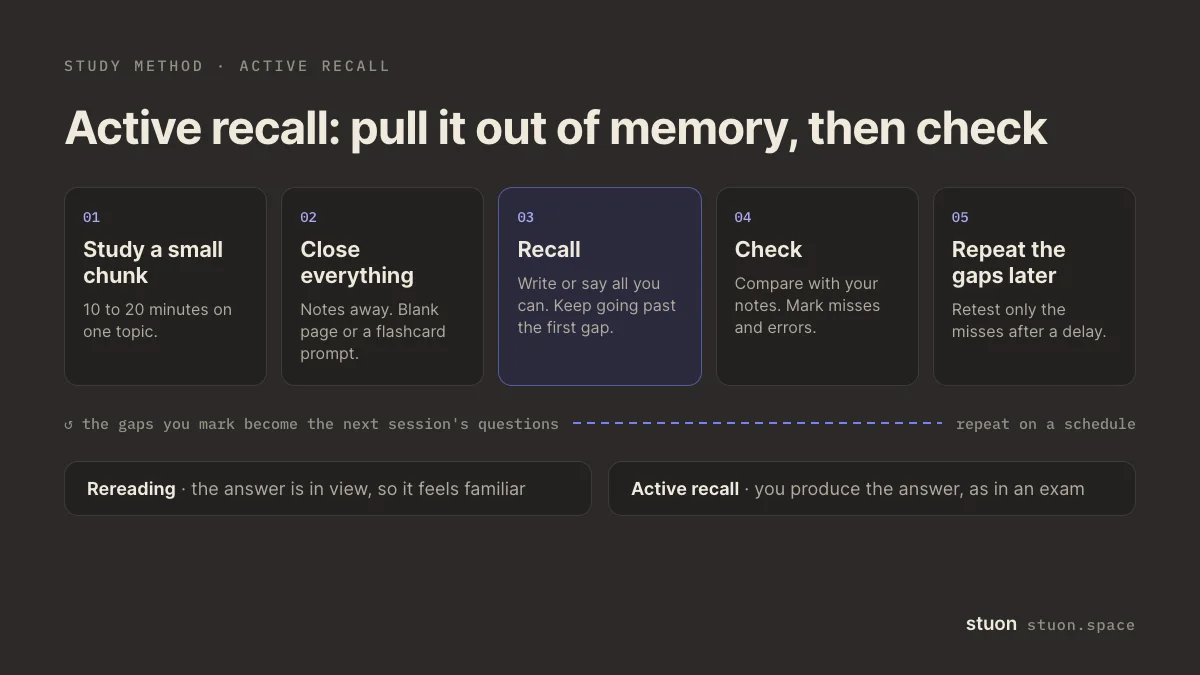
How to do active recall, step by step
- Study a small chunk. Read or watch 10 to 20 minutes of material on one topic.
- Close everything. Put away notes and the book. Open a blank page or a flashcard prompt.
- Recall. Write or say everything you can remember, or answer questions about the topic. Do not stop at the first gap.
- Check. Compare with your notes. Mark what you missed or got wrong.
- Repeat the gaps later. Re-study only the missed parts, then test them again after a delay. See spaced repetition.
When to use active recall
- After any reading or lecture, before moving on to the next topic.
- For facts, definitions, processes and formulas that you must produce in an exam.
- In the last weeks before an exam, in place of a final pass of rereading.
Benefits of active recall
- It shows you what you do not know while there is still time to fix it.
- It matches how exams work: you have to produce answers without your notes.
- It keeps sessions active, which makes it harder to drift into fake studying.
Common mistakes with active recall
- Peeking at the notes after a few seconds. A struggle is part of the effect.
- Recalling only what you already know well and skipping the weak areas.
- Skipping the check step, so wrong answers go uncorrected.
- Doing it once. Retest after a delay, ideally on a schedule.
Active recall example
You read a section on photosynthesis. You close the book and ask: "What goes into and comes out of the light-dependent reactions, and where do they happen?"
You write: "Water and light go in, oxygen comes out, ATP and NADPH are made, in the thylakoid membranes." You open the book and find you forgot that the products feed the next stage.
You add that to a flashcard and test it again tomorrow.
Ways to practice active recall
- A blank page: list everything you know about a topic (blurting).
- Flashcards with a question on one side and the answer on the other.
- Practice questions and past papers, done without notes.
- Explaining the topic out loud (Feynman technique).
Stuon Pro has a blurting workspace and flashcards with review tracking, and it logs the time you spend on each. You can also try the free blurting tool.
Frequently asked questions
What is active recall in simple terms?
Testing yourself from memory. Instead of reading your notes again, you close them and try to write or say what is in them.
Is active recall better than rereading?
Studies of retrieval practice report better long-term memory than rereading for the same study time, especially after a delay. See active recall vs rereading.
How often should I use active recall?
After each study block, and again on a schedule. Review at growing intervals as described in spaced repetition.
Does active recall work for essay subjects?
Yes. Recall the argument, the evidence and the key names or dates, then compare with your notes. Writing an essay plan from memory is a good test.
Do I need flashcards for active recall?
No. A blank page, practice questions and past papers also count. Flashcards suit facts and vocabulary best.
Sources
- Roediger and Karpicke (2006), Test-enhanced learning. Psychological Science.
- Karpicke and Blunt (2011), Retrieval practice produces more learning than elaborative studying with concept mapping. Science.
- Dunlosky et al. (2013), Improving students' learning with effective learning techniques. Psychological Science in the Public Interest.
More on Stuon about this topic
Related methods
Practice it, then keep a record
Stuon has a timer, a blurting space and flashcards, and it logs the time you spend on each.
Track this in StuonAdd to Chrome, freeor use the free version without an account