
Sarah used to be "The Highlighter Girl." You know the type. Her desk looked like a neon rainbow exploded. She had four different colors of Stabilo Boss markers—blue for definitions, yellow for key dates, pink for formulas, and green for quotes. By the time she was done with a chapter, it looked like a piece of modern art. She felt productive. She felt ready. And yet, she failed her midterm.
She remembers sitting in that exam hall, staring at a question she knew she had highlighted in neon yellow the night before. She could even visualize exactly where it was on the page (top right corner, next to a coffee stain). But for the life of her, she couldn't remember what the actual answer was. Her brain had captured the image of the highlight, but not the logic of the concept.
The Illusion of Competence
What she was experiencing is a psychological phenomenon called the "Illusion of Competence." When we read a sentence and it makes sense, our brain gives us a little hit of satisfaction. When we run a bright marker over it, that satisfaction doubles. We feel like we're "doing something."
In reality, highlighting is a form of passive studying. It requires almost zero mental effort. You are simply moving a pen over paper. Because the information "looks familiar" when you see it the second or third time, your brain tricks you into thinking you've actually learned it. Familiarity is not the same as mastery.
Why Highlighting Fails Under Pressure
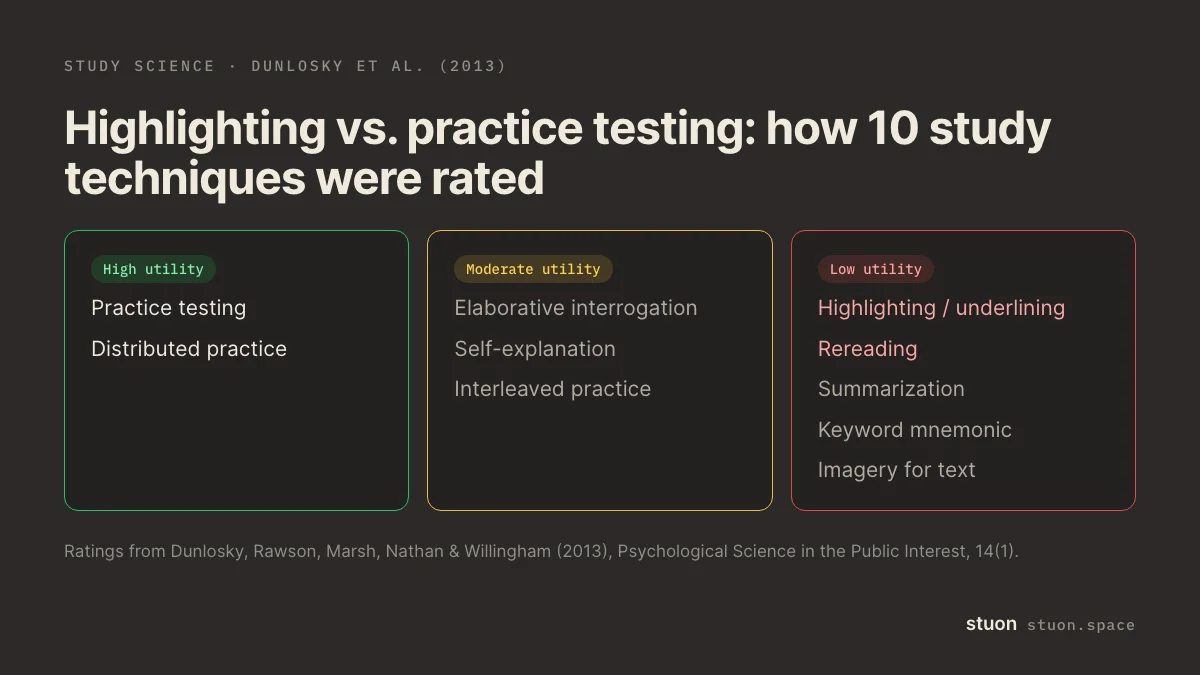
Learning only happens when your brain is forced to work. Research on retrieval practice points the same way. In experiments by Roediger and Karpicke (2006) at Washington University in St. Louis, students who practised recalling a passage remembered more of it a week later than students who spent the time re-reading it. A large review of study techniques (Dunlosky et al., 2013) rated highlighting as low utility. Why? Because highlighting doesn't ask your brain to reach for the information. It just provides it on a silver platter.
When you're in an exam, there is no highlighter. There is only a blank space and your own memory. If you haven't practiced retrieving that information without looking at your notes, you're going to freeze up—just like she did.
The Shift: From Painting to Testing
After that failed midterm, she threw away the highlighters. She started using active recall. Instead of coloring the book, she would read a paragraph, close it, and force herself to explain it out loud to her empty water bottle. If she couldn't explain it, she hadn't learned it.
It was painful. It was frustrating. It felt much "slower" than highlighting. But for the first time in her academic career, she wasn't just recognizing words—she was understanding systems. She stopped being afraid of blank pages because she had spent the last two weeks practicing how to fill them.
How to make the switch
- Read one section, then close the book.
- Write or say what you remember, without looking. The blurting method is a structured way to do this.
- Check against the book and mark what you missed.
- Come back to the same section a few days later and recall it again. Spacing the reviews matters as much as the recall (why spacing works).
If you still like a highlighter, use it after recall: mark only what you got wrong. For a side-by-side comparison of the two approaches, see active recall vs rereading.
Sources
- Roediger, H. L., & Karpicke, J. D. (2006). Test-enhanced learning: Taking memory tests improves long-term retention. Psychological Science, 17(3), 249–255. doi:10.1111/j.1467-9280.2006.01693.x
- Dunlosky, J., Rawson, K. A., Marsh, E. J., Nathan, M. J., & Willingham, D. T. (2013). Improving students’ learning with effective learning techniques. Psychological Science in the Public Interest, 14(1), 4–58. doi:10.1177/1529100612453266
Frequently asked questions
Is highlighting a bad way to study?
On its own, highlighting is passive. It takes little mental effort and makes the text look familiar the next time you see it, which feels like learning. Familiarity is not the same as being able to recall or apply the material in an exam.
What is the illusion of competence?
It is the feeling that you know material because it looks familiar or makes sense as you read it. Rereading and highlighting create this feeling without testing whether you can produce the answer from memory.
What should I do instead of highlighting?
Use active recall: read a paragraph, close the book, and explain it out loud or write down what you remember. If you cannot explain it, go back and relearn that part. The blurting method is one structured way to do this.
Related reading
Put Down the Highlighters
Ready to see if you actually know the material? Try a Blurting session on Stuon today. Read a chapter, set a 10-minute timer, and write down everything you remember. No highlighters allowed.
Start a Blurting Sessionor use the free version without an account