
The blurting method is simple to describe: study a topic, close your notes, write down everything you remember, then check what you missed. Most students get the idea in a minute. Where they go wrong is the details: how big a topic to pick, how long to write, and what to do with the gaps.
This post walks through one complete session with a worked example. If you want the overview first (what blurting is, who it suits and how it compares to other methods), start with our blurting method guide. Here we stay practical.
Why blurting works
Blurting is a form of retrieval practice: pulling information out of memory instead of reading it again. In experiments by Roediger and Karpicke (2006), students who practised recalling a passage remembered more of it a week later than students who spent the same time rereading it. A large review of study techniques (Dunlosky et al., 2013) rated practice testing as one of the most useful techniques it examined, and rated highlighting and rereading as low utility.
Blurting adds one practical benefit: the blank page shows you exactly where your gaps are. Rereading never does that. It only makes the page look familiar. (That trap has its own post: why highlighting feels like learning.)
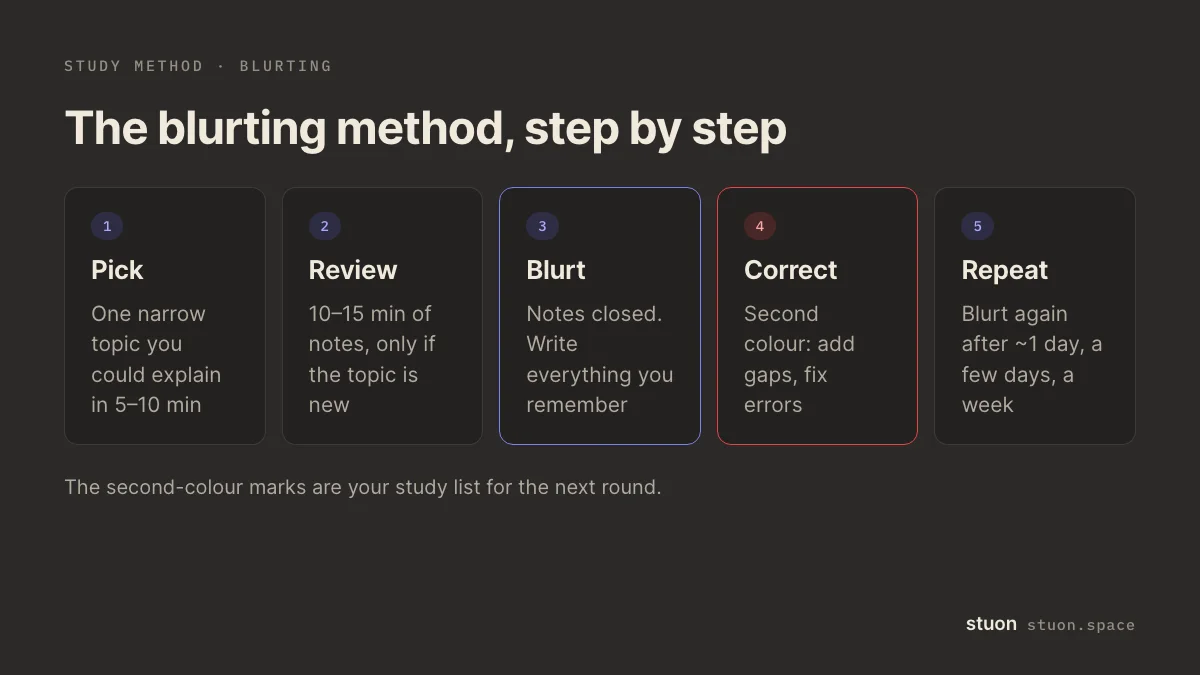
The blurting method, step by step
-
Pick one narrow topic
Choose something you could explain in 5 to 10 minutes. "World War II" is too big. "Causes of World War II, 1919 to 1939" is about right. A good test: could a teacher ask it as one exam question?
-
Review briefly, if you need to
If the topic is new, read your notes or textbook section for 10 to 15 minutes. If you studied it recently, skip this and go straight to the blurt. Blurting slightly later, after some forgetting, is harder but tends to help retention more.
-
Close everything and blurt
Put the notes away. Take a blank page, or the free blurting tool, and write everything you remember. Use bullets, arrows and rough sketches. Neatness does not matter. Keep going until you have been stuck for a minute or so. A 10-minute limit keeps it focused.
-
Correct in a second colour
Open your notes again. With a different coloured pen, add what you missed and fix what you got wrong. Do not rewrite the whole page; mark only the gaps and errors. The second colour is your study list.
-
Repeat on a schedule
Study the corrections, then blurt the same topic again later: roughly a day later, then a few days later, then a week later. Each round should need less of the second colour. Spacing your reviews like this is covered in our spaced repetition guide.
A worked example: causes of World War II
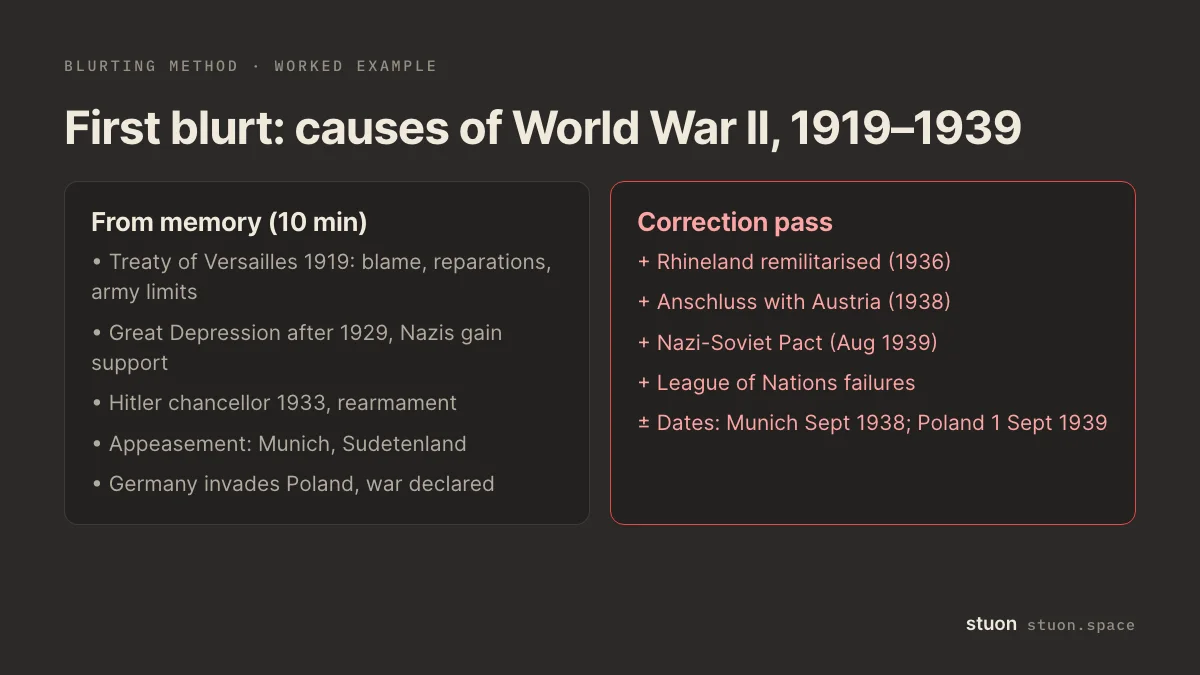
Say you are revising modern history and you pick "Causes of World War II, 1919 to 1939". You read your notes for 12 minutes, close them and set a 10-minute timer. Here is what a first blurt might look like:
- Treaty of Versailles 1919: Germany blamed, reparations, army limited, lost land.
- Great Depression after 1929, unemployment in Germany, Nazis gain support.
- Hitler chancellor 1933. Rearmament.
- Appeasement: Munich Agreement, Sudetenland given to Germany.
- Germany invades Poland, Britain and France declare war.
Then the correction pass, in a second colour, against the notes:
- Missed: remilitarisation of the Rhineland (1936) and the Anschluss with Austria (1938).
- Missed: the Nazi-Soviet Pact (August 1939), which made the invasion of Poland possible.
- Missed: the failures of the League of Nations, such as Manchuria and Abyssinia.
- Vague: "Munich Agreement" with no date. Add September 1938.
- Vague: "Germany invades Poland". Add 1 September 1939; Britain and France declare war on 3 September.
Five gaps on one page. That is a good result for a first blurt: it tells you precisely what to study next. The League of Nations is a whole cluster you missed, so it gets its own short review before the next blurt. Two days later you blurt the topic again from scratch, and this time you check whether the five gaps are filled.
Tips that make blurting work better
- Blurt later, not straight after reading. Recalling right after reading mostly tests short-term memory. Waiting a day makes the blurt harder and more useful.
- Typing is fine. If handwriting is slow, type. Speaking aloud and recording yourself also works. What matters is recalling without looking.
- Time-box it. Run the blurt and the correction as one focus session with a study timer, so it does not drift into rereading.
- Keep the pages. Comparing first and later blurts on the same topic shows real progress, which is more convincing than a feeling of familiarity.
For a list of what goes wrong, see 8 common blurting mistakes. For ready-made formats, the blurting template and blurting examples pages have printable layouts and samples for different subjects.
Sources
- Roediger, H. L., & Karpicke, J. D. (2006). Test-enhanced learning: Taking memory tests improves long-term retention. Psychological Science, 17(3), 249–255. doi:10.1111/j.1467-9280.2006.01693.x
- Dunlosky, J., Rawson, K. A., Marsh, E. J., Nathan, M. J., & Willingham, D. T. (2013). Improving students’ learning with effective learning techniques. Psychological Science in the Public Interest, 14(1), 4–58. doi:10.1177/1529100612453266
Frequently asked questions
How long should a blurting session take?
Keep each blurt to one specific topic or chapter, not a whole semester. Spend an optional 10 to 15 minutes reviewing your notes, write from memory until you cannot remember another detail, then correct the page against your notes.
What is the difference between blurting and active recall?
Blurting is one form of active recall. Active recall means retrieving information from memory without cues; blurting does this by writing everything you remember about a topic on a blank page and then checking it against the source.
How often should I repeat the blurting method on the same topic?
Blurt the same topic again a day or two later. Combined with spaced repetition, a useful schedule is one day after you learn it, then three days later, then a week later. The amount of red ink should shrink each round.
Can I type my blurts instead of writing them by hand?
Yes. Typing works if handwriting is slow or tiring, and you can also blurt out loud, record yourself and correct it while listening back. What matters is recalling without looking at your notes, then checking what you missed.
Related reading
Try one blurt now
Pick one narrow topic, set 10 minutes, and write everything you remember. The free blurting tool keeps the timer and the page in one place.
Try Stuon's Free Blurting Toolor use the free version without an account