study method
Interleaving
what is interleaving?
Interleaving is a study method where you mix different topics or problem types within one session instead of finishing one before starting the next. For example, you alternate between three kinds of maths problems rather than doing thirty of one kind.
by Vusal Imranli updated 14 Nov 20263 min read
How interleaving works
Blocked practice, such as 20 problems of one type in a row, lets you copy the same method each time. Mixed practice makes you decide which method fits each problem, which is what an exam asks of you.
In one experiment on maths problems, students who practiced in a mixed order scored higher on a test a week later than students who practiced in blocks, even though practice felt harder (Rohrer and Taylor, 2007).
Interleaving is different from multitasking. You still work on one problem at a time. Only the order is mixed.
How to do interleaving, step by step
- Learn each topic first. Study the basics of each type in a blocked way until you can do an example.
- List three or four related topics. Choose topics that are easy to confuse, such as different integration methods.
- Mix the practice. Make a set where types come in mixed order, for example A, C, B, A, B, C.
- Name the method before you solve. Write which approach applies and why, then solve.
- Review the mix-ups. Note any problem where you chose the wrong method and add it to the next set.
When to use interleaving
- Maths, physics, chemistry and other subjects with distinct problem types.
- Language practice that mixes grammar points or vocabulary sets.
- Revision across several subjects in a day, once each has been learned.
Benefits of interleaving
- You practice choosing a method, not only applying one.
- It exposes confusions between similar topics.
- It spaces practice on each topic without extra planning.
Common mistakes with interleaving
- Interleaving brand-new material. Learn the basics first.
- Mixing too many topics at once. Three or four is a workable range.
- Switching every minute. Each problem needs time to complete.
- Giving up because it feels slower. The difficulty is part of the effect.
Interleaving example
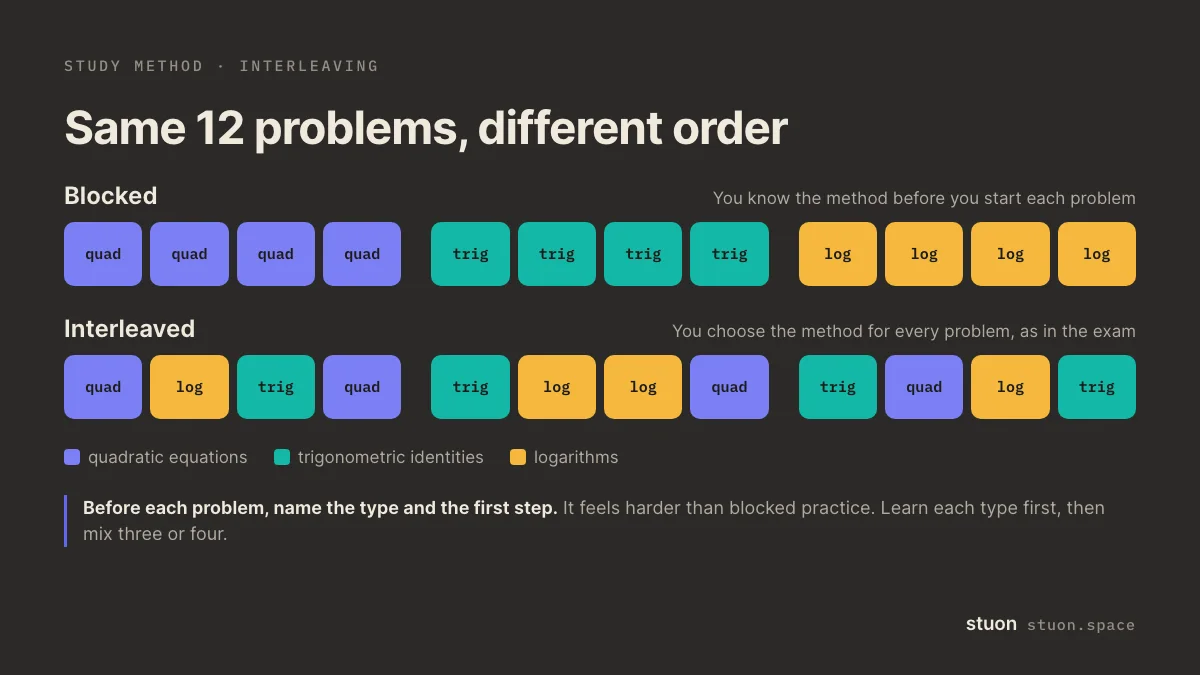
Blocked: 10 quadratic equations, then 10 trigonometric identities, then 10 logarithm problems.
Interleaved: a set of 12 with four of each type, shuffled. Before each problem you write "quadratic", "trig" or "log" and the first step.
The interleaved set feels harder, but the exam will not tell you which type a problem is.
Frequently asked questions
What is the difference between interleaving and spaced repetition?
Interleaving mixes topics within a session. Spaced repetition spreads reviews of the same material across time. They work well together.
Does interleaving work for memorising facts?
The strongest evidence is for problem solving and categories. For plain facts, spacing and active recall matter more.
How many topics should I interleave?
Three or four related ones are a practical start.
Is interleaving the same as multitasking?
No. You work on one problem at a time. Only the order of problem types is mixed.
Sources
Related methods
Practice it, then keep a record
Stuon has a timer, a blurting space and flashcards, and it logs the time you spend on each.
Track this in StuonAdd to Chrome, freeor use the free version without an account