study method
Retrieval practice
what is retrieval practice?
Retrieval practice is learning by recalling information from memory, for example by taking a practice test or answering questions without notes. It improves long-term retention more than restudying the same material. "Active recall" is the student term for the same idea.
by Vusal Imranli updated 14 Nov 20263 min read
How retrieval practice works
Retrieval strengthens a memory and makes it easier to reach later. Research calls the result the testing effect: students who are tested on material remember more later than students who reread it for the same time (Roediger and Karpicke, 2006).
A later study found that students who practiced free recall learned more than students who built concept maps while looking at the text, including on tests that asked for concept-map-style understanding (Karpicke and Blunt, 2011).
A large review of study techniques rated practice testing and distributed practice as high-utility, and highlighting and rereading as low-utility (Dunlosky et al., 2013).
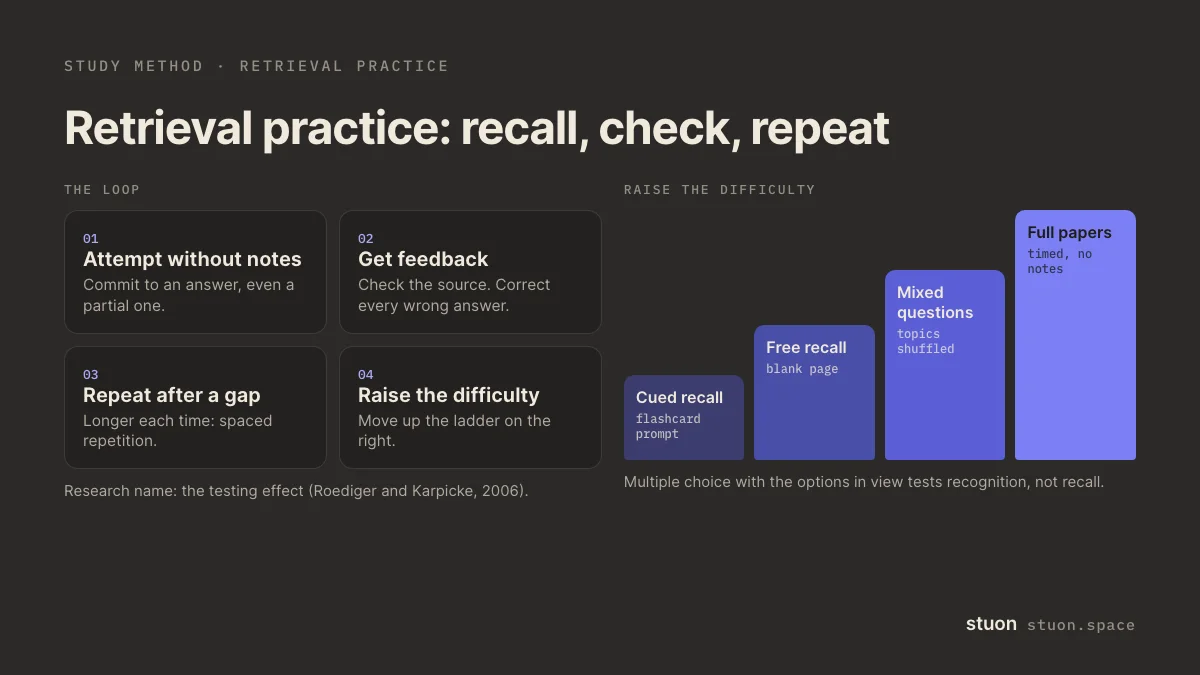
How to do retrieval practice, step by step
- Choose a retrieval format. Short-answer questions, flashcards, a blank-page recall or a past paper.
- Attempt without notes. Commit to an answer, even a partial one.
- Get feedback. Check against the source and correct errors. Feedback matters most when you answered wrong.
- Repeat on a schedule. Return to the material after a gap, longer each time. See spaced repetition.
- Raise the difficulty. Move from cued recall to free recall, then to mixed questions and full papers.
When to use retrieval practice
- Every time you finish studying a section.
- In place of a second read-through before exams.
- For any content you will need to use without notes.
Benefits of retrieval practice
- Better memory over weeks, not only the next day.
- It tells you where the gaps are while you can still fix them.
- It is the same skill an exam tests.
Common mistakes with retrieval practice
- Using only recognition, such as multiple choice with the options in view, when the exam asks for recall.
- Skipping feedback, which leaves errors in place.
- Practicing only on easy items.
- Retrieval once, then no more. Spaced repeats matter.
Retrieval practice example
Monday: read the chapter on the causes of the war, then write the main causes from memory.
Tuesday: answer three short questions on it without notes. Mark errors.
Friday: answer an essay question on the same topic under timed conditions.
Frequently asked questions
Is retrieval practice the same as active recall?
Yes in practice. Retrieval practice is the term used in research, active recall is the term students use.
Does retrieval practice work if I get the answers wrong?
It can, as long as you get feedback afterwards. Errors tell you what to study next.
How is retrieval practice different from testing for a grade?
It is low-stakes self-testing for learning, not assessment. The score matters less than the feedback.
What is the easiest way to start?
After your next study block, close your notes and write down what you remember. That is blurting.
Sources
- Roediger and Karpicke (2006), Test-enhanced learning. Psychological Science.
- Karpicke and Blunt (2011), Retrieval practice produces more learning than elaborative studying with concept mapping. Science.
- Dunlosky et al. (2013), Improving students' learning with effective learning techniques. Psychological Science in the Public Interest.
Related methods
Practice it, then keep a record
Stuon has a timer, a blurting space and flashcards, and it logs the time you spend on each.
Track this in StuonAdd to Chrome, freeor use the free version without an account