glossary
Testing effect: definition
what is testing effect?
The testing effect is the finding that trying to retrieve information from memory, as in a quiz, improves later memory for it more than spending the same time restudying. The benefit shows up mainly on delayed tests, days rather than minutes later.
by Vusal Imranli updated 10 Oct 20262 min read
also called test-enhanced learning, retrieval practice effect
Definition and key study
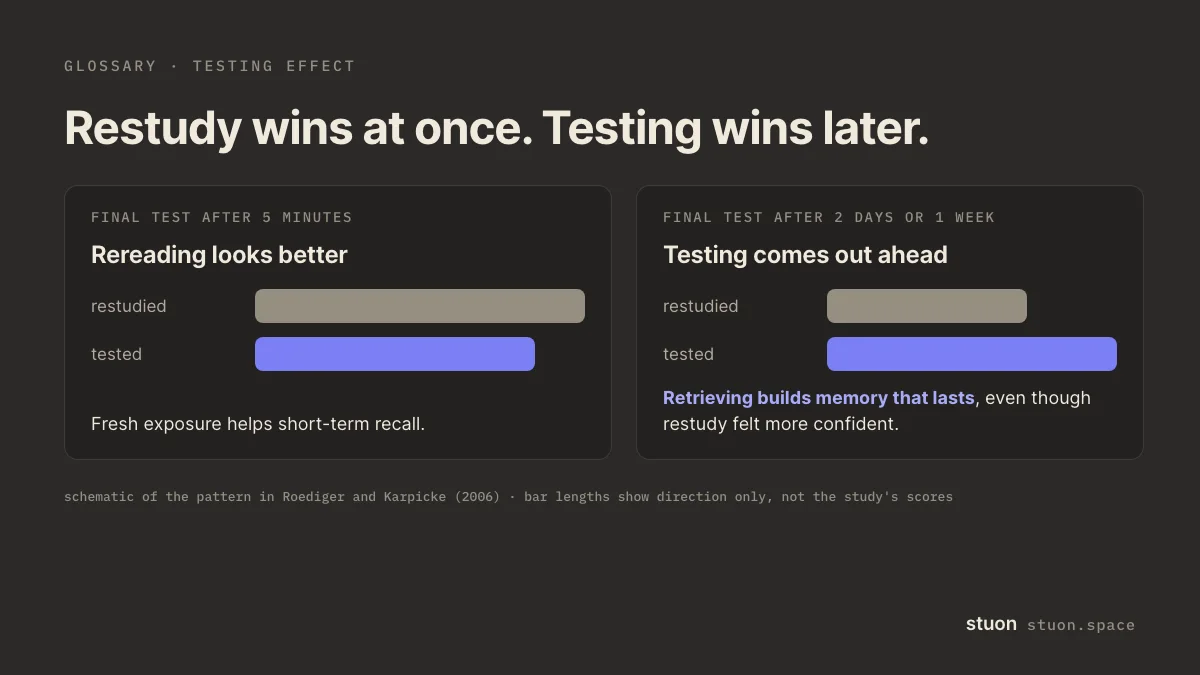
Roediger and Karpicke (2006) had students read prose passages and then either restudy them or take recall tests. On a test five minutes later, restudying came out ahead. On tests two days and one week later, the students who had been tested remembered more, even though the restudy group felt more confident.
A meta-analysis of many experiments found the effect is reliable, and larger when tests are followed by feedback (Rowland, 2014).
What it means for studying
Use tests as a study tool, not only as an assessment. Flashcards, past papers, blurting and short quizzes all count. Check your answers afterwards so mistakes are corrected. The everyday name for the habit is active recall.
A common misconception
Students often avoid testing themselves until they "know it". The effect works on partial knowledge too: a failed attempt followed by the correct answer still helps. Waiting until you feel ready means losing most of the benefit.
Full guide: Retrieval practice. The research behind active recall: learning by retrieving, not restudying.
Frequently asked questions
Is the testing effect the same as retrieval practice?
Retrieval practice is the activity; the testing effect is the result it produces. The terms are often used interchangeably.
Does the test have to be graded?
No. Low-stakes self-tests work. What matters is retrieving from memory and then checking.
Sources
Related terms and guides
Practice it, then keep a record
Stuon has a timer, a blurting space and flashcards, and it logs the time you spend on each.
Track this in StuonAdd to Chrome, freeor use the free version without an account