exam plan
TOEFL study plan
how do you make a TOEFL study plan?
Practise all four sections every week: timed Reading and Listening sets, Speaking answers you record and play back, and Writing tasks you get feedback on. Learn new words with spaced review. Take a full practice test at the start, in the middle and near the end, and move time toward the section furthest from your target.
by Vusal Imranli updated 10 Oct 20265 min read
What the TOEFL tests
| Section | Items (about) | Minutes (about) | Score |
|---|---|---|---|
| Reading | 50 | 30 | 1 to 6 |
| Listening | 47 | 29 | 1 to 6 |
| Writing | 12 | 23 | 1 to 6 |
| Speaking | 11 | 8 | 1 to 6 |
| Overall | Average of the four sections | 1 to 6, in half bands |
The updated test is adaptive, so the number of items and the time can vary; ETS says to allow about two hours. Scores are reported in half-band steps, and from January 2026 to January 2028 score reports also show a comparable score on the older 0 to 120 scale. Check ETS for current details before you plan.
How to build a TOEFL study plan
- Find out the score you need. Check what your university or programme asks for, and on which scale: requirements may be written on the 1 to 6 scale or the older 0 to 120 scale.
- Take a full practice test. Use official ETS practice material for the updated test. Note the band per section.
- Do Reading and Listening under time. Short timed sets most days. For each miss, note whether you did not understand, missed it in the audio or ran out of time.
- Record every Speaking answer. Speaking is short, so practise many answers. Listen back and note errors you repeat.
- Get feedback on Writing. Write a few tasks a week under time and ask a teacher or a strong English writer to mark them. Fix one recurring error at a time.
- Review vocabulary with recall. Test yourself on new words in sentences rather than rereading a list. See active recall.
An 8-week TOEFL schedule
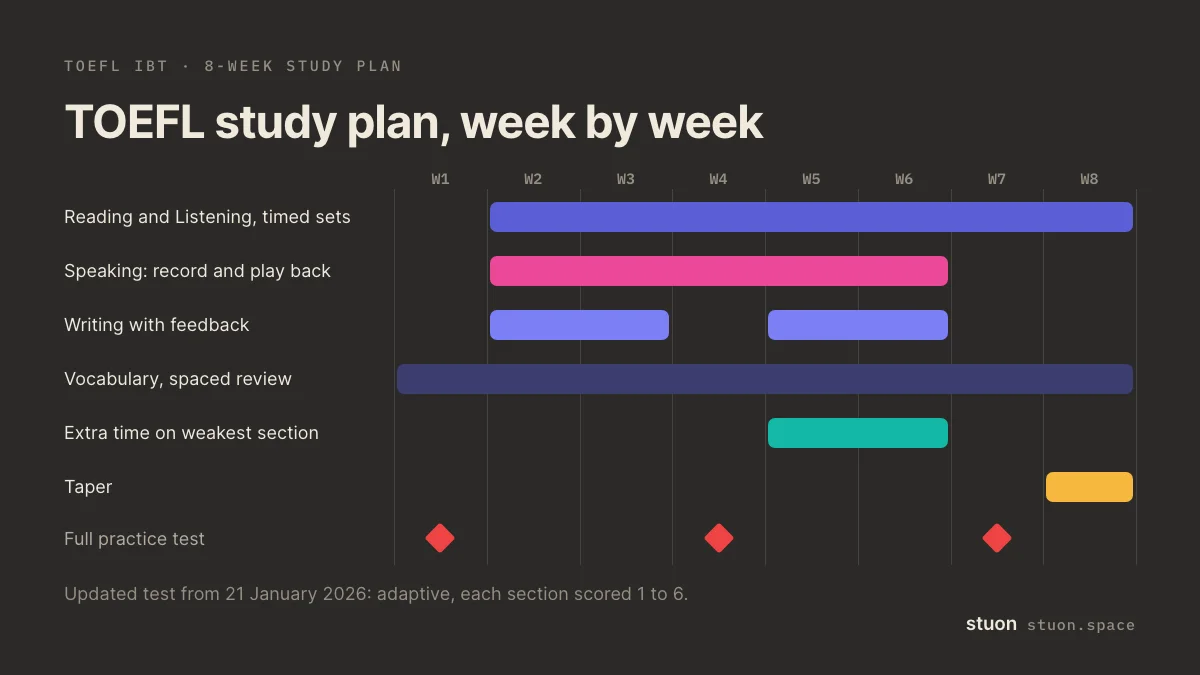
| Weeks | Focus | Main activities |
|---|---|---|
| Week 1 | Baseline | Full practice test, band per section, start the vocabulary deck and the error log |
| Weeks 2 to 3 | Build skills | Daily timed Reading or Listening set, five recorded Speaking answers a day, two Writing tasks a week with feedback |
| Week 4 | Checkpoint | Second full practice test, compare bands, move hours toward the weakest section |
| Weeks 5 to 6 | Weak section first | Extra sessions on the weakest section, mixed timed sets, keep Speaking and vocabulary daily |
| Weeks 7 to 8 | Simulate and taper | Full practice test in week 7, review, short sets, a light final two days |
With four weeks, keep a practice test at the start and one in week 3.
How many hours to plan
Set the weekly total from your test date and your current scores, as described in how many hours should I study. The study hours calculator turns hours per day into weekly and total hours.
| Per week | 4 weeks | 8 weeks | 12 weeks |
|---|---|---|---|
| 5 h | 20 h | 40 h | 60 h |
| 10 h | 40 h | 80 h | 120 h |
| 15 h | 60 h | 120 h | 180 h |
| 20 h | 80 h | 160 h | 240 h |
This is multiplication, not a recommendation. It assumes you study every planned week. Choose hours from your starting level and test date, then check them against a log.
Log what you actually do with a study time tracker. A plan of ten hours a week is only useful if the log shows ten hours.
Common TOEFL study mistakes
- Studying with material for the older TOEFL format. Check that practice material matches the test from January 2026.
- Practising Speaking in your head. Say every answer aloud and record it.
- Writing without feedback and repeating the same errors each week.
- Learning words from lists without testing yourself on them in sentences.
Short, daily sessions work best
Language skills grow with frequent practice. Five 30-minute sessions spread over the week usually beat one long weekend session, and they suit spaced repetition for vocabulary. A 25-minute timer is a simple unit for a Reading or Listening set.
Keep a note of your band per section after each practice test. If the overall band is stuck, it is usually one section holding it down, and that section should get the extra hours.
Frequently asked questions
What changed in the TOEFL iBT in 2026?
From 21 January 2026 the test is adaptive and scores each section and the overall result on a 1 to 6 scale in half bands. ETS also reports a comparable 0 to 120 score until January 2028.
How long is the updated TOEFL iBT?
ETS says to allow about two hours. Because the test is adaptive, the number of items and the time can vary.
How long should I study for the TOEFL?
It depends on your current English and the score you need. Take a practice test, compare it with the requirement, and set weeks and hours from the gap.
How do I track TOEFL study time?
Label each session by section with a study timer and check the weekly split in a study tracker.
Sources
- ETS, TOEFL iBT content and structure (updated test).
- ETS, TOEFL iBT score scale update (1 to 6 scale and comparable 0 to 120 scores).
- Dunlosky et al. (2013), Improving students' learning with effective learning techniques. Psychological Science in the Public Interest.
- Cepeda et al. (2006), Distributed practice in verbal recall tasks: a review and quantitative synthesis. Psychological Bulletin.
More on Stuon about this topic
Related pages
Turn your study time into progress
Levels, streaks and a heatmap give your hours a visible shape.
Turn your study time into progressAdd to Chrome, freeor use the free version without an account