
"I'm just lazy" is one of the most common things students say about themselves. It sounds like an explanation, but it doesn't tell you what to do next. It mostly makes you feel worse.
Here is a kinder and more useful way to look at it. You are not avoiding everything. You are avoiding this task, right now, for a reason. Find the reason and the fix usually becomes obvious. This post helps you do that, with a short quiz to diagnose what is going on.
Why "lazy" is the wrong label
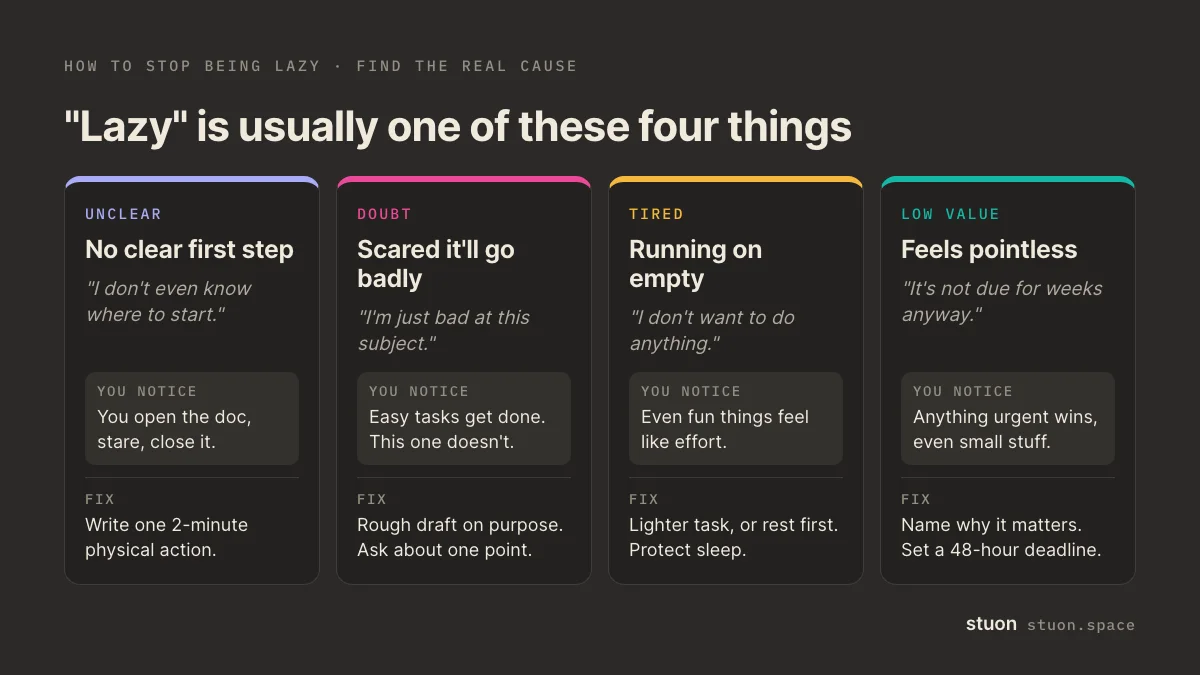
Look at what you do instead of studying. You might spend two hours editing a video, reorganising your room or getting through a hard level in a game. That is effort. So the problem is rarely that you can't put in effort. It is that this particular task feels bad to start.
Research on procrastination backs this up. In a large review, Piers Steel (2007) combined the results of a large body of earlier studies and found that people put things off more when the task feels unpleasant, when they doubt they can do it, when the reward is far away, and when they are easily distracted. None of those are character flaws. They are conditions you can change.
Calling yourself lazy also has a cost. It turns a small problem ("I don't know how to start this essay") into a big one ("something is wrong with me"), and that makes the task feel even worse to start.
Which one is it? Take the quiz
Tick everything that sounds like you right now, for the task you are avoiding. Be honest; nobody sees this.
"Am I lazy?" diagnostic
Think of one specific task you keep avoiding, then tick what is true.
Cause 1: The task is unclear
"Study for the history exam" is not a task. It is a cloud. Your brain can't start a cloud, so it looks for something clearer to do, like checking messages.
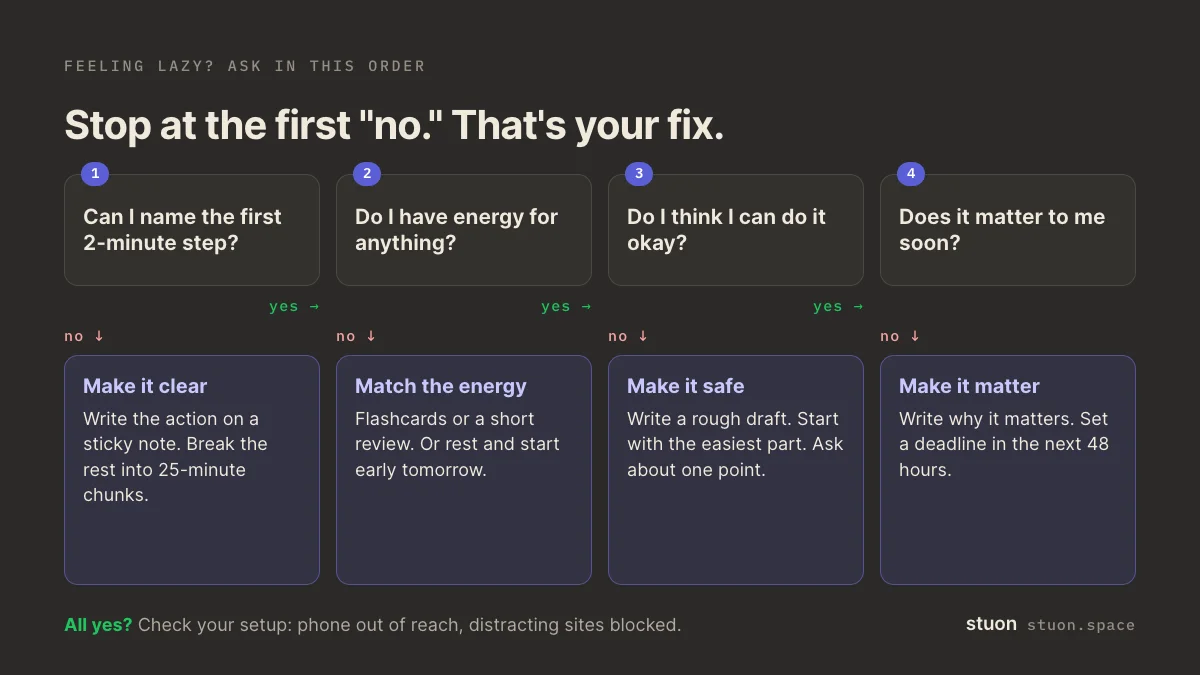
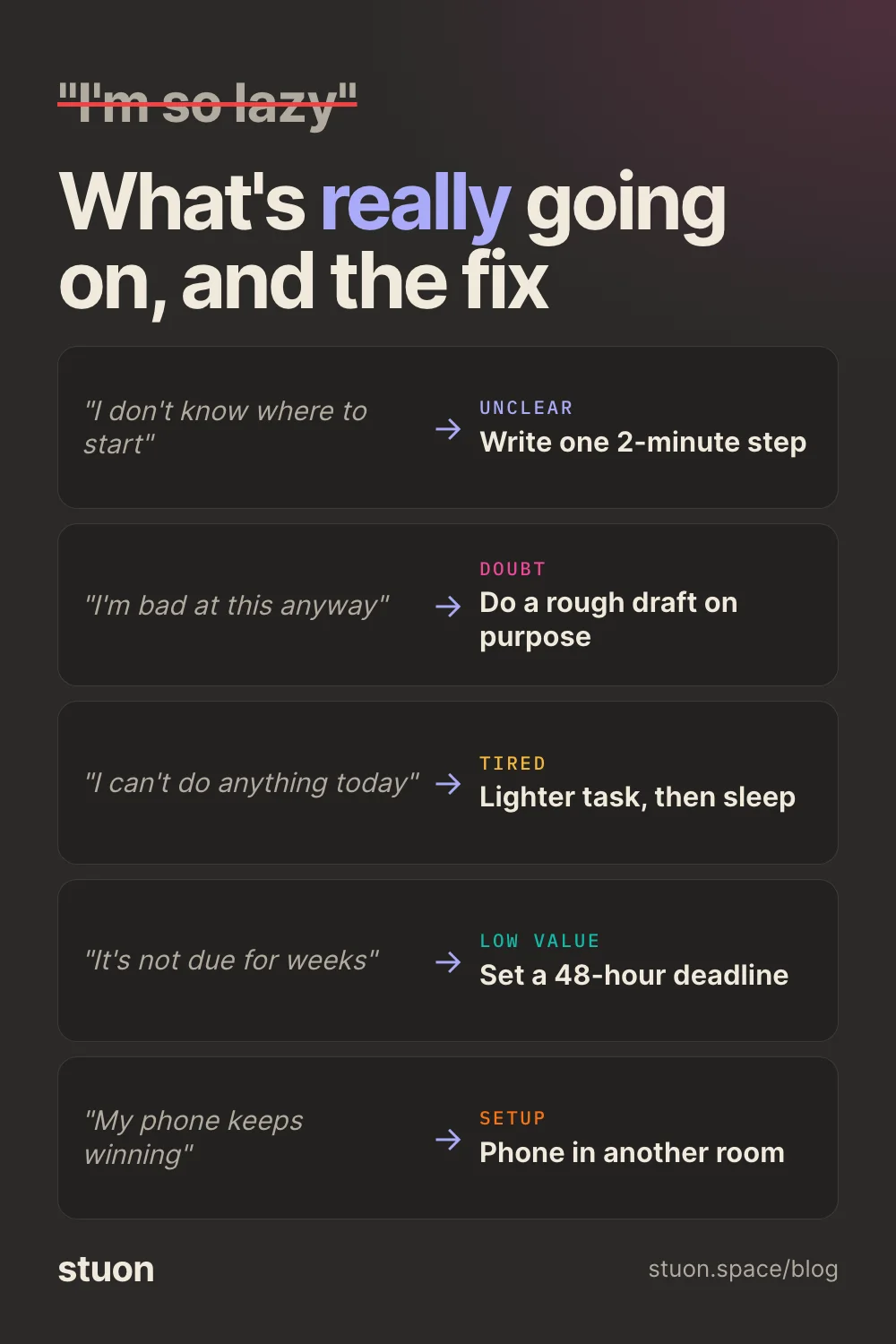
The fix: turn the cloud into one physical action. "Open the syllabus and list the five topics" is a task. "Write three facts about the causes of World War I from memory" is a task.
- Ask: "What would I literally do with my hands in the first two minutes?"
- Write that on a sticky note and put it on your laptop.
- For bigger work, list the steps, each under 25 minutes. A study session planner can help.
Cause 2: You doubt you can do it well
This one hides well. It looks like laziness from the outside, but on the inside it sounds like "if I try and it's bad, that proves I'm bad at this." Not starting protects you from finding out.
The fix: make the first attempt safe to fail.
- Call it a draft. Literally type "ROUGH DRAFT" at the top.
- Start with the part you understand best, not the hardest part.
- Pick one question you're stuck on and ask a teacher, a classmate or a tutor about just that. Small help early beats big panic later.
If this is your main cause, especially with one subject, the post on studying subjects you hate goes deeper on filling the gaps that make a subject feel impossible.
Cause 3: You are tired, not lazy
If you don't want to do anything, including things you enjoy, the problem may be energy, not attitude. Short sleep, skipped meals, a long day of classes or a part-time job can all look like laziness from the outside.
The fix: match the task to your energy.
- Low energy: flashcards, a short review, tidying tomorrow's plan. Things you can check.
- Very low energy: rest, then do one small thing. Or go to bed and start early.
- Every day: protect sleep. The CDC recommends 7 or more hours a night for adults and 8 to 10 for teenagers.
The guide to studying when tired has a 10-minute test to decide whether to keep going or stop.
Cause 4: The task feels pointless
Some tasks really do feel like busywork. And deadlines far away feel like no deadlines at all. When the payoff is distant or invisible, your brain picks something with a payoff now.
The fix: make the value visible and the deadline closer.
- Write one honest line: "This matters because ___." It can be practical: "a good mark here means less pressure in the final."
- Set a mini-deadline in the next 48 hours and tell someone about it.
- Reward yourself right after a session: a walk, an episode, a game. Rewards now help with work that pays off later.
A bonus cause: your environment
Sometimes none of the four fit, and the answer is simpler: the easy option is too easy. Your phone is in your hand, a video tab is open, and your desk is your bed.
Change the setup rather than your personality. Put the phone in another room, block the two or three sites you always drift to with a website blocker, and work somewhere that is only for work. The post on phone and tab distractions covers this in more detail.
A worked example
Imagine a student, Sam, who has a lab report due Friday. It is Monday, 4 p.m., and Sam has been "about to start" since lunch. Sam takes the quiz and ticks three statements: not sure of the first step, the task feels huge, and the deadline feels far away.
So the main cause is an unclear task, plus low urgency. Sam's plan:
- 4:05: Write the first action: "Open the lab handout and copy the report headings into a doc."
- 4:10: Do it. Then list what goes under each heading, one line each.
- 4:20: Set a mini-deadline: "Method and results written by Tuesday 6 p.m." Text it to a lab partner.
- 4:25: 25-minute timer on the method section, which is the easiest part.
Sam didn't need to become a different person. Sam needed a first step and a closer deadline.
What doesn't help
- Insulting yourself. Shame makes the task feel worse, which makes avoiding it more tempting.
- Huge resolutions. "From tomorrow I'll study 6 hours a day" usually lasts a day. Start with 20 minutes you will actually do.
- Waiting until you feel like it. The feeling often comes after you start. See how to study with zero motivation.
- Copying someone else's routine. A 5 a.m. routine won't fix a problem that's really about an unclear task.
If you feel flat and unmotivated about almost everything for weeks at a time, that is worth talking to a doctor or counsellor about. It might not be a study problem at all.
Frequently asked questions
Why am I so lazy?
Most of the time it isn't laziness. People avoid tasks that feel unclear, unpleasant, too hard or not worth it, and they avoid more when they are tired or distracted. Figuring out which of these applies tells you what to fix.
How do I stop being lazy and start studying?
Pick one task, write the first physical step, make it small enough to do in two minutes, and remove your main distraction. Then start a short timer. Momentum does more than willpower.
Is laziness a real thing?
Everyone has days when they don't want to do anything, and rest is a real need. But a pattern of avoiding one specific task usually has a specific reason behind it, which is more useful to address than the label.
How long does it take to stop being lazy?
You can change today's session in five minutes with a clear first step. Changing the pattern takes longer, because habits form over weeks to months. The 30-day discipline plan is a good place to start.
Related reading
Sources
- Steel, P. (2007). The nature of procrastination: A meta-analytic and theoretical review of quintessential self-regulatory failure. Psychological Bulletin, 133(1), 65–94. doi:10.1037/0033-2909.133.1.65
- Centers for Disease Control and Prevention. About sleep.
Make starting the easy part
Block your usual escape sites for one session and see each one you finish on your study heatmap.
Get the free Chrome extensionor use the free version without an account