
Three days is not a lot. It is also not nothing. Three focused days are roughly 15 to 20 hours of study, which is more than many students put into a whole term on one subject. The problem is rarely the time. It is spending it on rereading, on topics you already know, or on a final all-nighter that wipes out what you learned.
This plan fixes that. It tells you what to do each day, and the planner below splits your own topics across the three days.
Before you start: be honest about what three days can do
You will not master the whole course. You can get the important topics to the point where you can answer exam questions on them, and that is what earns marks. So the goal is not "cover everything." The goal is "be able to answer the questions most likely to come up."
That means two things matter more than anything else: knowing what the exam asks, and practising answering it. Reading your notes from start to finish does neither.
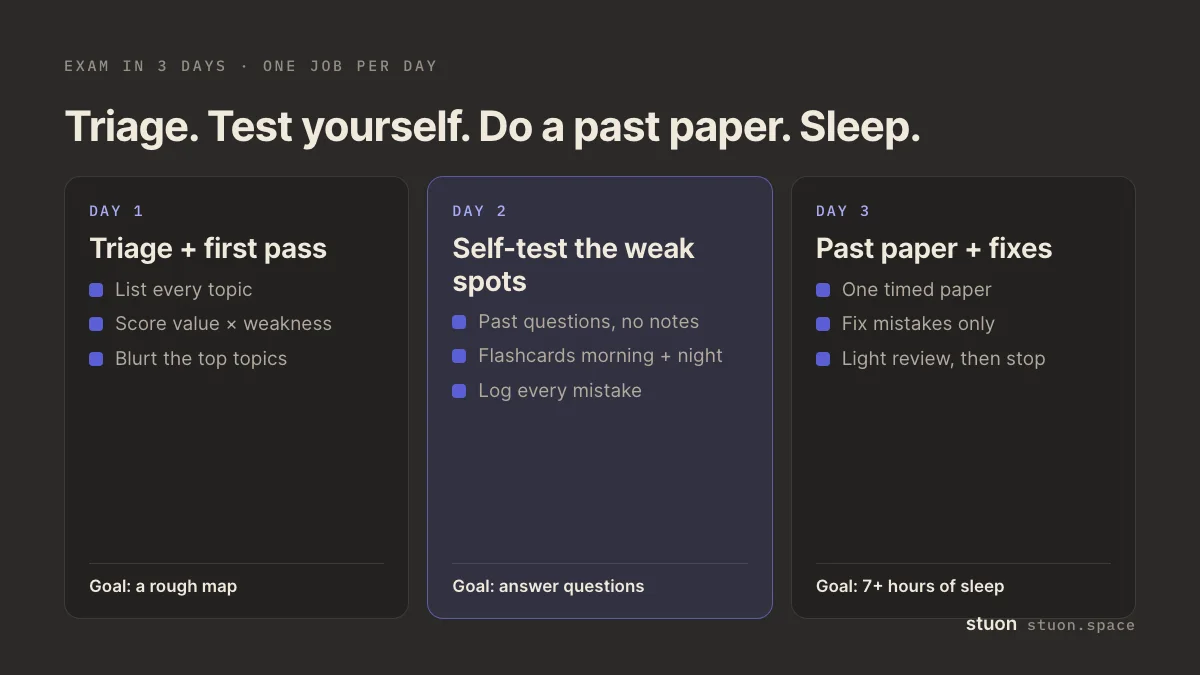
Day 1: Triage, then a fast first pass
Make the topic list (30 minutes)
Write every topic on the syllabus or in the lecture list. Next to each one, add two scores from 1 to 3:
- Value: how much it is likely to be worth. Use past papers, the syllabus weighting, or what the teacher stressed.
- Weakness: how badly you know it. 3 means "I could not answer a question on this right now."
Multiply the two. Topics scoring 6 or 9 are your priority. Topics scoring 1 or 2 get a quick skim at most. This feels brutal, and it is the point. Time spent on low-value or already-known topics is time taken from the ones that move your grade.
First pass on the priority topics (rest of the day)
For each priority topic, read or watch just enough to understand it, then close the material and write down what you remember. This is the blurting method, and it shows you the gaps immediately. Check against your notes and fill in what you missed in a different colour.
Keep it moving. Thirty to forty-five minutes per topic, then the next one. You are building a rough map, not a perfect one.
Day 2: Test yourself on the weak spots
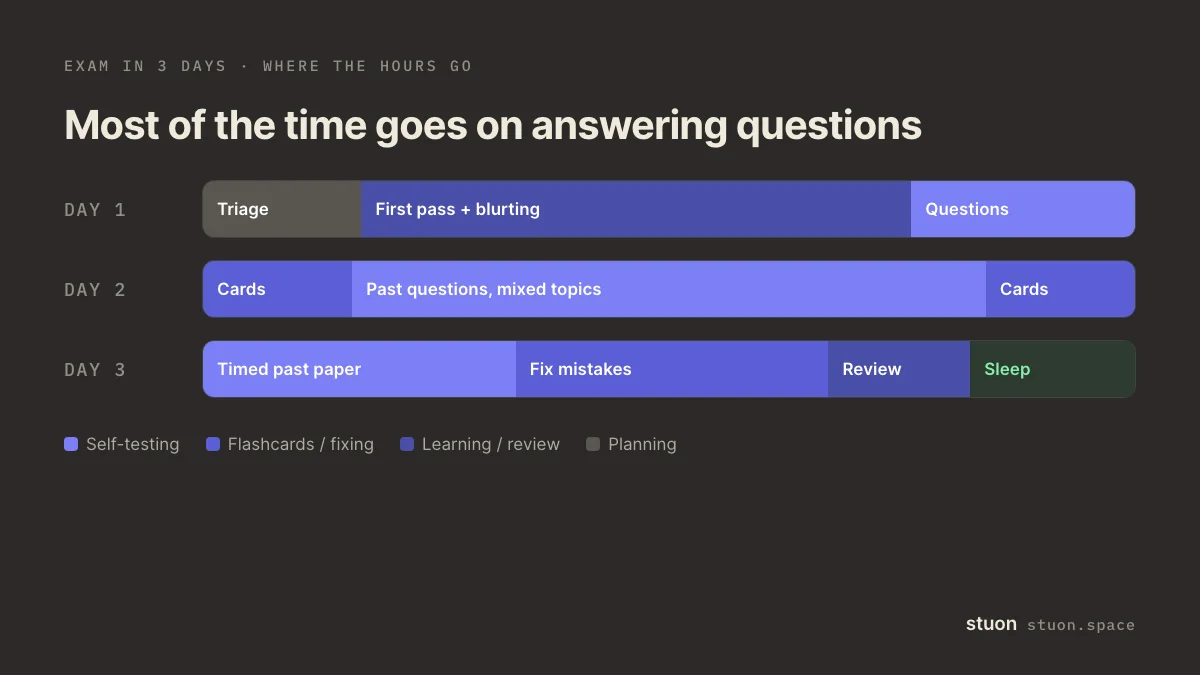
This is the most important day. Instead of reading again, you answer questions.
The research on this is unusually clear. In a well-known study by Roediger and Karpicke (2006), students who spent study time recalling a passage remembered much more of it a week later than students who spent the same time rereading it. A large review by Dunlosky and colleagues (2013) rated practice testing as one of the two most useful study techniques they examined, with evidence across many ages, subjects and test formats.
- Answer past paper questions or textbook questions on each priority topic, without notes.
- Make quick flashcards for facts, formulas and definitions, and go through them twice during the day: once in the morning, once in the evening.
- Every time you get something wrong, write the correct answer and one line on why you missed it.
Mix topics instead of finishing one before starting the next. Mixing problem types is harder in the moment, but it trains you to recognise which method a question needs, which is exactly what the exam tests. More on that in interleaving.
3-day exam planner
Add your topics with a value and weakness score. The planner ranks them and spreads them across the three days.
Day 3: A timed past paper, then fix it
In the morning, do one full past paper (or a mock you build from past questions) under real conditions: timed, no notes, phone in another room. This shows you how the real thing will feel and where your time goes.
Mark it honestly. Then spend the afternoon on the mistakes only. For each one, ask: did I not know it, did I misread the question, or did I run out of time? Each cause has a different fix: learn the content, slow down on the question, or practise faster on that question type.
In the evening, do a light review: one pass through your flashcards and your list of mistakes. Then stop. Pack what you need for the exam, set two alarms and go to bed.
Sleep is part of the plan
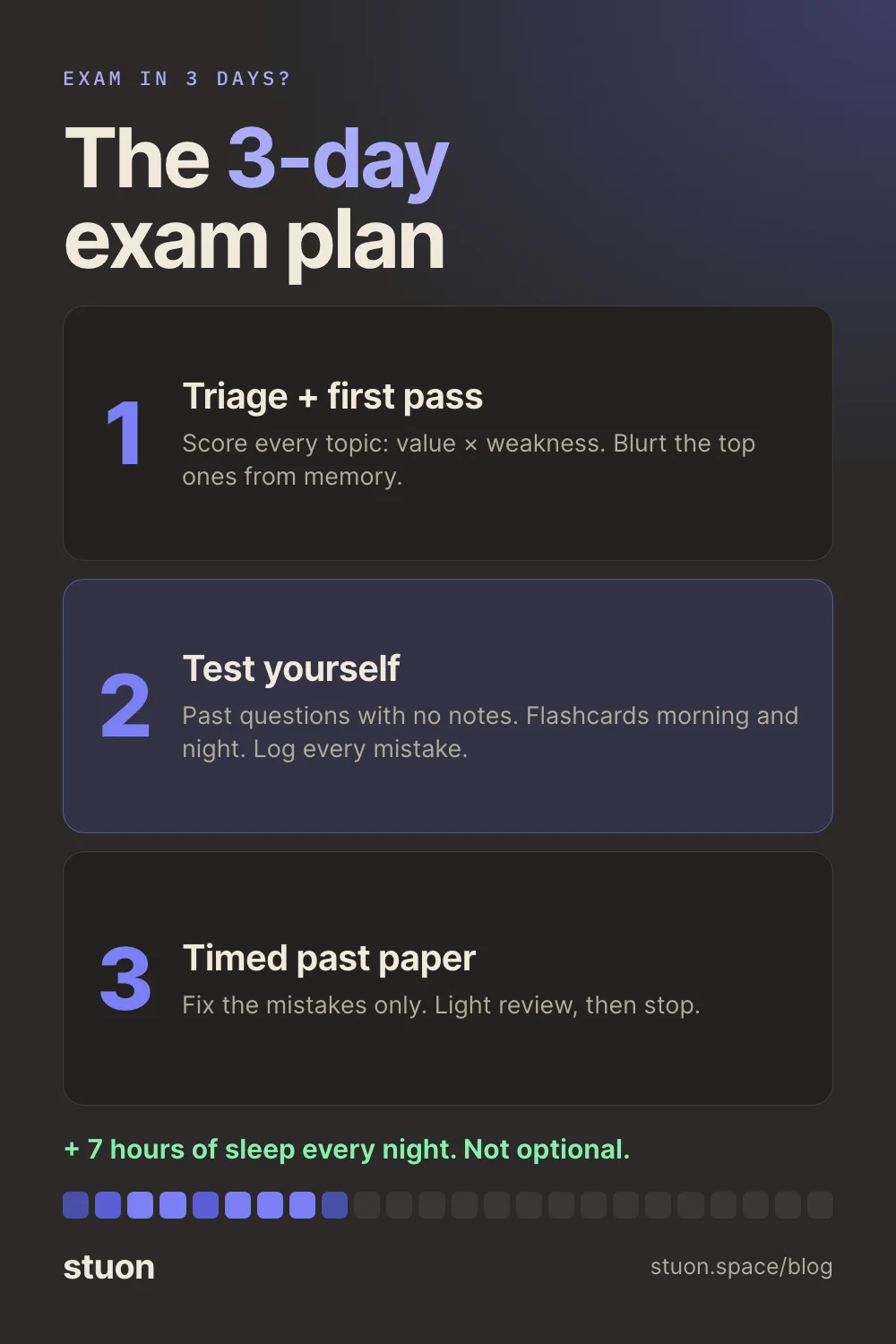
It is tempting to treat the last night as bonus study time. It usually costs more than it gives. Sleep helps your brain hold on to what you studied during the day, and missing it makes attention and memory worse the next day. The post on all-nighters covers the research. Aim for at least seven hours on each of the three nights, not just the last one.
A sample day
| Time | Day 2 example |
|---|---|
| 9:00 | Flashcards, all priority topics (20 min) |
| 9:30 | Past questions: topic A, no notes (50 min), then check |
| 10:45 | Break, walk, water |
| 11:00 | Past questions: topic B mixed with A (50 min) |
| 13:00 | Lunch away from the desk |
| 14:00 | Blurt topic C, check, fix gaps (45 min) |
| 15:00 | Questions on topic C and the mistakes list (50 min) |
| 17:00 | Done for the main block. Dinner. |
| 19:30 | Flashcards again (20 min), plan tomorrow, stop |
Work in focused blocks with real breaks. A study timer helps you stop checking the clock and keeps the breaks honest.
Common mistakes with a 3-day plan
- Rewriting notes neatly. It feels productive and teaches you very little. Write from memory instead.
- Starting with your favourite topic. Start with the highest score on your triage list.
- Skipping the past paper because you "are not ready yet". You will not feel ready. Do it anyway; it is the best diagnostic you have.
- Studying 14 hours a day. Six to eight hours of focused work with breaks beats twelve hours of drifting.
Frequently asked questions
Can you study for an exam in 3 days?
Yes, if you are realistic about the goal. You can get the most important topics to the point where you can answer exam questions on them. Spend the time on self-testing and past papers rather than rereading.
How many hours a day should I study with 3 days left?
Around six to eight hours of focused work per day, in blocks of 45 to 60 minutes with breaks, is a sensible target for most students. More than that usually turns into low-quality time.
Should I pull an all-nighter before the exam?
Usually not. Sleep loss hurts attention and memory the next day, which is exactly when you need them. A light review and a full night of sleep is the better bet.
What if I have three exams in three days?
Triage across all three subjects at once, give each day's exam priority the day before, and use the short gaps for flashcards on the later subjects. The exam season guide covers back-to-back exams.
Related reading
Sources
- Roediger, H. L., & Karpicke, J. D. (2006). Test-enhanced learning: Taking memory tests improves long-term retention. Psychological Science, 17(3), 249–255. doi:10.1111/j.1467-9280.2006.01693.x
- Dunlosky, J., Rawson, K. A., Marsh, E. J., Nathan, M. J., & Willingham, D. T. (2013). Improving students' learning with effective learning techniques. Psychological Science in the Public Interest, 14(1), 4–58. doi:10.1177/1529100612453266
Three days, one timer
Run each block on a timer and see your study hours add up on a heatmap.
Start the free study timeror use the free version without an account