
One week is not much time, but it is enough to change your result if you spend it well. The problem is that most students spend a panic week the same way: rereading notes from the beginning, highlighting again, and staying up late. That feels busy. It does not leave much behind.
This post gives you a day-by-day plan for the last seven days before a final. It assumes you have one main exam that week, or that you will run the plan in parallel for two or three subjects. The general principles of exam preparation are covered on our guide to studying for exams. Here we focus on the narrow case: the final is close, and you need a plan for the time you actually have.
The three rules behind the plan
Test yourself more than you read. In a well-known experiment, students who practised recalling a passage remembered more of it a week later than students who spent the same time rereading it (Roediger & Karpicke, 2006). With one week left, every hour of rereading is an hour you could have spent finding out what you cannot yet recall. If you want the background, read about active recall.
Come back to each topic more than once. A large review of spacing research found that spreading study of the same material across sessions beats massing it into one block, across many kinds of material (Cepeda et al., 2006). A week is short, but it is long enough to see a hard topic on day 2, again on day 3, and again on day 5 or 6. A review of ten common study techniques rated practice testing and spaced practice as the two most useful of the ten (Dunlosky et al., 2013).
Protect sleep, especially at the end. Staying up late to cover more feels responsible. Research on sleep and memory points the other way, which we cover in why all-nighters backfire.
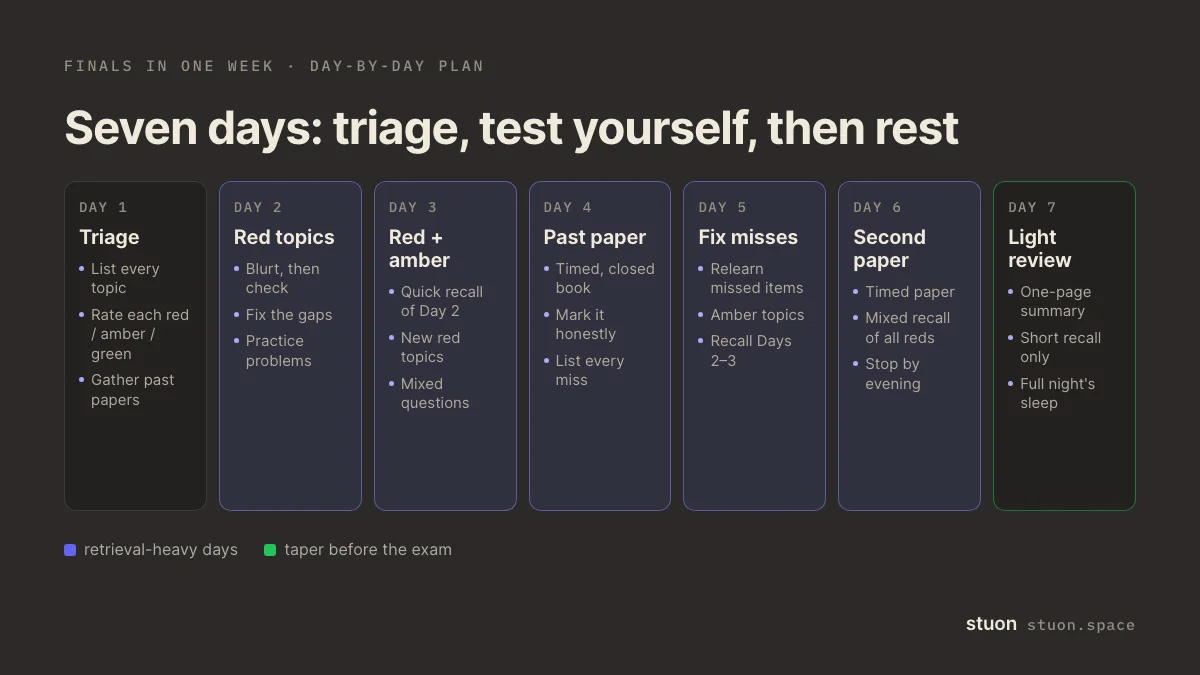
Day 1: triage
Spend the first session making a list, not studying. Write down every topic the exam can cover. Use the syllabus, the lecture list and any past papers. Then rate each topic:
- Red: you could not explain it or solve a question on it right now.
- Amber: you half know it. You recognise it but would make mistakes.
- Green: you could answer an exam question on it today.
Rate honestly. Recognising a slide is not the same as knowing it, which is the trap described in the highlighting trap. If you are unsure, try one question on the topic without notes. Finish Day 1 by finding two past papers or practice exams and putting them aside. Do not look at them yet.
Days 2 and 3: work the red topics with retrieval
Take one red topic at a time. For each one:
- Read or watch a short source on it. Keep it to 15 to 20 minutes.
- Close everything and write down all you remember on a blank page. This is the blurting method.
- Open your notes and compare. Mark what you missed or got wrong.
- Do two or three practice questions on the topic.
Start Day 3 with ten minutes of recall on Day 2's topics before anything new. This short return is your first spaced review. Then move to the remaining reds and the hardest ambers. End the day with a few mixed questions drawn from different topics, so you practise choosing the right method and not just repeating one.
Day 4: your first full past paper
Sit one past paper under exam conditions. Use the real time limit, no notes and no phone. A countdown timer on the screen helps you feel the pace. Then mark it strictly, using the mark scheme if you have one.
The score matters less than the list you make afterwards. Write down every question you lost marks on and why: did not know it, misread it, ran out of time, or made a careless slip. Each reason needs a different fix.
Day 5: fix the misses
Work through the list from Day 4. Relearn anything you did not know, then test it again from a blank page. If timing was the problem, practise the slowest question type with a timer. Use the rest of the day for amber topics and a quick recall round of everything from Days 2 and 3.
Day 6: second paper and mixed recall
Sit the second past paper in the morning. Mark it, then repeat the Day 5 process on the new misses. In the afternoon, do one mixed recall round: write a one-line prompt for each red topic, shuffle them, and answer each from memory. Stop at a fixed time in the evening. The goal for the night is sleep, not one more chapter.
Day 7: light review and rest
The day before the exam is for consolidation, not new material. Make a one-page summary of the formulas, definitions or arguments you most need, written from memory and then checked. Do a short recall session in the morning and another in the afternoon. Pack what you need for the exam. Go to bed at your normal time.
A worked example
Say you have a first-year statistics final on Friday and it is Saturday. Your Day 1 list has twelve topics. Four are red: hypothesis tests, confidence intervals, the normal approximation and regression. Three are amber. Five are green.
On Sunday (Day 2) you blurt hypothesis tests and confidence intervals, check against your lecture notes, and do three textbook problems on each. On Monday you spend ten minutes recalling those two, then work through the normal approximation and regression the same way. Tuesday is the first past paper. You lose most marks on regression and on two questions where you used the wrong test. Wednesday you relearn regression and practise picking the right test from a mixed set of question stems. Thursday is the second paper and a mixed recall round. Thursday evening you stop at 9 p.m.
Notice what is missing: there is no day spent reading the whole course from the start, and the green topics get almost no time. That is deliberate.
How many hours a day?
There is no magic number, and more hours with less focus is not a better trade. For one main exam, four to six focused hours a day is plenty for most students during a finals week. Work in blocks with breaks, for example with the Pomodoro timer. If you want a more careful answer, see how many hours you should study and the four-hour study day.
If you have more than one final that week
Run the same structure for each subject, but interleave them. Put the exam that comes first slightly ahead in the plan, and give each subject at least one past paper. A revision timetable generator can lay out the days once you know your exam dates. Students on specific tracks, such as STEM or medical courses, can find subject-specific advice on those pages.
Frequently asked questions
Can you really study for a final in one week?
You can improve your result a lot in a week, especially if you spend it on retrieval and past papers rather than rereading. You will not master a whole course from nothing in seven days, so triage matters: spend the time on the topics you cannot yet do.
Should I start from the beginning of the course?
No. Start from your red topics. Material you already know well needs only a quick check, and rereading it uses time you need for weaker topics.
What if there are no past papers?
Use end-of-chapter questions, problem sets, or questions you write yourself from the lecture headings. The point is to practise producing answers under time pressure without notes.
Is it worth pulling an all-nighter on the last day?
Generally not. Sleep loss makes it harder to learn new material and to think clearly the next day. Stop at a set time on Day 6 and Day 7.
Related reading
Sources
- Roediger, H. L., & Karpicke, J. D. (2006). Test-enhanced learning: Taking memory tests improves long-term retention. Psychological Science, 17(3), 249–255. doi:10.1111/j.1467-9280.2006.01693.x
- Cepeda, N. J., Pashler, H., Vul, E., Wixted, J. T., & Rohrer, D. (2006). Distributed practice in verbal recall tasks: A review and quantitative synthesis. Psychological Bulletin, 132(3), 354–380. doi:10.1037/0033-2909.132.3.354
- Dunlosky, J., Rawson, K. A., Marsh, E. J., Nathan, M. J., & Willingham, D. T. (2013). Improving students’ learning with effective learning techniques. Psychological Science in the Public Interest, 14(1), 4–58. doi:10.1177/1529100612453266
Start Day 1 now
Set a 25-minute block, write your topic list and rate every topic. Then let the timer track the rest of the week.
Start the free study timeror use the free version without an account