focus method
Deep work for students
what is deep work for students?
Deep work is focused work on a demanding task without distraction. For students it means a long, planned study block, often 60 to 90 minutes, with the phone away and one clear task. The term comes from Cal Newport's 2016 book Deep Work.
by Vusal Imranli updated 14 Nov 20263 min read
How deep work works
Hard tasks such as problem sets, proofs and essay drafting need your full attention. Each interruption forces you to rebuild the thought you were holding.
Deep work protects those tasks with a fixed time, a fixed place and a clear stopping point. Shallow work, such as formatting notes or answering messages, can fit in the gaps around it.
It is related to the Pomodoro technique but uses longer blocks. See study timer vs Pomodoro for how to choose.
How to do deep work, step by step
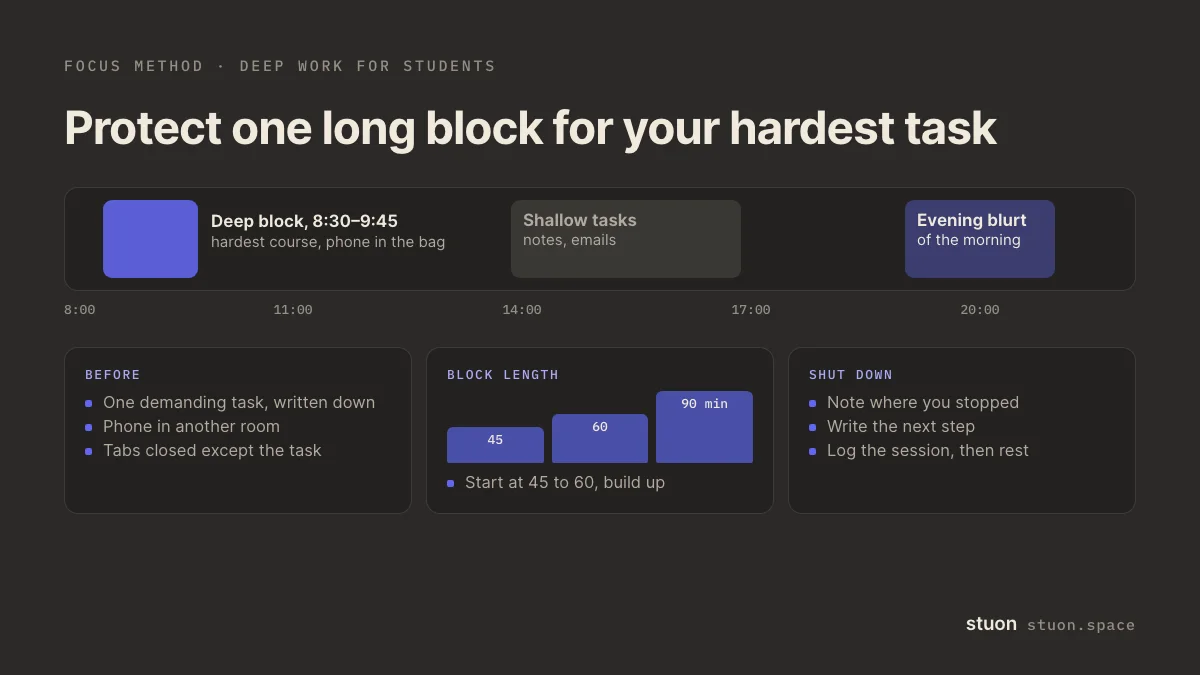
- Pick one demanding task. For example, "finish problems 5 to 12" or "draft the second section".
- Choose a time and place. Use the same slot daily if you can, in a place where you can study undisturbed.
- Remove distractions first. Phone in another room, notifications off, tabs closed except what the task needs.
- Set the block length. Start with 45 to 60 minutes and build toward 90. Start the study timer.
- Shut down on purpose. Write down where you stopped and what the next step is, then log the session.
When to use deep work
- Problem sets, proofs, coding, and essay drafting.
- Reading dense texts that need sustained attention.
- The part of the day when you have the most energy.
Benefits of deep work
- Hard work gets your best attention instead of leftovers.
- A set start and end makes it easier to rest without guilt.
- Fewer, longer blocks mean fewer restarts.
Common mistakes with deep work
- Starting with a three-hour block. Build up gradually.
- Keeping the phone nearby "just in case".
- Calling shallow tasks deep work, such as tidying notes.
- No breaks between blocks. Rest is part of the plan.
Deep work example
Monday to Thursday, 8:30 to 9:45: one deep block on the hardest course, phone in the bag.
After lunch: shallow tasks such as formatting notes and emails.
Evening: a short blurt of the morning's material.
Frequently asked questions
How long can I do deep work?
It depends on the person and the task, and it improves with practice. Start with 45 to 60 minutes.
Is deep work the same as the Pomodoro technique?
No. Pomodoro uses short blocks with scheduled breaks. Deep work uses longer blocks for demanding tasks. Both rely on a fixed start and end.
Do I need to turn off my phone?
Put it out of reach. Having it nearby makes it easier to check without noticing.
How do I track deep work sessions?
Log the start, the length and the task. A timer that records sessions, like the one in Stuon, does this for you.
Sources
- Cal Newport (2016), Deep Work: Rules for Focused Success in a Distracted World. Grand Central Publishing.
Related methods
Save your study sessions
This page does not store anything. In Stuon every session is logged and added to your streak and heatmap.
Save your study sessionsAdd to Chrome, freeor use the free version without an account