study method
Time blocking for students
what is time blocking?
Time blocking is a planning method where you give each task its own block of time on your calendar, such as "Tuesday 4 to 5 pm: chemistry past paper", instead of working from an open to-do list. The block decides what you do and when you stop.
by Vusal Imranli updated 10 Oct 20264 min read
How time blocking works
A to-do list tells you what to do but not when. Each time you sit down you have to choose, and the easy or urgent tasks tend to win. A time block makes the choice in advance. Cal Newport recommends blocking the whole working day in Deep Work (2016), and the idea fits students well because classes already fix part of the week.
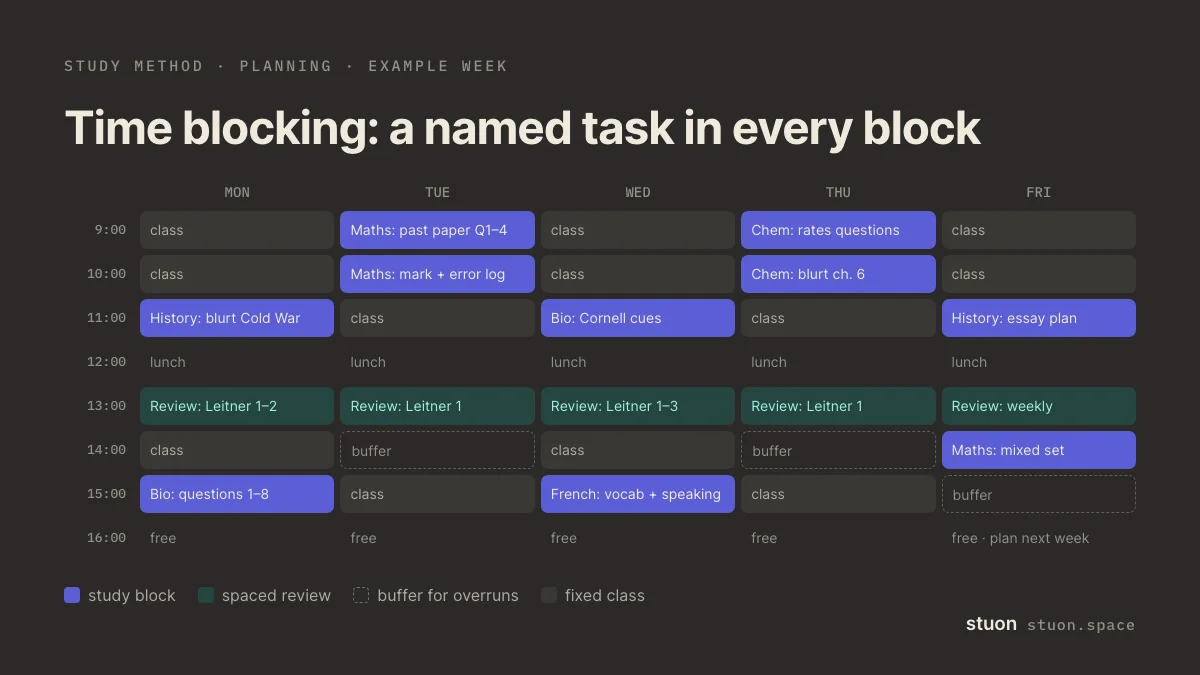
Two research findings support it. Plans that state when and where you will act, called implementation intentions, raise the chance that you follow through (Gollwitzer and Sheeran, 2006). And people tend to underestimate how long tasks take (Buehler, Griffin and Ross, 1994), which a calendar makes visible: if the blocks do not fit, the plan was unrealistic.
How to time block your study week, step by step
- Put fixed things in first. Classes, work shifts, travel, meals, sleep and sport. What is left is your real study time.
- List the week's study tasks. Be specific: "Biology: blurt chapter 4", not "Biology".
- Place the hardest tasks in your best hours. Give each task a block of 45 to 90 minutes. Put demanding work when you are most alert.
- Add review and buffer blocks. Leave a short review block for spaced repetition and one or two empty buffer blocks for overruns.
- Rebuild, do not abandon. When a block is missed, move the task to a buffer block the same day. At the end of the week, compare the plan with what happened.
When to use time blocking
- Weeks with several subjects competing for the same evenings.
- Revision periods, when there are no classes to structure the day.
- When you spend more time deciding what to study than studying.
Benefits of time blocking
- You stop negotiating with yourself every time you sit down.
- Weak subjects get time even when they are not urgent.
- A real schedule shows whether your plan fits the hours you have.
Common mistakes with time blocking
- Filling every hour. A plan with no buffer breaks on the first late bus.
- Making blocks vague, such as "study". Name the task and the method.
- Treating a missed block as failure and dropping the plan for the week.
- Blocking time but not protecting it. Silence your phone or use a website blocker.
Time blocking example
9:00 to 10:30, maths: one past-paper section, timed. 10:30 to 10:45, break.
10:45 to 12:00, history: blurt the causes of the Cold War, check, make five cards.
13:00 to 13:30, review block: Leitner boxes 1 and 2. 13:30 to 14:30, buffer.
15:00 to 16:00, chemistry: rates of reaction questions. Evening free.
The maths section runs 20 minutes over, so chemistry moves into the buffer and the evening stays free.
Time blocking with other methods
Inside a block, you can work in Pomodoro cycles or one long deep work session. Use the study session planner to split a block, or the revision timetable generator to draft the week.
Logging what you actually did in a study tracker closes the loop. After two or three weeks you will know how long a past paper or a chapter really takes, and your blocks become accurate. To decide what goes into the blocks first, use the Eisenhower matrix.
Frequently asked questions
How long should a time block be?
For study, 45 to 90 minutes suits most tasks. Shorter blocks of 25 to 30 minutes help on days when starting is hard.
What if I keep missing my blocks?
Your plan is probably too full. Block fewer hours, add buffers and compare with what you actually did last week.
Is time blocking the same as a timetable?
A school timetable is a time-block plan made for you. Time blocking means making your own for study outside class.
Should I time block weekends?
Block the study you plan to do and leave the rest unblocked. Rest is easier when study has a clear end time.
Paper or app?
Either. A calendar app can move blocks easily; paper is harder to ignore on a desk.
Sources
- Gollwitzer and Sheeran (2006), Implementation intentions and goal achievement: a meta-analysis of effects and processes. Advances in Experimental Social Psychology.
- Buehler, Griffin and Ross (1994), Exploring the "planning fallacy": why people underestimate their task completion times. Journal of Personality and Social Psychology.
- Cal Newport (2016), Deep Work: Rules for Focused Success in a Distracted World. Grand Central Publishing.
Related methods
Practice it, then keep a record
Stuon has a timer, a blurting space and flashcards, and it logs the time you spend on each.
Track this in StuonAdd to Chrome, freeor use the free version without an account