study method
The Eisenhower matrix for students
what is the Eisenhower matrix?
The Eisenhower matrix is a two-by-two grid for prioritising tasks. One axis asks whether a task is urgent, the other whether it is important. Do urgent and important tasks now, schedule important but not urgent ones, keep urgent but unimportant ones small, and drop the rest.
by Vusal Imranli updated 10 Oct 20264 min read
How the Eisenhower matrix works
The matrix is named after US President Dwight D. Eisenhower, who said in a 1954 speech, quoting a college president, that he had two kinds of problems, the urgent and the important, and that the urgent are not important and the important are never urgent. The grid was built on that line later by time-management writers.
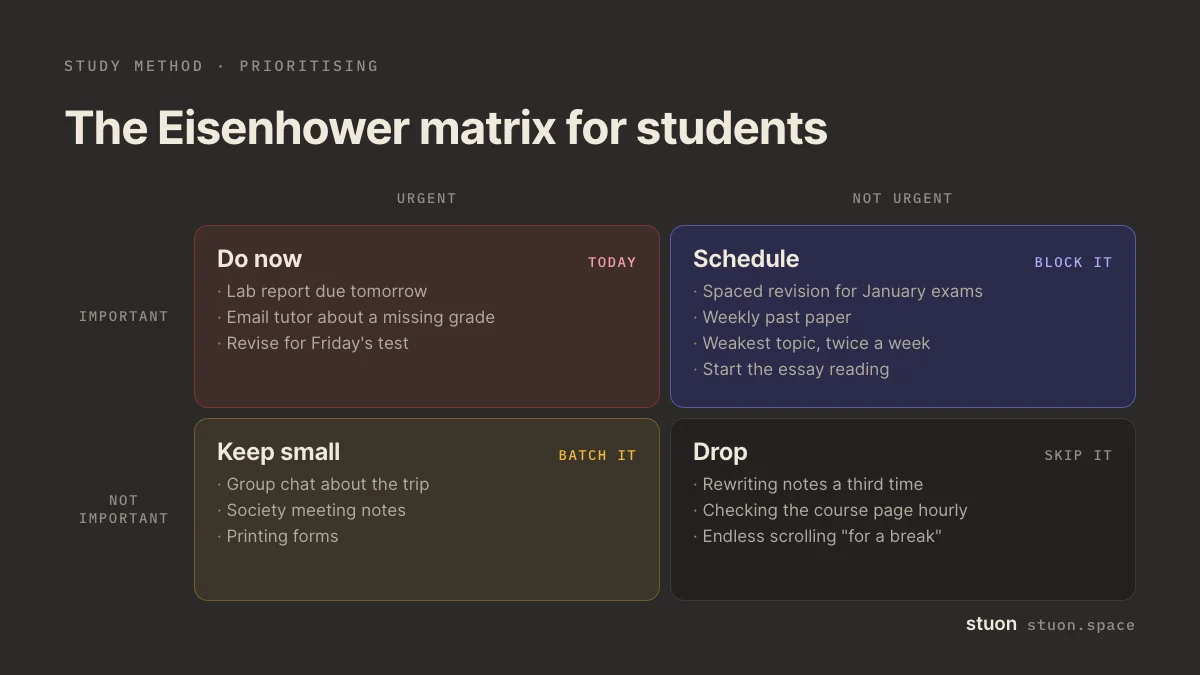
For students the key box is important but not urgent: spaced revision, practice papers and weak topics. These rarely feel pressing until the exam is close. Research on the "mere urgency effect" found that people often choose tasks with a short deadline over more valuable tasks without one (Zhu, Yang and Hsee, 2018). The matrix is a way to notice that pull.
How to use the Eisenhower matrix, step by step
- List everything. Write every task for the coming week: deadlines, revision, admin, messages, chores.
- Ask "important?" Important means it affects your grades or goals. Be honest: replying to the group chat rarely is.
- Ask "urgent?" Urgent means it has a deadline in the next day or two, or a cost if it waits.
- Place each task in a box. Do now (urgent and important). Schedule (important, not urgent). Keep small (urgent, not important). Drop (neither).
- Block the schedule box first. Put "important, not urgent" tasks into your calendar before the week fills up. See time blocking.
When to use the Eisenhower matrix
- At the start of each week, as a ten-minute planning step.
- When you feel busy all day but your revision is not moving.
- During exam season, when many small tasks compete with study.
Benefits of the Eisenhower matrix
- It separates feeling busy from making progress.
- Revision and weak topics get planned before they become emergencies.
- It makes it easier to say no to low-value tasks.
Common mistakes with the Eisenhower matrix
- Calling everything important. If every box is "do now", the grid is not helping.
- Using it only in a crisis. Its value is in planning the non-urgent box early.
- Leaving "schedule" tasks without a time. Give each one a block.
- Spending longer sorting than doing. Ten minutes a week is enough.
Eisenhower matrix example for a student
Do now: lab report due tomorrow; email the tutor about a missing grade.
Schedule: revise organic chemistry for January (two blocks a week); past paper on Saturday; start the essay reading.
Keep small: society meeting notes, group chat about the trip, printing forms. Ten minutes at the end of the day.
Drop: reorganising notes for the third time; checking the course page every hour.
Why the important box matters most for exams
Methods with the strongest evidence, such as spaced repetition and practice testing, need time spread over weeks. That is exactly the kind of task the urgent box crowds out. Treat the schedule box as your revision plan and protect it.
Pair the matrix with a weekly review of your study hours to check that important tasks really got time. If procrastination is the main problem, start each scheduled task with a short 5-minute timer. See Parkinson's law for why loose deadlines stretch work.
Frequently asked questions
What are the four quadrants of the Eisenhower matrix?
Urgent and important (do now), important but not urgent (schedule), urgent but not important (keep small or delegate), and neither (drop).
Did Eisenhower invent the matrix?
No. He spoke about urgent and important problems in a 1954 speech. The grid was developed later by time-management writers and named after him.
What does "delegate" mean for a student?
Usually it means do it quickly, batch it or ask for help, such as asking a classmate for a lecture link instead of searching for it.
How often should I use it?
Once a week to plan, and again on any day that feels overloaded.
Is revision urgent or important?
Important, and usually not urgent until the last weeks. That is why it needs to be scheduled on purpose.
Sources
- Dwight D. Eisenhower (1954), Address at the Second Assembly of the World Council of Churches, Evanston, Illinois. The American Presidency Project.
- Zhu, Yang and Hsee (2018), The mere urgency effect. Journal of Consumer Research.
- Gollwitzer and Sheeran (2006), Implementation intentions and goal achievement: a meta-analysis of effects and processes. Advances in Experimental Social Psychology.
Related methods
Practice it, then keep a record
Stuon has a timer, a blurting space and flashcards, and it logs the time you spend on each.
Track this in StuonAdd to Chrome, freeor use the free version without an account