study method
Elaborative interrogation
what is elaborative interrogation?
Elaborative interrogation is a study method in which you ask "why?" or "how?" about each fact you learn and try to explain the answer using what you already know. Linking a new fact to a reason makes it easier to remember than reading it alone.
by Vusal Imranli updated 10 Oct 20264 min read
How elaborative interrogation works
A bare fact has nothing to hold on to. When you ask why it is true, you connect it to things you already know, and that connection becomes a route back to the fact later. Pressley and colleagues (1987) found that people who answered why-questions about simple sentences remembered them better than people who only read the sentences.
Dunlosky et al. (2013) rated the method as moderate utility. It works best when you already know something about the topic, because the explanations come from prior knowledge. With a brand-new subject you may not have enough to explain with, and a wrong explanation can stick.
How to do elaborative interrogation, step by step
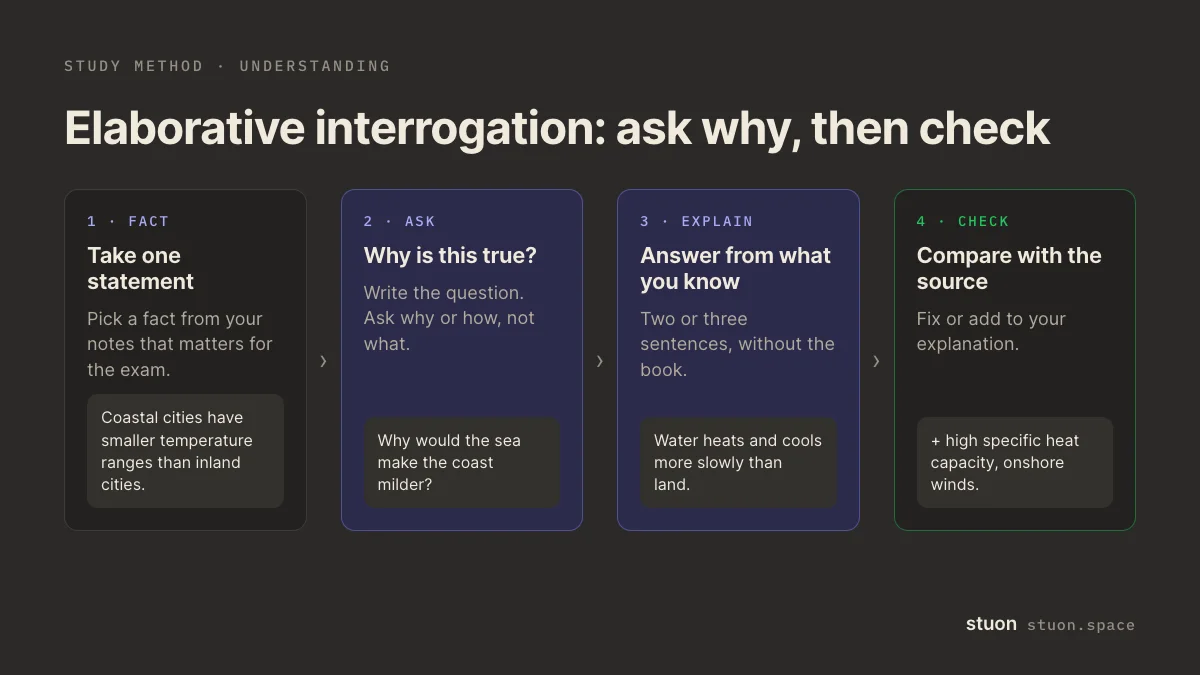
- Pick a fact. Take one statement from your notes, such as "Blood in veins has a lower pressure than blood in arteries."
- Ask why. Write "Why is this true?" or "Why would this be the case?" next to it.
- Answer without looking. Explain using what you already know. Write two or three sentences.
- Check the source. Compare with your textbook. Correct the explanation if it was wrong or incomplete.
- Move on and mix. Do the same for the next fact. Then ask how two facts relate: "Why do veins have valves but arteries mostly do not?"
When to use elaborative interrogation
- Factual subjects such as biology, geography, history and economics.
- Topics where you already know the basics and are adding detail.
- When facts feel arbitrary and keep slipping away.
Benefits of elaborative interrogation
- It turns lists of facts into connected explanations.
- It shows you quickly where your understanding is thin.
- It needs no materials beyond your notes.
Common mistakes with elaborative interrogation
- Accepting your first explanation without checking it.
- Asking "what" questions that only repeat the fact.
- Using it on a topic you know nothing about yet. Learn the basics first.
- Doing it for every line of a long text. Choose the facts that matter.
Elaborative interrogation example
Fact: "Coastal cities have smaller temperature ranges than inland cities at the same latitude."
Why? "Water heats and cools more slowly than land, so the sea keeps the coast cooler in summer and warmer in winter."
Check: the textbook adds that the ocean has a high specific heat capacity and that onshore winds carry the effect inland. You add both.
Linked question: "Why does Moscow have colder winters than London?" You answer from the same idea: distance from the sea.
Elaborative interrogation vs self-explanation
Self-explanation is a close relative. Instead of asking why a fact is true, you explain each step of a worked example or text as you read it: "This step uses the chain rule because...". Dunlosky et al. (2013) also rated it moderate utility.
Both methods are about understanding. Pair them with active recall for memory, and with the Feynman technique when you want to test whether you can explain a whole topic simply. See elaboration for the broader term.
Frequently asked questions
Is elaborative interrogation effective?
A major review rated it moderate utility: helpful for factual material, especially when you have some prior knowledge, with less evidence for complex tasks.
What questions should I ask?
"Why is this true?", "Why would this happen?", "How does this connect to what I already know?" and "Why this and not something else?"
How is it different from the Feynman technique?
Elaborative interrogation works fact by fact with why-questions. The Feynman technique explains a whole concept in plain words and looks for gaps.
Can it backfire?
If you never check your answers, a wrong explanation can stick. Always compare with a reliable source.
How long should I spend per fact?
A minute or two. The point is a short explanation, not an essay.
Sources
- Pressley, McDaniel, Turnure, Wood and Ahmad (1987), Generation and precision of elaboration: effects on intentional and incidental learning. Journal of Experimental Psychology: Learning, Memory, and Cognition.
- Dunlosky et al. (2013), Improving students' learning with effective learning techniques. Psychological Science in the Public Interest.
Related methods
Practice it, then keep a record
Stuon has a timer, a blurting space and flashcards, and it logs the time you spend on each.
Track this in StuonAdd to Chrome, freeor use the free version without an account