glossary
Metacognition: definition
what is metacognition?
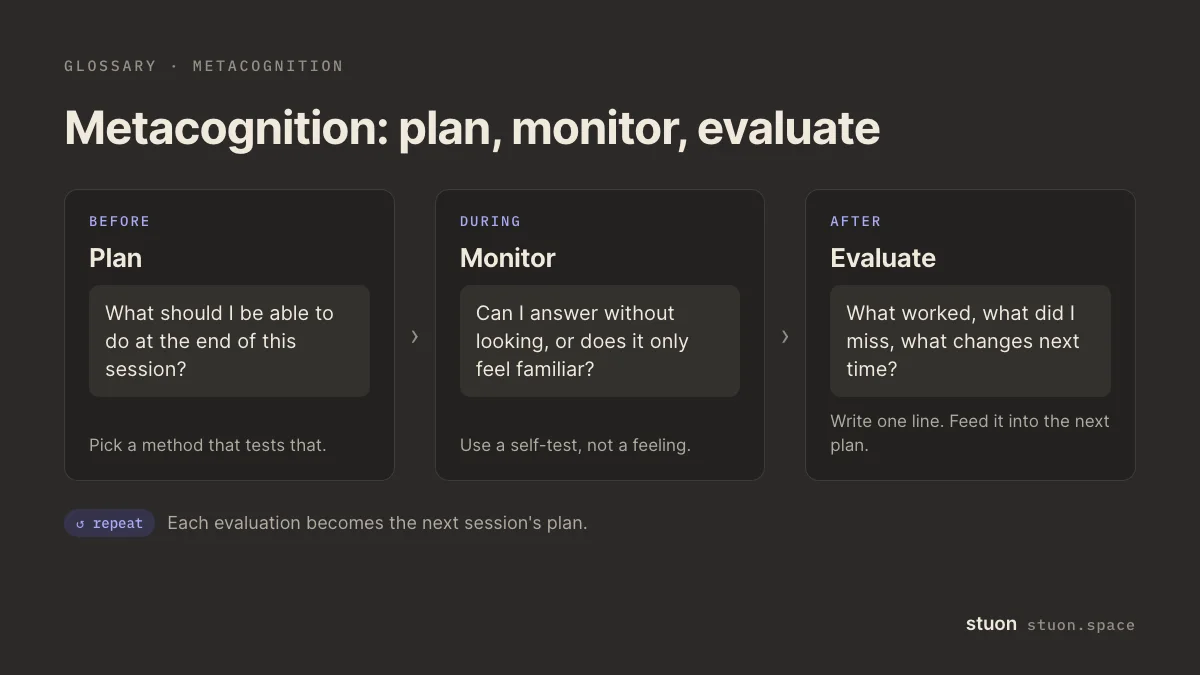
Metacognition is awareness and control of your own thinking: knowing what you know and do not know, and choosing how to study as a result. For students it shows up as planning a session, monitoring understanding while studying and evaluating what worked afterwards.
by Vusal Imranli updated 10 Oct 20262 min read
also called thinking about thinking, self-monitoring
Definition and example
The psychologist John Flavell (1979) described metacognition as knowledge about and regulation of one's own cognitive processes. A student who notices "I can follow this worked example but could not start the problem myself" and switches to practising without the example is using metacognition.
Why it matters
Students often misjudge what they know. Dunlosky and Rawson (2012) found that students who were overconfident about their answers stopped studying too early and remembered less on a later test. Accurate monitoring needs evidence, such as a self-test, not a feeling.
The confidence vs accuracy check lets you compare how sure you feel with how often you are right.
How to practise it
- Before: decide what you will be able to do at the end of the session.
- During: test yourself rather than asking "do I get this?"
- After: write one line about what worked and what to change.
Full guide: How to study effectively. Five habits that make the same hours count for more: recall, spacing, mixing, checking and focus.
Frequently asked questions
What is an example of metacognition?
Rating your confidence on each flashcard before flipping it, then checking which ratings were wrong.
Can metacognition be improved?
Yes, mainly by getting regular, honest feedback from self-tests instead of relying on how familiar material feels.
Sources
Related terms and guides
Practice it, then keep a record
Stuon has a timer, a blurting space and flashcards, and it logs the time you spend on each.
Track this in StuonAdd to Chrome, freeor use the free version without an account