guide
How to study effectively
how do you study effectively?
To study effectively, spend most of your time testing yourself instead of rereading, spread reviews of each topic over days and weeks, mix different problem types in practice, check your answers against a source, and study in focused blocks without your phone.
by Vusal Imranli updated 10 Oct 20264 min read
The study loop
Effective study is not a single trick. It is a loop you repeat for every topic: learn a small piece, recall it without notes, check what you missed, come back to it later, and mix it with other topics once it is familiar.
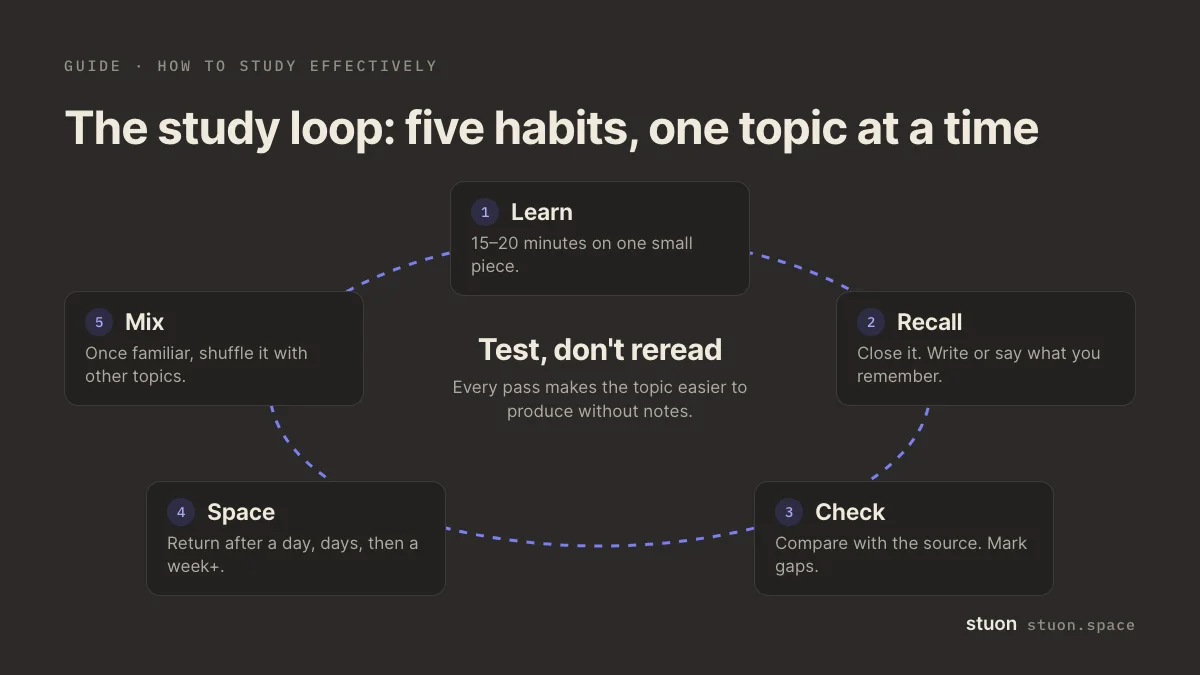
Each part of the loop has research behind it. Testing yourself beats rereading on delayed tests (Roediger and Karpicke, 2006). Spreading reviews over time beats massing them (Cepeda et al., 2006). Mixing problem types improves later test scores in maths (Rohrer and Taylor, 2007). A large review rated practice testing and spaced practice as the two most useful techniques it examined (Dunlosky et al., 2013).
Five habits, step by step
- Test before you feel ready. After 15 to 20 minutes of new material, close it and recall what you can. Use active recall, blurting or practice questions.
- Check every answer. Compare with the source and mark what was missing or wrong. Unchecked recall can lock in mistakes.
- Space the reviews. Return to the topic after a day, a few days and a week or more. A spaced repetition schedule or Leitner boxes make this automatic.
- Mix once it is familiar. In later reviews, shuffle problem types so you practise choosing the method. See interleaving.
- Protect the time. Study in blocks with your phone out of reach. Plan the blocks with time blocking.
What to stop doing
| Habit | Why it misleads | Swap it for |
|---|---|---|
| Rereading notes | Familiar text feels known even when you cannot produce it | Close the notes and recall |
| Highlighting | Marking text is not the same as learning it | Write a question for each key line |
| Cramming one topic for hours | Feels productive, fades fast | Shorter sessions spread over days |
| Only easy topics | Progress feels good but weak topics stay weak | Start each session with the weakest topic |
Dunlosky et al. (2013) rated rereading and highlighting as low utility.
Students often choose rereading because it feels easier. In one survey, most students said they reread notes and few said they tested themselves (Karpicke, Butler and Roediger, 2009). The feeling of fluency is the trap. See illusion of competence and how to stop fake studying.
A one-hour session that uses all five habits
- 0 to 5 min: recall last session's topic on a blank page. Check it.
- 5 to 30 min: learn one new section, then close it and recall.
- 30 to 35 min: check and mark gaps.
- 35 to 50 min: mixed practice questions from this week and last week.
- 50 to 60 min: review Leitner box 1 and plan tomorrow's first task.
Track the session in a study tracker so you can see whether reviews are actually happening. Want deeper reasons for each habit? See best study methods.
Frequently asked questions
What is the most effective way to study?
Practice testing spread over time. Test yourself on each topic, check your answers, and come back to it at growing intervals.
How long should I study each day?
It depends on your course and deadlines. See how many hours should I study for a way to set a number you can keep.
Is it better to study in the morning or at night?
There is no single best time for everyone. Put demanding work when you are most alert, and keep sleep regular.
Does rewriting notes help?
Rewriting from memory helps; copying from the page mostly does not. The useful part is the recall.
How do I know if my studying is working?
Test yourself a few days after studying, without notes. If you can answer, it is working. If you only recognise the material, add more recall.
Sources
- Roediger and Karpicke (2006), Test-enhanced learning: taking memory tests improves long-term retention. Psychological Science.
- Cepeda et al. (2006), Distributed practice in verbal recall tasks: a review and quantitative synthesis. Psychological Bulletin.
- Rohrer and Taylor (2007), The shuffling of mathematics problems improves learning. Instructional Science.
- Dunlosky et al. (2013), Improving students' learning with effective learning techniques. Psychological Science in the Public Interest.
- Karpicke, Butler and Roediger (2009), Metacognitive strategies in student learning: do students practise retrieval when they study on their own? Memory.
Related pages
Practice it, then keep a record
Stuon has a timer, a blurting space and flashcards, and it logs the time you spend on each.
Track this in StuonAdd to Chrome, freeor use the free version without an account