glossary
Working memory: definition
what is working memory?
Working memory is the limited system that holds and works with information you are using right now, such as the numbers in a sum or the start of a sentence you are reading. It can hold only a few items at once and loses them quickly without attention.
by Vusal Imranli updated 10 Oct 20262 min read
also called short-term memory (related)
Definition and model
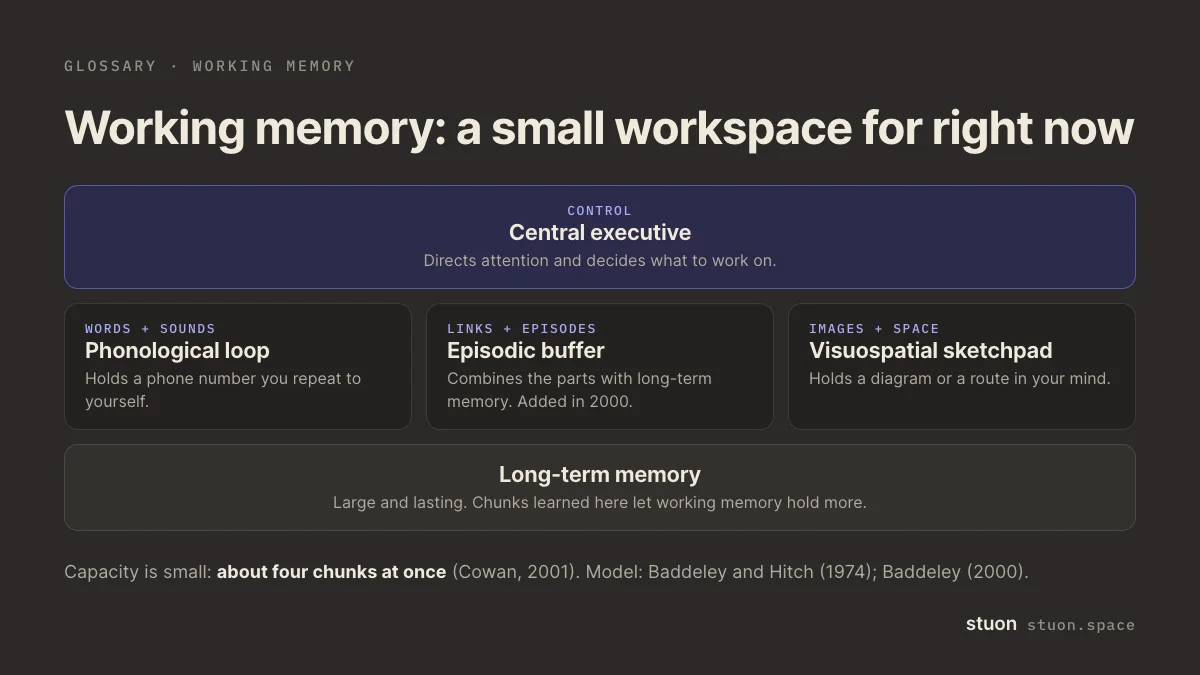
Baddeley and Hitch (1974) proposed a model with a central executive that directs attention and two stores: a phonological loop for sounds and words and a visuospatial sketchpad for images and space. Baddeley (2000) later added an episodic buffer that links them with long-term memory.
Its limits
Working memory capacity is small. Cowan (2001) argued that adults can hold about four chunks at once. What counts as a chunk depends on what you already know, which is why experts can handle more: they hold larger, meaningful units. See chunking.
What it means for studying
- Remove distractions; they take up the same small space (cognitive load).
- Write intermediate steps down instead of holding them in your head.
- Learn the parts of a topic before combining them.
- Practise basics until they become automatic.
Full guide: Chunking. Group small pieces of information into larger, meaningful units so they are easier to hold and recall.
Frequently asked questions
Is working memory the same as short-term memory?
They overlap. Short-term memory usually means holding information briefly; working memory also includes manipulating it.
Can you train working memory?
Training improves performance on the trained tasks, but reviews have found little transfer to unrelated skills such as school grades. See transfer of learning.
Sources
- Baddeley and Hitch (1974), Working memory. Psychology of Learning and Motivation, vol. 8.
- Baddeley (2000), The episodic buffer: a new component of working memory? Trends in Cognitive Sciences.
- Cowan (2001), The magical number 4 in short-term memory: a reconsideration of mental storage capacity. Behavioral and Brain Sciences.
Related terms and guides
Practice it, then keep a record
Stuon has a timer, a blurting space and flashcards, and it logs the time you spend on each.
Track this in StuonAdd to Chrome, freeor use the free version without an account