study method
Chunking as a study method
what is chunking?
Chunking is grouping separate pieces of information into larger units that mean something to you, so you can hold and recall more at once. A phone number split into three groups, or a formula you know as one idea, are both chunks.
by Vusal Imranli updated 10 Oct 20264 min read
How chunking works
Working memory, the part of the mind that holds what you are thinking about right now, can only hold a few things at a time. George Miller (1956) suggested about seven items; later work by Nelson Cowan (2001) suggests closer to four chunks. The trick is that a chunk can be large. Once a group of items means something, it takes up roughly one slot.
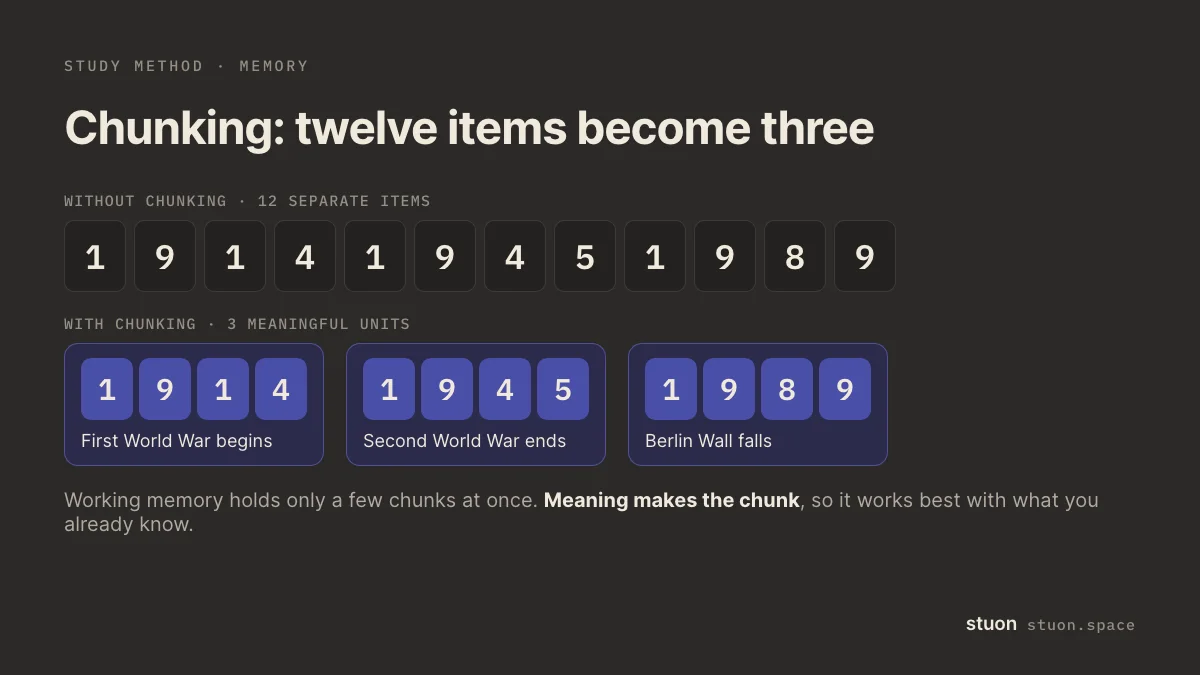
Expertise is largely a store of chunks. Chase and Simon (1973) found that chess masters could recreate a game position after a brief look far better than beginners, but not a board with pieces placed at random. The masters saw familiar patterns, not 25 separate pieces.
For students this means two things. First, break a new topic into a few meaningful groups instead of a long flat list. Second, practise until steps fuse together, so they stop competing for space in working memory.
How to chunk a topic, step by step
- List the pieces. Write down every fact, step or term in the topic, in any order.
- Find the groups. Sort them into three to five groups that share a meaning: causes, effects, stages, types. Give each group a short label.
- Learn one group at a time. Study a group until you can recall it from its label without notes.
- Link the groups. Ask how the groups connect. Causes lead to events; stages follow each other. Write one sentence per link.
- Practise until it fuses. Recall the whole topic from the labels. With repetition, a group becomes one idea you can use without thinking about its parts.
When to use chunking
- A new topic that feels like a long, flat list of facts.
- Multi-step procedures in maths, chemistry or programming.
- Vocabulary, where words can be grouped by root, theme or sound.
Benefits of chunking
- It makes large topics feel smaller and more structured.
- Group labels become cues for active recall.
- It frees working memory for the hard part of a problem.
Common mistakes with chunking
- Grouping by appearance, such as page order, instead of by meaning.
- Making groups too big. If you cannot recall a group from its label, split it.
- Expecting chunks to form from reading alone. They form through practice.
- Forgetting to link the groups, so you know parts but not the whole.
Chunking examples
Flat list: Franz Ferdinand, Triple Entente, naval race, Schlieffen Plan, Balkan wars, nationalism, Triple Alliance, colonies, mobilisation timetables.
Chunked: Alliances (Triple Entente, Triple Alliance). Rivalry (naval race, colonies). Nationalism (Balkan wars, Serbian nationalism). Trigger (assassination of Franz Ferdinand). Military plans (Schlieffen Plan, mobilisation timetables).
You recall the five labels first, then fill in each group. A gap in "Military plans" is easy to spot because the group is visibly thin.
Chunking your study time
The word is also used for splitting work into short sessions. That is a different idea, closer to the Pomodoro technique or time blocking. Both help, but this page is about chunking information.
Chunked topics fit well on a mind map: the labels become branches. They also suit a memory palace when the groups must be recalled in order. See cognitive load for why fewer, larger units are easier to work with.
Frequently asked questions
What is an example of chunking?
Remembering 0-7-9-1-2-3-4-5-6-7-8 as "079 123 45678" or, better, as numbers that mean something to you.
How many chunks can I remember?
Research suggests working memory holds about four chunks at once for most adults. The size of each chunk grows as you learn.
Is chunking the same as breaking work into parts?
Not quite. Breaking work into parts is a planning idea. Chunking in memory research means grouping information into meaningful units.
Does chunking work for maths?
Yes. A method you have practised, such as completing the square, becomes one chunk, which leaves room to think about the rest of the problem.
How do I know a chunk has formed?
You can recall or use the group from its label without listing each part, and it no longer feels like several things.
Sources
- Miller (1956), The magical number seven, plus or minus two: some limits on our capacity for processing information. Psychological Review.
- Cowan (2001), The magical number 4 in short-term memory: a reconsideration of mental storage capacity. Behavioral and Brain Sciences.
- Chase and Simon (1973), Perception in chess. Cognitive Psychology.
Related methods
Practice it, then keep a record
Stuon has a timer, a blurting space and flashcards, and it logs the time you spend on each.
Track this in StuonAdd to Chrome, freeor use the free version without an account