study method
Dual coding
what is dual coding?
Dual coding is a study method in which you combine words with visuals, such as diagrams, timelines or flowcharts, so the same idea is stored in two forms. It comes from Allan Paivio's dual coding theory, which proposes separate verbal and visual systems in memory.
by Vusal Imranli updated 10 Oct 20264 min read
How dual coding works
Paivio's theory proposes that memory has a verbal system and a visual system. An idea that is stored in both has two routes back to it. Clark and Paivio (1991) set out how this applies to teaching: concrete words, pictures and diagrams tend to be remembered better than abstract words alone.
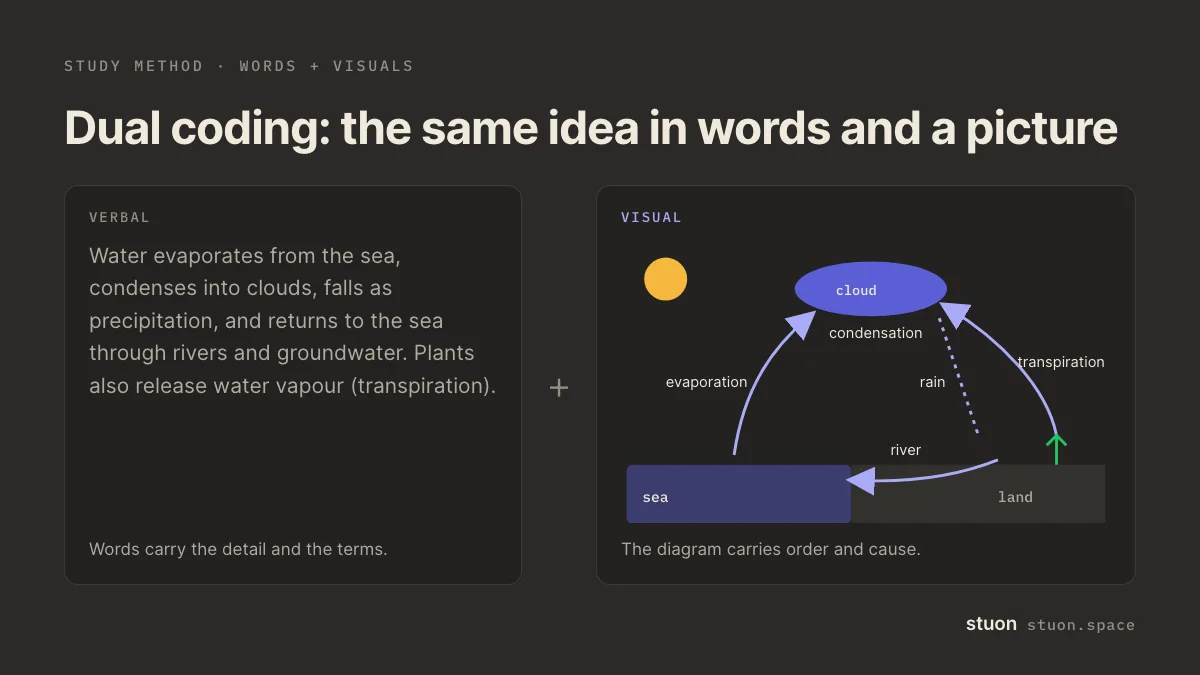
Research on multimedia learning points the same way. In Mayer and Anderson (1991), students who saw an animation with spoken narration at the same time did better on problem-solving questions than students who got words alone. The visual has to carry meaning: arrows for cause, positions for order, sizes for amount.
Dual coding is not the same as "learning styles". The idea that each person learns best in a preferred mode, visual or verbal, has little support. Dual coding says that most people benefit from both forms together.
How to use dual coding, step by step
- Pick a topic with structure. Processes, cycles, timelines, comparisons and hierarchies work best.
- Choose a visual form. Flowchart for a process, timeline for events, table for comparison, labelled diagram for a structure.
- Draw it from your notes. Keep it plain: boxes, arrows and short labels. No colouring yet.
- Explain it in words. Say or write what each part shows. The words and the drawing should match.
- Redraw from memory. Later, draw the visual and explain it without notes. Check and fix. This adds recall to dual coding.
When to use dual coding
- Sciences with processes and structures, such as biology and chemistry.
- History and literature timelines, and essay plans.
- Any topic where you keep confusing the order or relationships of ideas.
Benefits of dual coding
- Relationships that are hard to describe become easy to see.
- A sketch is a fast way to test yourself: draw it blank, then label it.
- It makes notes shorter and easier to review.
Common mistakes with dual coding
- Spending an hour making a beautiful page. Time spent decorating is not time spent learning.
- Adding pictures that do not show anything, such as clip art next to a definition.
- Copying a diagram from the book without explaining it.
- Treating it as a learning style. It is for everyone, not only "visual learners".
Dual coding example
Words: "Water evaporates from the sea, condenses into clouds, falls as precipitation and returns by rivers and groundwater."
Visual: a sun, the sea, an arrow up labelled evaporation, a cloud labelled condensation, rain labelled precipitation, and a river arrow back to the sea.
Recall: next day you draw the cycle from memory and explain each arrow aloud. You forget transpiration from plants, so you add that branch.
Simple visuals to start with
- Flowchart: steps and decisions in a process.
- Timeline: dates and the order of events.
- Two-column table: compare two theories or two periods.
- Labelled diagram: parts of a cell, an engine or a circuit.
- Concept map: a central idea with linked sub-ideas, as in mind mapping.
Combine dual coding with active recall: draw from memory, then check. For why too many visuals at once can hurt, see cognitive load.
Frequently asked questions
Is dual coding the same as learning styles?
No. Learning styles claims people learn best in one preferred mode, which has little evidence. Dual coding claims words and visuals together help most learners.
Do I need to be good at drawing?
No. Boxes, arrows, stick figures and short labels are enough.
Does dual coding work for maths?
Yes. Graphs, number lines, area models and diagrams for word problems are all dual coding.
Is highlighting in colours dual coding?
No. Colour on its own does not add a visual representation of the idea. A diagram or timeline does.
Who came up with dual coding?
The psychologist Allan Paivio developed dual coding theory from the late 1960s onwards.
Sources
- Clark and Paivio (1991), Dual coding theory and education. Educational Psychology Review.
- Mayer and Anderson (1991), Animations need narrations: an experimental test of a dual-coding hypothesis. Journal of Educational Psychology.
- Dunlosky et al. (2013), Improving students' learning with effective learning techniques. Psychological Science in the Public Interest.
Related methods
Practice it, then keep a record
Stuon has a timer, a blurting space and flashcards, and it logs the time you spend on each.
Track this in StuonAdd to Chrome, freeor use the free version without an account