study method
SQ3R reading method
what is the SQ3R method?
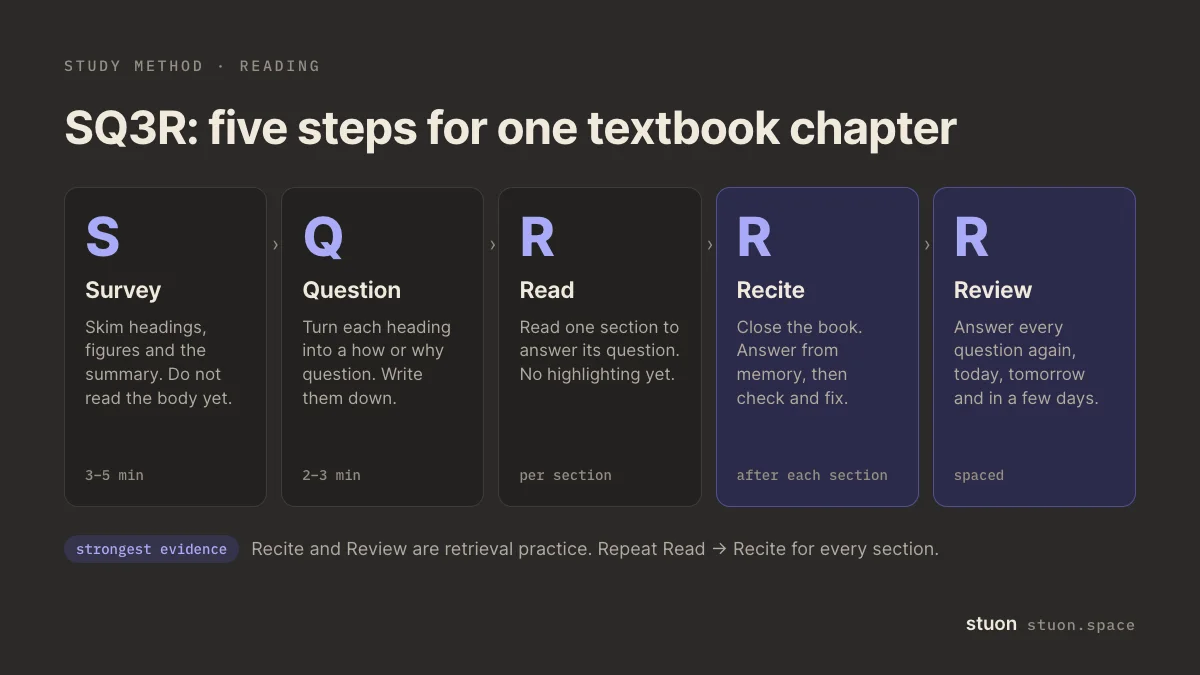
SQ3R is a reading method with five steps: Survey the chapter, turn headings into Questions, Read to answer them, Recite the answers from memory, and Review the whole chapter later. Francis Robinson described it in 1946 to help students learn from textbooks.
by Vusal Imranli updated 10 Oct 20265 min read
How SQ3R works
Most students read a chapter from the first line to the last and hope it sticks. SQ3R changes the order. You look at the shape of the chapter before reading, you read with questions in mind, and you stop after each section to say the answers without looking.
The Recite and Review steps are the strongest part of the method. They are forms of retrieval practice, which has good experimental support (Roediger and Karpicke, 2006). The Survey and Question steps help you notice structure and stay alert while reading.
Be honest about the evidence. Very few studies test SQ3R as a whole, and Robinson's own trials were small (The Learning Scientists, 2021). One classroom study found that students who used SQ3R-style note packets scored higher on course exams (Carlston, 2011), but it was not a controlled trial of each step.
How to use SQ3R, step by step
- Survey (3 to 5 minutes). Skim the title, the introduction, every heading, the figures and the summary. Do not read the body yet.
- Question. Turn each heading into a question. "Causes of inflation" becomes "What causes inflation?" Write the questions down.
- Read one section. Read to answer that section's question. Mark nothing until you have finished the section.
- Recite. Close the book and answer the question aloud or on paper. Check, fix what you missed, then move to the next section.
- Review. At the end, answer every question again from memory. Repeat the review the next day and a few days later.
When to use SQ3R
- Textbook chapters and long readings with clear headings.
- Courses where the exam tests what is in the set reading.
- When you notice you finish a chapter and cannot say what it was about.
Benefits of SQ3R
- It turns passive reading into a series of small self-tests.
- The written questions become a ready review sheet for later.
- Surveying first makes long chapters feel less shapeless.
Common mistakes with SQ3R
- Spending 20 minutes on the survey. It is a skim, not a first read.
- Skipping Recite because the section "made sense". Making sense is not the same as being able to say it.
- Writing questions that copy the heading word for word. Ask how, why and what-if questions.
- Doing Review only once. Space the reviews out, as in spaced repetition.
SQ3R example
Survey: headings are "Sensory memory", "Working memory", "Long-term memory" and "Forgetting". A diagram shows boxes with arrows.
Questions: "How long does sensory memory last?", "Why is working memory limited?", "What moves information into long-term memory?", "Why do we forget?"
Read and Recite: after "Working memory" you close the book and say "a few items at a time, it fades without rehearsal". You check and add the missing detail about chunking.
Review: the next morning you answer all four questions on a blank page. Two answers are thin, so those sections go on tomorrow's list.
SQ3R, PQ4R and other variants
Later versions add steps. PQ4R is Preview, Question, Read, Reflect, Recite, Review. The extra Reflect step asks you to connect the text to what you already know, which is close to elaborative interrogation. The core is the same: read with questions, then answer them without the book.
If you want a lighter version, keep only three steps: read a section, close the book and recall it, then check. That is the part with the strongest evidence. The how to study a textbook guide shows a full chapter plan built this way.
Frequently asked questions
What does SQ3R stand for?
Survey, Question, Read, Recite, Review. Some versions use "Recall" or "Recite" for the fourth step; both mean answering from memory.
Is SQ3R effective?
Direct tests of SQ3R are few and small. Its Recite and Review steps are forms of retrieval practice, which is well supported, so it is a reasonable method if you do those steps properly.
How long does SQ3R take?
Longer than a single read-through, often by a third or more for the first chapter. The time is spent testing yourself, which saves rereading later.
Can I use SQ3R for online articles or PDFs?
Yes, if they have headings. For text without headings, make your own questions from the first sentence of each paragraph.
What is the difference between SQ3R and active recall?
SQ3R is a reading routine. Active recall is the habit of testing yourself from memory, which SQ3R uses in its last two steps.
Sources
- Francis P. Robinson (1946), Effective Study. Harper and Brothers. Original description of SQ3R.
- The Learning Scientists (2021), SQ3R or Read, Recite, Review? Blog post reviewing the evidence for SQ3R.
- Carlston (2011), Benefits of student-generated note packets: a preliminary investigation of SQ3R implementation. Teaching of Psychology.
- Roediger and Karpicke (2006), Test-enhanced learning: taking memory tests improves long-term retention. Psychological Science.
- Dunlosky et al. (2013), Improving students' learning with effective learning techniques. Psychological Science in the Public Interest.
Related methods
Practice it, then keep a record
Stuon has a timer, a blurting space and flashcards, and it logs the time you spend on each.
Track this in StuonAdd to Chrome, freeor use the free version without an account