glossary
Desirable difficulties: definition
what is desirable difficulties?
Desirable difficulties are study conditions that make learning feel slower or harder at the time but improve long-term memory and transfer. Robert and Elizabeth Bjork use the term for techniques such as spacing, self-testing, interleaving and varying practice conditions.
by Vusal Imranli updated 10 Oct 20262 min read
Definition and examples
Bjork and Bjork (2011) point out that performance during study is a poor guide to learning. Conditions that make practice look smooth, such as rereading or blocked repetition, can leave little behind. Conditions that create effort, such as recalling from memory or mixing problem types, often lead to better results later.
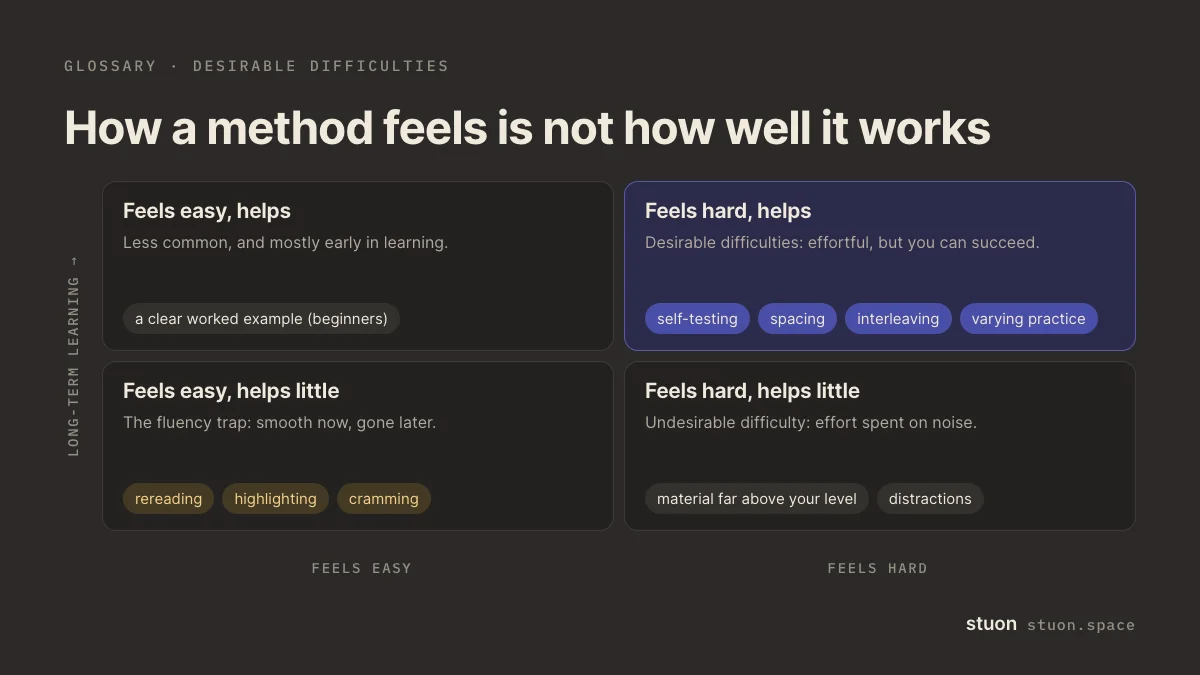
Desirable vs undesirable
Not every difficulty helps. A difficulty is desirable when you can still respond to it successfully, for example by retrieving an answer with some effort. Material far beyond your level, unclear instructions or a noisy room make study harder without making it better.
What it means for studying
- Test yourself instead of rereading (testing effect).
- Spread sessions out (spacing effect).
- Mix problem types once each is familiar (interleaving).
- Judge a method by a test days later, not by how it felt.
Full guide: Best study methods. Which study methods have the strongest evidence, and how to combine them.
Frequently asked questions
Who coined the term desirable difficulties?
Robert A. Bjork, a psychologist at UCLA, introduced it in the 1990s.
Does harder always mean better?
No. The difficulty has to be one you can overcome with effort. Material that is simply too hard does not help.
Sources
Related terms and guides
Practice it, then keep a record
Stuon has a timer, a blurting space and flashcards, and it logs the time you spend on each.
Track this in StuonAdd to Chrome, freeor use the free version without an account