exam plan
GRE study plan
how do you make a GRE study plan?
Start with an official practice test, then split each week between Quantitative Reasoning review, Verbal Reasoning practice with spaced vocabulary review, and one timed Analyze an Issue essay. Log every miss and retry it days later. In the last weeks, take full timed practice tests and review each one in detail.
by Vusal Imranli updated 10 Oct 20265 min read
What the GRE tests
| Section | Questions | Minutes | Score |
|---|---|---|---|
| Analytical Writing (always first) | 1 Analyze an Issue task | 30 | 0 to 6, in half points |
| Verbal Reasoning, section 1 | 12 | 18 | 130 to 170 for both sections together |
| Verbal Reasoning, section 2 | 15 | 23 | |
| Quantitative Reasoning, section 1 | 12 | 21 | 130 to 170 for both sections together |
| Quantitative Reasoning, section 2 | 15 | 26 |
ETS gives the total testing time as about 1 hour and 58 minutes. Verbal and Quant are scored in 1-point steps. Check the ETS GRE test structure page for current details before you plan.
How to build a GRE study plan
- Take an official practice test. ETS publishes free POWERPREP practice tests. Take one timed, in one sitting, as the baseline.
- Split Quant into topics. Arithmetic, algebra, geometry and data analysis. Rate each one weak, unsure or secure, and start with the weak ones.
- Learn vocabulary in sentences. Verbal questions test words in context. Make cards with a sentence for each word, test yourself and review on a schedule. See spaced repetition.
- Write one Issue essay a week. Under 30 minutes, from an official prompt. Compare it with the scored sample responses ETS publishes.
- Keep an error log. For each miss, note the question type and why you missed it. Retry the question after a few days.
- Practise timed sections. Sections are short, so pace matters. In the second half of the plan, do every set under section timing.
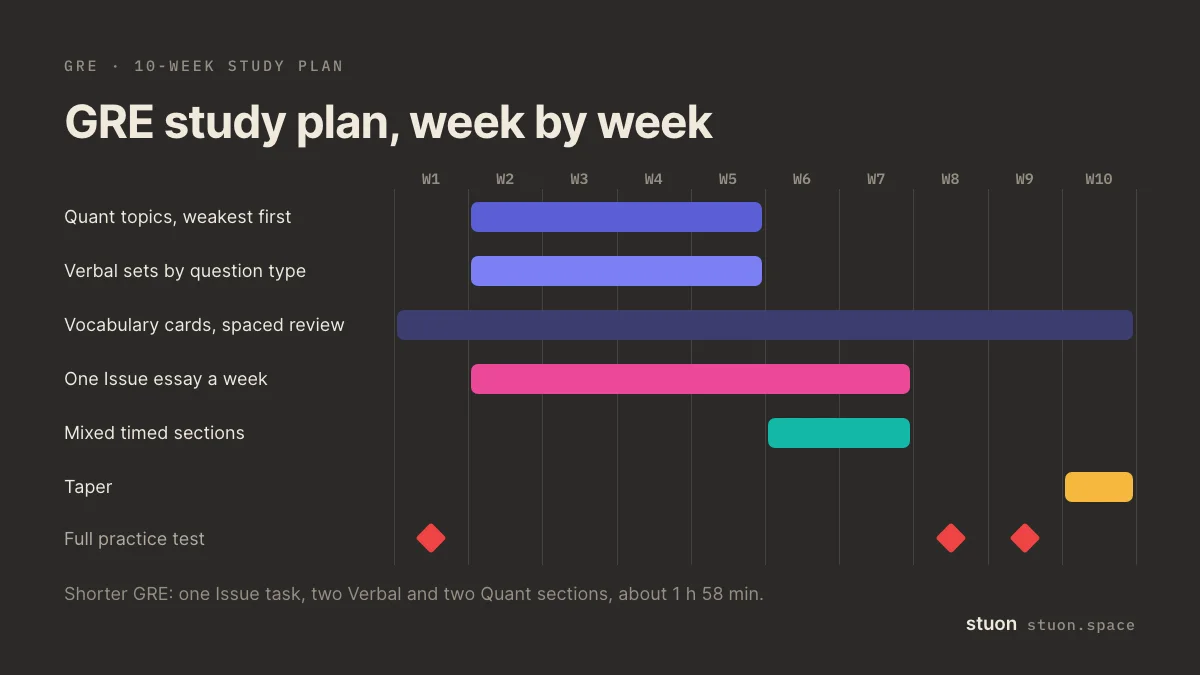
A 10-week GRE schedule
| Weeks | Focus | Main activities |
|---|---|---|
| Week 1 | Baseline | POWERPREP test, topic list for Quant, start the vocabulary deck and the error log |
| Weeks 2 to 5 | Content | Quant topics from weakest up, Verbal sets by question type, daily vocabulary review, one Issue essay a week |
| Weeks 6 to 7 | Mixed timed sets | Mixed Verbal and Quant sets under section timing, retry logged mistakes, keep the essay and cards going |
| Weeks 8 to 9 | Full tests | One full timed practice test a week, a full review after each, targeted sets on new weak spots |
| Week 10 | Taper | Short timed sections, card review, a light final two days |
With six weeks, keep the order: baseline, content, timed sets, then full tests.
How many hours to plan
Set the weekly total from your test date and your current scores, as described in how many hours should I study. The study hours calculator turns hours per day into weekly and total hours.
| Per week | 6 weeks | 10 weeks | 14 weeks |
|---|---|---|---|
| 5 h | 30 h | 50 h | 70 h |
| 10 h | 60 h | 100 h | 140 h |
| 15 h | 90 h | 150 h | 210 h |
| 20 h | 120 h | 200 h | 280 h |
This is multiplication, not a recommendation. It assumes you study every planned week. Choose hours from your starting level and test date, then check them against a log.
Log what you actually do with a study time tracker. A plan of ten hours a week is only useful if the log shows ten hours.
Common GRE study mistakes
- Memorising long word lists without context. Learn each word in a sentence and test yourself on it.
- Leaving the essay until the last week. It is scored on its own scale and needs practice under time.
- Doing Quant review without timed practice. Knowing the method is not the same as solving under the clock.
- Using every official practice test early. Keep at least one for the final weeks.
Short sections change the plan
The current GRE is shorter than the older version, and each section is short too. Endurance matters less than pace and accuracy: losing two minutes on one hard question costs a larger share of an 18-minute section than of a long one. Practise skipping and coming back within a section.
Vocabulary is a good fit for spaced repetition because it is many small facts. Ten to fifteen minutes of card review a day keeps it moving while most of your hours go to question practice.
Frequently asked questions
How long is the GRE now?
ETS gives the total testing time as about 1 hour and 58 minutes: one 30-minute Issue task, two Verbal sections and two Quant sections.
Is there still an Argument essay on the GRE?
No. Analytical Writing is now one Analyze an Issue task of 30 minutes, scored from 0 to 6.
How long should I study for the GRE?
It depends on your baseline and target scores. Take a practice test first and set weeks and hours from the gap. The schedule here uses ten weeks as an example.
How do I track GRE study hours?
Log sessions as Verbal, Quant or Writing with a study timer and check the weekly split in a study tracker.
Sources
- ETS, GRE General Test structure (sections, questions and timing).
- ETS, GRE General Test scoring (score scales).
- Dunlosky et al. (2013), Improving students' learning with effective learning techniques. Psychological Science in the Public Interest.
- Cepeda et al. (2006), Distributed practice in verbal recall tasks: a review and quantitative synthesis. Psychological Bulletin.
More on Stuon about this topic
Related pages
Turn your study time into progress
Levels, streaks and a heatmap give your hours a visible shape.
Turn your study time into progressAdd to Chrome, freeor use the free version without an account