exam plan
GMAT study plan
how do you make a GMAT study plan?
Take an official practice exam, then rotate through the three sections every week: Quantitative Reasoning, Verbal Reasoning and Data Insights. Each section is 45 minutes, so practise in timed sets from early on. Keep an error log by question type, retry misses after a few days, and take full practice exams in the last weeks.
by Vusal Imranli updated 10 Oct 20265 min read
What the GMAT tests
| Section | Questions | Minutes | Score |
|---|---|---|---|
| Quantitative Reasoning | 21 | 45 | 60 to 90 |
| Verbal Reasoning | 23 | 45 | 60 to 90 |
| Data Insights | 20 | 45 | 60 to 90 |
| Total | 64 | 135 | 205 to 805 |
This is the GMAT Focus Edition, now the only version: GMAC ended the previous edition on 31 January 2024. Totals in the table are the sums of the section rows. Check GMAC for current details before you plan.
How to build a GMAT study plan
- Take an official practice exam. Use GMAC's official practice exams as the baseline. Note the score per section and where time ran short.
- Make an error log by question type. Quant problem solving, critical reasoning, reading comprehension and the Data Insights types. Record the reason for every miss.
- Rebuild Quant fundamentals. Arithmetic and algebra underpin the section. Learn the method you missed, then do a short timed set that uses it.
- Practise Data Insights early. Its formats, such as tables and graphics, are unfamiliar to most people. Start them in week 2, not at the end.
- Read arguments actively. For critical reasoning, state the conclusion and the assumption in your own words before reading the answers.
- Retry, then mix. Redo logged questions after a few days. In later weeks, mix question types so you have to identify each one. See interleaving.
A 10-week GMAT schedule
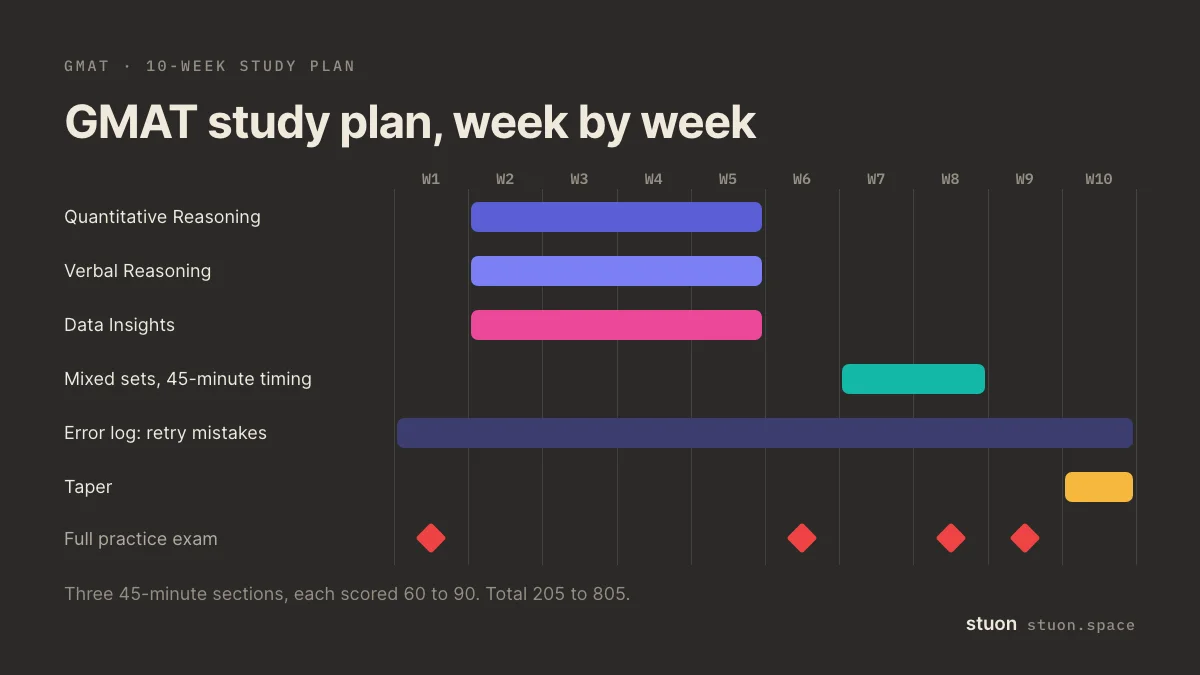
| Weeks | Focus | Main activities |
|---|---|---|
| Week 1 | Baseline | Official practice exam, error log, rank the question types from weakest |
| Weeks 2 to 5 | Section rotation | Two Quant, two Verbal and two Data Insights sessions a week, short timed sets, retry logged mistakes |
| Week 6 | First checkpoint | Full practice exam, a full review, update the weak list |
| Weeks 7 to 8 | Mixed and timed | Mixed sets across types under 45-minute section timing, practice exam at the end of week 8 |
| Weeks 9 to 10 | Simulate and taper | One more practice exam, error-log review, short sets, a light final two days |
With six weeks, cut the rotation to three weeks and keep two practice exams.
How many hours to plan
Set the weekly total from your test date and your current scores, as described in how many hours should I study. The study hours calculator turns hours per day into weekly and total hours.
| Per week | 6 weeks | 10 weeks | 14 weeks |
|---|---|---|---|
| 5 h | 30 h | 50 h | 70 h |
| 10 h | 60 h | 100 h | 140 h |
| 15 h | 90 h | 150 h | 210 h |
| 20 h | 120 h | 200 h | 280 h |
This is multiplication, not a recommendation. It assumes you study every planned week. Choose hours from your starting level and test date, then check them against a log.
Log what you actually do with a study time tracker. A plan of ten hours a week is only useful if the log shows ten hours.
Common GMAT study mistakes
- Studying from material written for the previous GMAT. It had different sections, so check that your material matches the current exam.
- Ignoring Data Insights because it feels like a mix of the other two. It has its own formats and needs its own practice.
- Working untimed for weeks. At 45 minutes for about 20 questions, pace is part of the skill.
- Taking practice exams without a review. Spend at least as long reviewing as the exam took.
Balancing three equal sections
Each section has the same length and the same score range, so none can be skipped. A simple rule: every week has at least two sessions of each section, and the extra sessions go to the weakest one on your latest practice exam.
Plan the sessions in the weekly study planner and log what you actually did with a study time tracker. If one section keeps losing its sessions, move it to your best time of day.
Frequently asked questions
Is the GMAT Focus Edition the only GMAT now?
Yes. GMAC ended the previous edition on 31 January 2024. The current exam has three sections: Quantitative Reasoning, Verbal Reasoning and Data Insights.
What is the GMAT score range?
The total score runs from 205 to 805, and each section is scored from 60 to 90.
How long should I study for the GMAT?
It depends on your baseline, your target and how many hours a week you have next to work. Take a practice exam first, then set weeks and hours from the gap.
How do I track GMAT study hours?
Log each session by section with a study timer. The study heatmap shows whether you kept a steady weekly routine.
Sources
- GMAC, GMAT Focus Edition exam scores (sections, questions, timing and score scales).
- GMAC, GMAT Focus Edition becomes the only edition (press release).
- Dunlosky et al. (2013), Improving students' learning with effective learning techniques. Psychological Science in the Public Interest.
- Cepeda et al. (2006), Distributed practice in verbal recall tasks: a review and quantitative synthesis. Psychological Bulletin.
More on Stuon about this topic
Related pages
Turn your study time into progress
Levels, streaks and a heatmap give your hours a visible shape.
Turn your study time into progressAdd to Chrome, freeor use the free version without an account