guide
How to revise for GCSEs
how should you revise for GCSEs?
To revise for GCSEs, download each subject's specification, list every topic and rate it red, amber or green. Revise weak topics first with active recall and flashcards, return to each topic on a spaced schedule, and in the final weeks practise full past papers marked with the official mark scheme.
by Vusal Imranli updated 10 Oct 20264 min read
Start with the specification, not your notes
Every GCSE has a specification published by its exam board, such as AQA, Pearson Edexcel, OCR or WJEC Eduqas. It lists everything that can be examined. Check with your teacher which board and which tier you are sitting, then download the specification and the past papers from the board's website.
Turn each specification into a checklist. Rate each topic red (cannot explain it), amber (shaky) or green (could answer an exam question now). This list is your revision plan. GCSEs in England are graded 9 to 1, with 9 the highest (GOV.UK).
A revision timeline
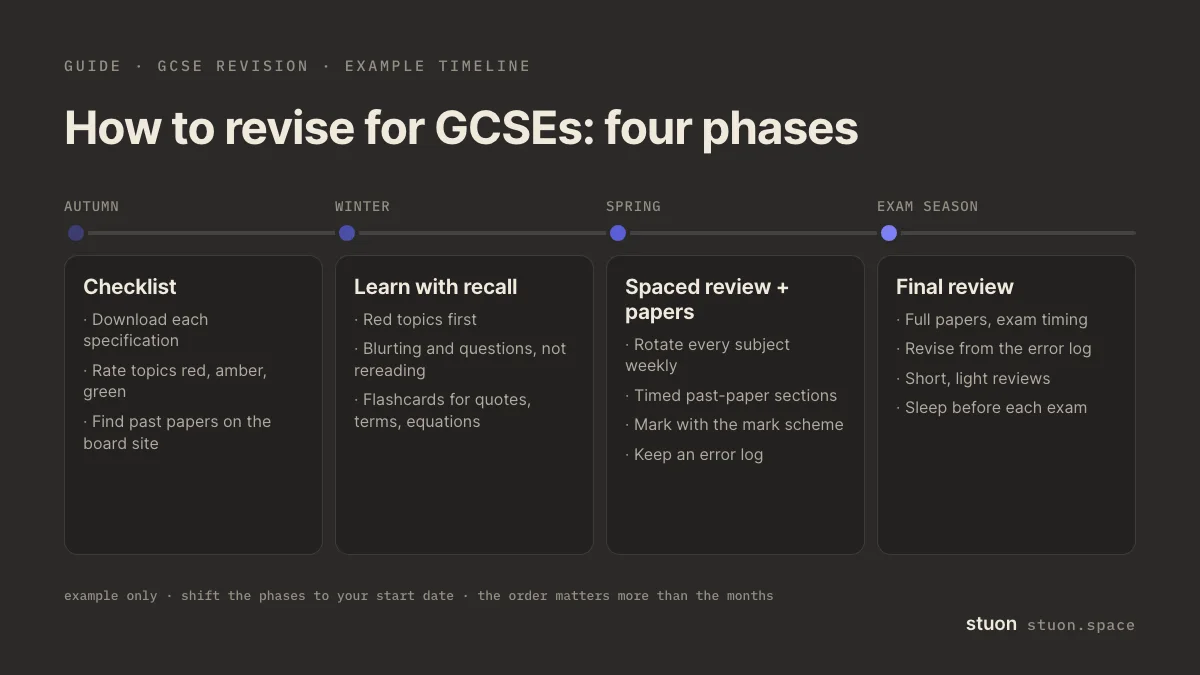
- Early on: build the checklist and learn. Work through red topics with active recall and blurting. Make flashcards for definitions, quotes and equations.
- Middle: spaced review. Return to each topic after a day, a week and a month. A revision timetable generator can rotate subjects so none go untouched.
- From the spring: past papers. Do sections, then whole papers, under timed conditions. Mark them with the mark scheme and log every lost mark.
- Exam season: short reviews. Revise from your error log and flashcards. Sleep and keep the night before light.
How to revise each type of subject
| Subject type | Examples | What to practise |
|---|---|---|
| Content-heavy | Biology, history, geography, RE | Blurting, flashcards, explaining processes and causes |
| Problem-solving | Maths, physics, chemistry calculations | Mixed question sets, past-paper questions, worked examples from memory |
| Essay and analysis | English literature and language | Quotes on flashcards, timed paragraphs, essay plans from memory |
| Languages | French, Spanish, German | Vocab in Leitner boxes, speaking answers aloud, timed writing |
Check the mark scheme for each subject; it shows what earns marks.
For problem subjects, mix question types once each one is familiar. Mixed practice improved later test scores in a maths study (Rohrer and Taylor, 2007). See interleaving.
Mark schemes and examiner reports
Mark schemes show the exact points and wording that earn marks. Examiner reports, also on the board websites, describe the mistakes students commonly made on each question. Read them after doing a paper, not instead of it.
Keep an error log: question, mark lost, why, and the fix. Before the exam, revise from the log rather than from a fresh set of notes. Track your hours with a study tracker and see how many hours you should study to set a realistic weekly target.
Frequently asked questions
When should I start revising for GCSEs?
Many students start structured revision several months before the summer exams. Starting earlier gives more rounds of spaced review; starting later means prioritising weak, high-mark topics.
How many hours a day should I revise for GCSEs?
It depends on how close the exams are and on your other commitments. A steady daily amount you can keep is worth more than occasional long days. See how many hours should I study.
Are past papers the best way to revise?
They are one of the best for the final months, because they test recall and exam technique together. Earlier on, learn the content first so the papers are useful.
Should I make revision notes?
Short notes are fine, but most of your time should go on testing yourself. Turn notes into questions or flashcards.
What if I am behind?
Rate topics by marks and weakness, and spend time where you can gain most. Use questions from day one and accept that some low-value topics will get less time.
Sources
- GOV.UK (Ofqual), GCSE 9 to 1 grade scale explained.
- Dunlosky et al. (2013), Improving students' learning with effective learning techniques. Psychological Science in the Public Interest.
- Cepeda et al. (2006), Distributed practice in verbal recall tasks: a review and quantitative synthesis. Psychological Bulletin.
- Rohrer and Taylor (2007), The shuffling of mathematics problems improves learning. Instructional Science.
Related pages
Turn your study time into progress
Levels, streaks and a heatmap give your hours a visible shape.
Turn your study time into progressAdd to Chrome, freeor use the free version without an account