free study tool
Random question picker
how do you quiz yourself with random questions?
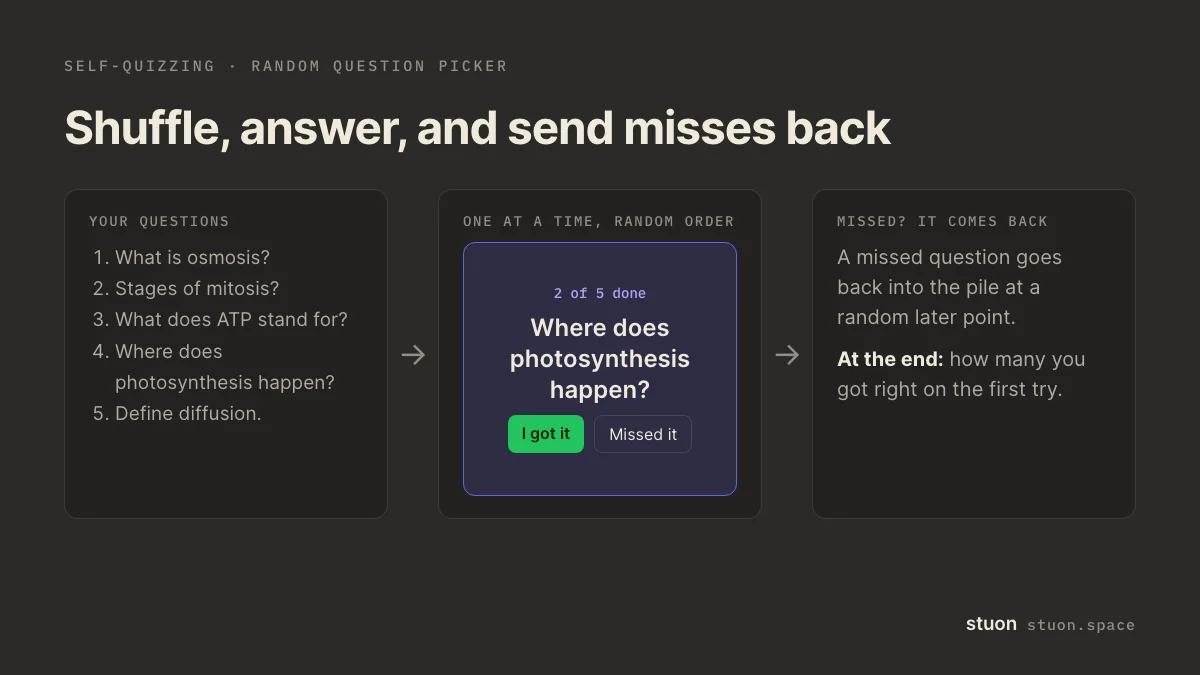
Write your revision questions in a list, then draw them one at a time in a random order and answer each before checking. Random order stops you from relying on the sequence, and putting missed questions back into the pile gives you another try once other questions have pushed them out of short-term memory.
by Vusal Imranli updated 10 Oct 20263 min read
Questions are drawn in a random order with no repeats. A missed question goes back into the pile and comes up again later. Saved in this browser only.
use this result
Keep a focus timer and site blocker in your Chrome toolbar.Add to Chrome, free
How to use the picker
- Paste your questions. One per line, up to 200. Past paper questions, cues from a Cornell notes page or questions from the end of a chapter all work.
- Start the quiz. The picker shuffles the list and shows one question at a time, with no repeats.
- Answer before you press. Say or write the answer. Then press I got it, or Missed it to send the question back into the pile at a random later point.
- Read the result. At the end you see how many you got right on the first try and how many needed another go. Start with those next time.
Shuffle the list gives you the whole set in a new order, to print or to use in a study group. Your questions are saved in this browser.
Why random order helps
If you always go through your questions in the same order, the order becomes a cue. You remember the answer to question 7 partly because it follows question 6, and that cue is gone in the exam. Shuffling removes it.
Mixing questions from different topics also means you have to work out what each question is about before answering, which is the idea behind interleaving. And answering from memory, then checking, is retrieval practice: it strengthens memory more than reading the answers (Roediger and Karpicke, 2006).
Missed questions come back within the session because a second try after a short gap is a stronger test than repeating the question straight away. In a flashcard study, practising a large stack with spacing between repetitions of each card led to better recall than learning it in small stacks repeated close together (Kornell, 2009).
Writing good revision questions
- One answer per question. "What is osmosis?" is clear; "Tell me about cells" is not.
- Ask why and how, not only what. "Why does the rate fall at high temperature?" tests understanding.
- Use exam wording. If the exam asks you to "explain" or "compare", write questions that way.
- Keep the answers somewhere else. The picker shows only the question, so check against your notes or a flashcard set.
Frequently asked questions
Can I use it to pick random students or names?
Yes. Any list works, one item per line. Use I got it to move to the next one.
Does a missed question come back straight away?
No. It goes back into the remaining pile at a random position after the current one, so other questions come in between.
Are my questions saved?
Yes, in this browser, so the list is there when you come back. Nothing is uploaded.
Is my text uploaded?
No. The tool runs in your browser. Nothing you type is sent anywhere, and anything saved stays in this browser only.
Sources
- Roediger and Karpicke (2006), Test-enhanced learning. Psychological Science.
- Kornell (2009), Optimising learning using flashcards: spacing is more effective than cramming. Applied Cognitive Psychology.
- Rohrer and Taylor (2007), The shuffling of mathematics problems improves learning. Instructional Science.
Related pages
Turn studying into a game
Stuon logs your sessions, builds your streak and draws your heatmap, so progress stays visible.
Continue in StuonAdd to Chrome, freeor use the free version without an account