exam plan
USMLE Step 1 study plan
how do you make a USMLE Step 1 study plan?
Build the dedicated period around timed question blocks. Do blocks every day, review every question, turn what you missed into cards and review them on a schedule. Cover systems in a planned order, take practice exams at the start, middle and end, and use the scores to decide what to review next.
by Vusal Imranli updated 10 Oct 20265 min read
What the USMLE Step 1 tests
| Item | Detail |
|---|---|
| Testing session | One day, 8 hours |
| Blocks | Fourteen blocks of 30 minutes |
| Questions | Up to 20 per block, up to 280 in total |
| Break time | At least 55 minutes, plus a 5-minute optional tutorial |
| Score | Pass or fail (for exams taken on or after 26 January 2022) |
Before 14 May 2026, Step 1 used seven 60-minute blocks of up to 40 questions, so older prep material describes that version. Check the USMLE site for current details before you plan.
How to build a USMLE Step 1 study plan
- Take a baseline practice exam. Use an official or widely used self-assessment at the start of dedicated study. It shows which systems and disciplines need the most time.
- Do timed question blocks daily. Use the real block length. Mix systems in each block once you are past the first weeks, as the exam does.
- Review every question. For right and wrong answers, check why each option is right or wrong. Review takes longer than the block, and that is expected.
- Turn misses into cards. Write a card for each concept you missed and review cards daily on a schedule. See spaced repetition.
- Cover systems in a set order. Plan which systems you review each week, so nothing is left untouched by the last two weeks.
- Practise the full day. Do at least one full-length simulation before the test, with breaks planned as on test day.
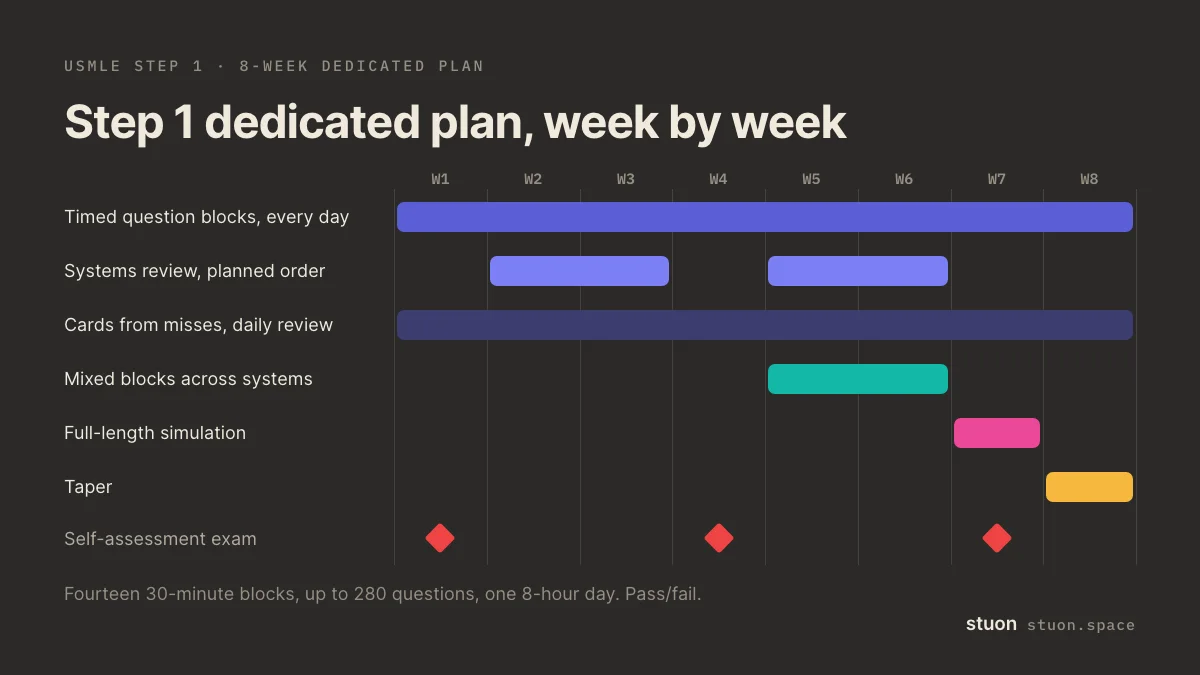
An 8-week Step 1 dedicated schedule
| Weeks | Focus | Main activities |
|---|---|---|
| Week 1 | Baseline | Self-assessment exam, list weak systems, set up the card deck and the review schedule |
| Weeks 2 to 3 | Systems, first pass | Two or three systems a week, timed blocks on those systems, cards from every miss |
| Week 4 | Checkpoint | Second self-assessment, change the systems order to match the new weak list |
| Weeks 5 to 6 | Mixed blocks | Daily mixed timed blocks across all systems, card review, targeted review of weak systems |
| Week 7 | Simulation | Full-length simulation with planned breaks, a full review, last self-assessment |
| Week 8 | Taper | Lighter blocks, card review, sleep and the same daily routine as test day |
Schools set dedicated periods of different lengths. A longer window keeps the order: baseline, systems, mixed blocks, simulation.
How many hours to plan
Set the weekly total from your test date and your current scores, as described in how many hours should I study. The study hours calculator turns hours per day into weekly and total hours.
| Per week | 4 weeks | 6 weeks | 8 weeks |
|---|---|---|---|
| 5 h | 20 h | 30 h | 40 h |
| 10 h | 40 h | 60 h | 80 h |
| 15 h | 60 h | 90 h | 120 h |
| 20 h | 80 h | 120 h | 160 h |
This is multiplication, not a recommendation. It assumes you study every planned week. Choose hours from your starting level and test date, then check them against a log.
Log what you actually do with a study time tracker. A plan of ten hours a week is only useful if the log shows ten hours.
Common USMLE Step 1 study mistakes
- Watching or reading content for weeks before starting questions. Questions show what you need to review.
- Doing blocks without reviewing them. The review is where most of the learning happens.
- Letting the card review pile up. Short daily review keeps it manageable; skipped days do not.
- Using guides written for the previous seven-block format to plan breaks and pacing.
Pass/fail still needs a plan
Step 1 is reported as pass or fail, so the goal of the dedicated period is a safe margin above the passing standard, not a number to compare. Use practice exams to check that margin, and stop adding new material in the last days.
Long days need structure. A rhythm of block, review, short break works well with a study timer, and a Pomodoro timer set to 50 and 10 suits long review sessions. Log hours so you can see the week, not just the day.
Frequently asked questions
How many questions are on USMLE Step 1?
Up to 280, in fourteen 30-minute blocks of up to 20 questions, in one 8-hour testing day. This is the format from 14 May 2026.
Is Step 1 still scored?
It is reported as pass or fail for exams taken on or after 26 January 2022.
How long is a Step 1 dedicated period?
It varies by school and by student. Set yours from your baseline self-assessment and your school's calendar. The plan here uses eight weeks as an example.
How do I track Step 1 study hours?
Log blocks, review and cards as separate sessions with a study timer and check the weekly total in a study tracker.
Sources
- USMLE, Step 1 exam content and format.
- USMLE, Exam resources (number of items).
- USMLE, Step 1 pass/fail score reporting implementation date.
- Dunlosky et al. (2013), Improving students' learning with effective learning techniques. Psychological Science in the Public Interest.
- Cepeda et al. (2006), Distributed practice in verbal recall tasks: a review and quantitative synthesis. Psychological Bulletin.
More on Stuon about this topic
Related pages
Turn your study time into progress
Levels, streaks and a heatmap give your hours a visible shape.
Turn your study time into progressAdd to Chrome, freeor use the free version without an account