exam plan
ACT study plan
how do you make a ACT study plan?
Take an official practice test first, then spend most weeks on timed question sets in your weakest of English, Math and Reading, the three sections that make up the composite. Log every mistake, retry it days later, and take a full timed test every one to two weeks. Add Science or Writing only if your colleges ask for them.
by Vusal Imranli updated 10 Oct 20265 min read
What the ACT tests
| Section | Questions | Minutes | Score |
|---|---|---|---|
| English | 50 | 35 | 1 to 36 |
| Math | 45 | 50 | 1 to 36 |
| Reading | 36 | 40 | 1 to 36 |
| Science (optional) | 40 | 40 | 1 to 36 |
| Writing (optional) | 1 essay | 40 | 2 to 12 |
| Composite | Average of English, Math and Reading | 1 to 36 |
Some questions in each section do not count toward your score. Science and Writing are optional and do not count toward the composite; Math and Science together give a separate STEM score. Check ACT for current details before you plan.
How to build a ACT study plan
- Decide on Science and Writing first. Look up what each of your colleges asks for. If none wants Science or Writing, put all your time into English, Math and Reading.
- Take a timed baseline. Use an official ACT practice test in one sitting, with the real section times. Note the score per section and which questions you ran out of time on.
- Build an error log. For every miss, write the question type, the reason (did not know, misread, ran out of time) and the rule or step you needed.
- Fix content in Math and English. Both reward known rules: grammar and punctuation in English, formulas and methods in Math. Learn the missing rule, then do a short set that uses it.
- Train pace in Reading. Reading is mostly a timing problem. Do one timed passage a day and note how long each passage took.
- Retry and mix. Redo logged questions after a few days without looking at the answer. In later weeks, do mixed sets so you have to recognise the type. See interleaving.
An 8-week ACT schedule
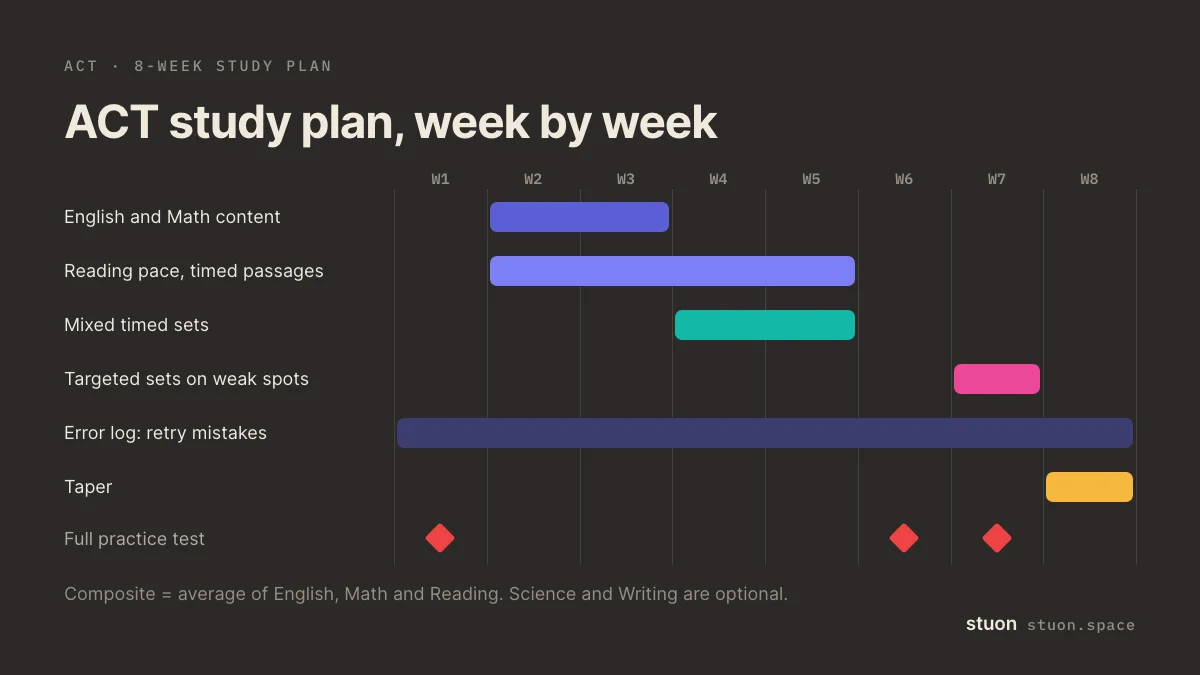
| Weeks | Focus | Main activities |
|---|---|---|
| Week 1 | Baseline | Official practice test under time, start the error log, list the three weakest question types |
| Weeks 2 to 3 | Content | English grammar rules and Math methods you missed, short sets by type, one timed Reading passage a day |
| Weeks 4 to 5 | Pace and mix | Timed sections, mixed question sets, retry logged mistakes, Science passages if you take it |
| Week 6 | Full test | Full timed test, two days of review, update the weak list |
| Week 7 | Weak spots | Targeted sets on the new weak list, a second full test at the end of the week |
| Week 8 | Taper | Error-log review, short timed sets, a light last two days and sleep before test day |
With four weeks, keep the order and halve each block: baseline, content, mixed timed sets, one full test.
How many hours to plan
Set the weekly total from your test date and your current scores, as described in how many hours should I study. The study hours calculator turns hours per day into weekly and total hours.
| Per week | 4 weeks | 8 weeks | 12 weeks |
|---|---|---|---|
| 5 h | 20 h | 40 h | 60 h |
| 10 h | 40 h | 80 h | 120 h |
| 15 h | 60 h | 120 h | 180 h |
| 20 h | 80 h | 160 h | 240 h |
This is multiplication, not a recommendation. It assumes you study every planned week. Choose hours from your starting level and test date, then check them against a log.
Log what you actually do with a study time tracker. A plan of ten hours a week is only useful if the log shows ten hours.
Common ACT study mistakes
- Studying for Science when none of your colleges asks for it.
- Practising untimed. The ACT gives 35 minutes for 50 English questions and 40 minutes for 36 Reading questions, so pace is a skill to train.
- Rereading answer explanations instead of retrying the question later. See active recall vs rereading.
- Taking practice tests without reviewing them. The review is where the points come from.
Using the composite to plan
The composite is the average of English, Math and Reading, rounded to the nearest whole number. A point gained in your weakest section counts the same as a point gained in your strongest, and the weak one usually has more points to gain. Spend the most hours there.
Track hours per section with a study timer and look at the split each week. If Math is the weakest section but gets the fewest hours, change the plan. The weekly study planner helps you place the blocks.
Frequently asked questions
Is the ACT Science section still required?
No. On the enhanced ACT, Science is optional and does not count toward the composite. Some colleges may still want it, so check theirs.
How is the ACT composite score calculated?
It is the average of your English, Math and Reading scores, rounded to the nearest whole number, on a scale of 1 to 36.
How long should I study for the ACT?
It depends on your baseline and your target. Take a practice test, see the gap, then choose weeks and weekly hours. This page uses eight weeks as an example.
How do I track ACT study time?
Label each session by section in a study time tracker, and check the weekly total in the study heatmap.
Sources
- ACT, ACT exam sections and structure (questions, timing, optional sections).
- ACT, Understanding your scores (composite, STEM and Writing scores).
- Dunlosky et al. (2013), Improving students' learning with effective learning techniques. Psychological Science in the Public Interest.
- Cepeda et al. (2006), Distributed practice in verbal recall tasks: a review and quantitative synthesis. Psychological Bulletin.
More on Stuon about this topic
Related pages
Turn your study time into progress
Levels, streaks and a heatmap give your hours a visible shape.
Turn your study time into progressAdd to Chrome, freeor use the free version without an account