
Falling behind usually happens quietly. You miss a lecture when you are ill. Then a problem set takes longer than planned, so you skip the reading. Three weeks later there is a pile of slides you have not opened, a quiz on Friday, and new lectures that assume you know all of it.
The instinct is to start at the first thing you missed and work forward. That is usually the wrong move. You cannot redo three weeks in three days, and while you try, the class keeps moving. This guide shows how to sort the backlog, stop the gap from growing, and get current in about two weeks.
Step 1: Stop the gap from growing
Before you touch the backlog, protect the present. Go to every class this week and keep up with new material, even if it does not fully make sense yet. Every new lecture you skip to catch up on an old one adds to the pile.
This feels backwards. It is not. If you only work on old material, you will be exactly as far behind in two weeks as you are now, just on different topics.
Step 2: Make the full list
Write down everything you have missed or only half-done: lectures, readings, problem sets, labs. Be specific. "Week 4 lecture on enzyme kinetics" is useful. "Biology stuff" is not.
Seeing the whole list is often a relief. The backlog in your head tends to feel bigger than the one on paper. Steel (2007), in a large review of procrastination research, found that people delay more when a task feels unpleasant and when they doubt they can do it. A concrete list attacks both: it shows the work is finite and breaks it into pieces you can see yourself finishing.
Step 3: Triage the backlog
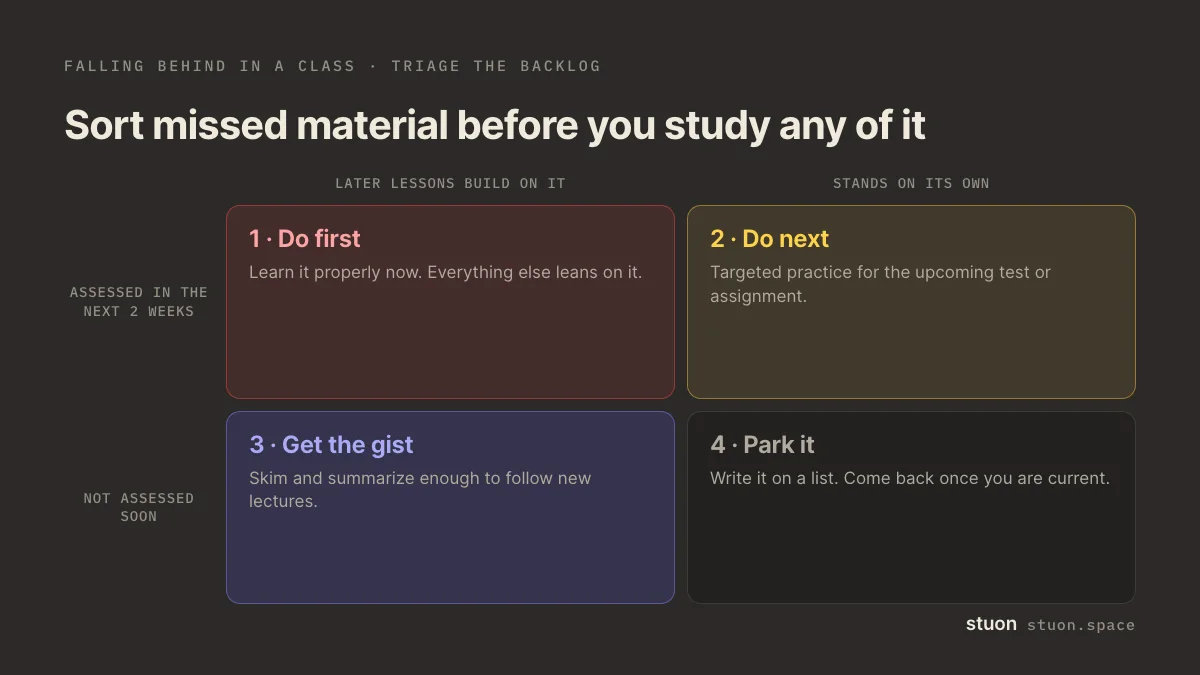
Now sort each item using two questions.
- Will it be assessed in the next two weeks? Check the syllabus, the quiz dates and the assignment briefs.
- Do later lessons build on it? In maths, sciences and languages, early topics often underpin everything after them. In other subjects, some weeks stand more on their own.
That gives four groups:
- Do first: assessed soon and foundational. Learn these properly now.
- Do next: assessed soon but self-contained. Prepare for the specific test or assignment.
- Get the gist: foundational but not assessed soon. Learn enough to follow the new lectures. A one-page summary is often enough for now.
- Park it: neither. Keep it on the list and come back once you are current.
Parking things is hard for conscientious students. But a backlog item that is not assessed soon and that nothing depends on can wait a week without harm.
Step 4: Study the backlog actively
When you are behind, it is tempting to "get through" material by reading it fast. That gives you coverage without memory. A review of study techniques by Dunlosky and colleagues (2013) rated rereading and highlighting as low utility, and practice testing and spaced practice as high utility.
So for each "do first" item:
- Read the lecture slides or notes once, carefully.
- Close them and write down what you remember, then check. This is the blurting method.
- Do two or three practice questions on the topic.
- Come back to it briefly two or three days later and test yourself again.
This takes longer per item than skimming. It also means you only have to learn each item once.
Step 5: Ask for help early
Lecturers, teaching assistants and tutors see students who have fallen behind every term. A short email or a visit to office hours can save you hours. Useful questions to ask:
- "Which of the topics I missed matter most for the next assessment?"
- "Is there a deadline extension policy for illness?" (if that is why you fell behind)
- "Are there recorded lectures or worked solutions for weeks 3 to 5?"
A classmate's notes can also help, as long as you use them actively. Studying with a friend who is up to date can work well if the session has a clear plan; this guide shows how to keep it focused.
A worked example: two weeks to catch up
Say you are three weeks behind in an introductory chemistry course. A quiz on stoichiometry is in nine days. You have about eight hours a week for this course on top of attending classes.
Your triage looks like this:
- Do first: moles and molar mass (week 3), balancing equations (week 4). Both appear on the quiz and everything after depends on them.
- Do next: the week 5 problem set on limiting reagents, which is on the quiz.
- Get the gist: the week 2 lecture on significant figures. You half-know it already.
- Park: an optional reading on the history of atomic theory.
Week 1: attend all classes. Three 50-minute sessions on moles and balancing equations, each ending with a blurt and five practice problems. One short session on significant figures.
Week 2: two sessions on the limiting-reagent problem set. One session of mixed practice questions across all quiz topics, notes closed. Quiz day. The weekend after: pick up the parked reading if it still matters.
This is hypothetical, and your numbers will differ. The shape is what matters: protect the present, do the foundational and assessed material first, and leave the rest for later.
How to avoid falling behind again
- A weekly check: fifteen minutes on Sunday to compare the syllabus with what you have done. Small gaps are easy to close.
- Schedule a buffer: leave one empty block each week. See how to make a study schedule you'll actually keep.
- Start small when you are avoiding something: the 5-minute rule works well for the first item on a scary list.
- Count days, not weeks: an exam countdown makes the next deadline concrete.
Frequently asked questions
How long does it take to catch up in a class?
It depends on how far behind you are and how much time you have. For a few weeks of missed material, two weeks of focused work alongside attending classes is a realistic target if you triage instead of trying to redo everything.
Should I skip new lectures to catch up on old ones?
Usually not. Skipping new classes makes the backlog grow. Attend, keep up as best you can, and work on the backlog in separate sessions.
What if I can't catch up before the exam?
Focus on what is most likely to be assessed and on the topics others depend on. Talk to your lecturer or tutor about what to prioritize. The guide on how to study for exams covers the final stretch.
Is it worth rewatching every lecture I missed?
Not always. Slides, notes and practice questions are often faster. Rewatch only the lectures on foundational topics you find hard, and test yourself afterwards.
Related reading
Sources
- Steel, P. (2007). The nature of procrastination: A meta-analytic and theoretical review of quintessential self-regulatory failure. Psychological Bulletin, 133(1), 65–94. doi:10.1037/0033-2909.133.1.65
- Dunlosky, J., Rawson, K. A., Marsh, E. J., Nathan, M. J., & Willingham, D. T. (2013). Improving students’ learning with effective learning techniques. Psychological Science in the Public Interest, 14(1), 4–58. doi:10.1177/1529100612453266
Start with the first item on your list
Pick the top "do first" topic, set a 50-minute session, and end it by writing down what you remember.
Start the free study timeror use the free version without an account