
Most study schedules are written on a Sunday night by an optimistic version of you. Four hours a day, every subject covered, no gaps. By Wednesday you are two blocks behind, and by Friday the plan has quietly stopped existing.
The problem is rarely discipline. It is that the schedule was built for a week that was never going to happen. This guide shows how to build a study schedule around the week you actually have, with tasks small enough to start, reviews spaced out, and room for things to go wrong.
Why study schedules fall apart
Three things break most plans.
We underestimate how long things take. Psychologists call this the planning fallacy. In studies by Buehler, Griffin and Ross (1994), students predicted when they would finish their own assignments and projects, and most finished later than they predicted. They knew past projects had run late, but they treated the new one as an exception.
The blocks are vague. "Chemistry, 2 hours" does not tell you what to do when you sit down. You spend the first twenty minutes deciding, or you avoid the block altogether because starting feels heavy.
There is no slack. A plan with every hour filled has nowhere to put a late shift, a sick day or a lab report that takes longer than expected. One miss pushes everything back, and the plan collapses.
Five steps to a schedule you will keep
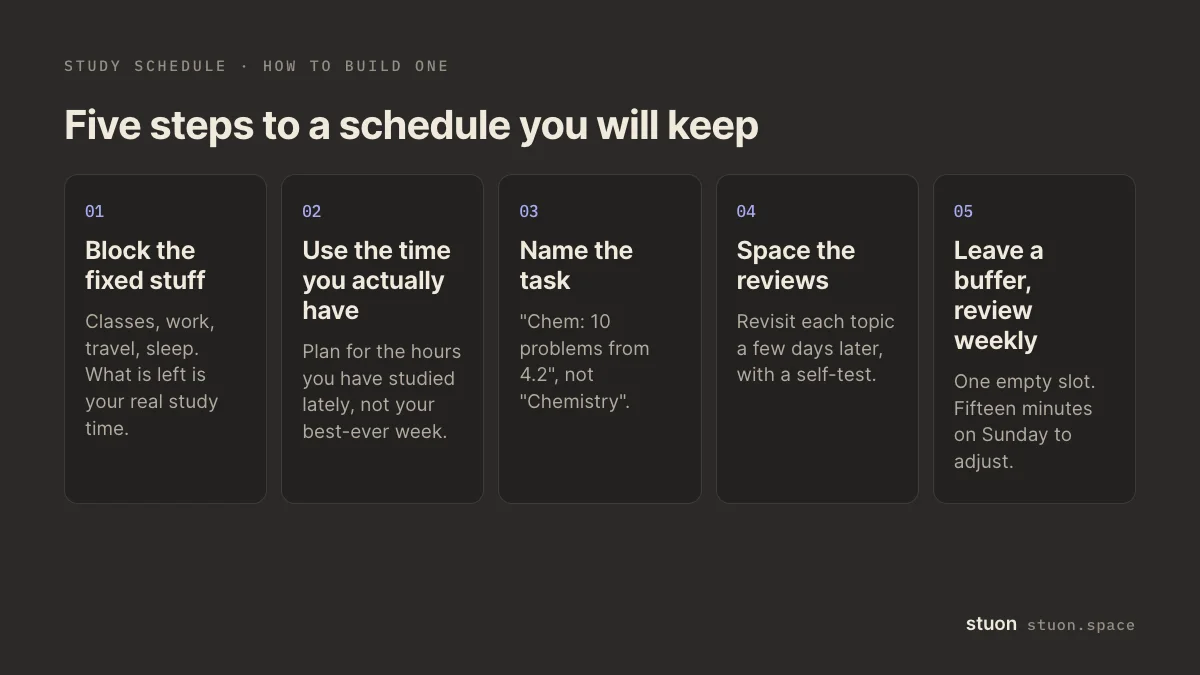
1. Block the fixed commitments first
Start with an empty week and fill in everything that is not negotiable: classes, labs, work shifts, commuting, meals, sports, and sleep. What is left is your real study time. For many students this is smaller than they expected, and it is better to find that out now than on Thursday.
2. Plan for the hours you actually study
Look at the last two weeks. How many focused hours did you really put in? If the answer is ten, do not plan for thirty. Plan for twelve. If you track your sessions with a study timer, you already have this number. If you do not, track for a week before you plan the next one.
Unsure what a reasonable total is? The guide on how many hours you should study gives ranges by level. The short answer is that consistent, focused hours matter more than big totals, a point the 4-hour study day post makes in more detail.
3. Turn subjects into tasks
Every block should answer the question "what exactly will I do?" Compare:
- "Biology" versus "Biology: self-test on chapter 5, then fix the gaps."
- "History essay" versus "History: write the outline and pick three sources."
- "Maths" versus "Maths: ten mixed problems from 4.1 to 4.3, mark them."
This is more than tidiness. A meta-analysis by Gollwitzer and Sheeran (2006) found that "if-then" plans, which name when, where and how you will act, made people more likely to reach their goals than intentions alone. "On Tuesday after lunch, at the library desk, I will do ten chemistry problems" is that kind of plan.
4. Space the reviews
A schedule that only covers each topic once leaves you to cram it all again before the exam. Instead, plan a short return visit to each topic a few days after you first study it, and again a week or two later. Spaced practice beats massed practice across a large body of research (Cepeda et al., 2006). The spaced repetition guide explains the intervals.
Reviews should be active. Close your notes and test yourself, using active recall, rather than rereading.
5. Leave a buffer and review weekly
Leave at least one block a week empty. If the week goes to plan, use it to get ahead or take the time off. If it does not, the buffer absorbs the overflow without breaking the rest of the plan.
Then set fifteen minutes at the end of the week to look back. Which blocks happened? Which did not, and why? Adjust next week's plan to match what you learned. A schedule is a draft you revise, not a contract.
A worked example
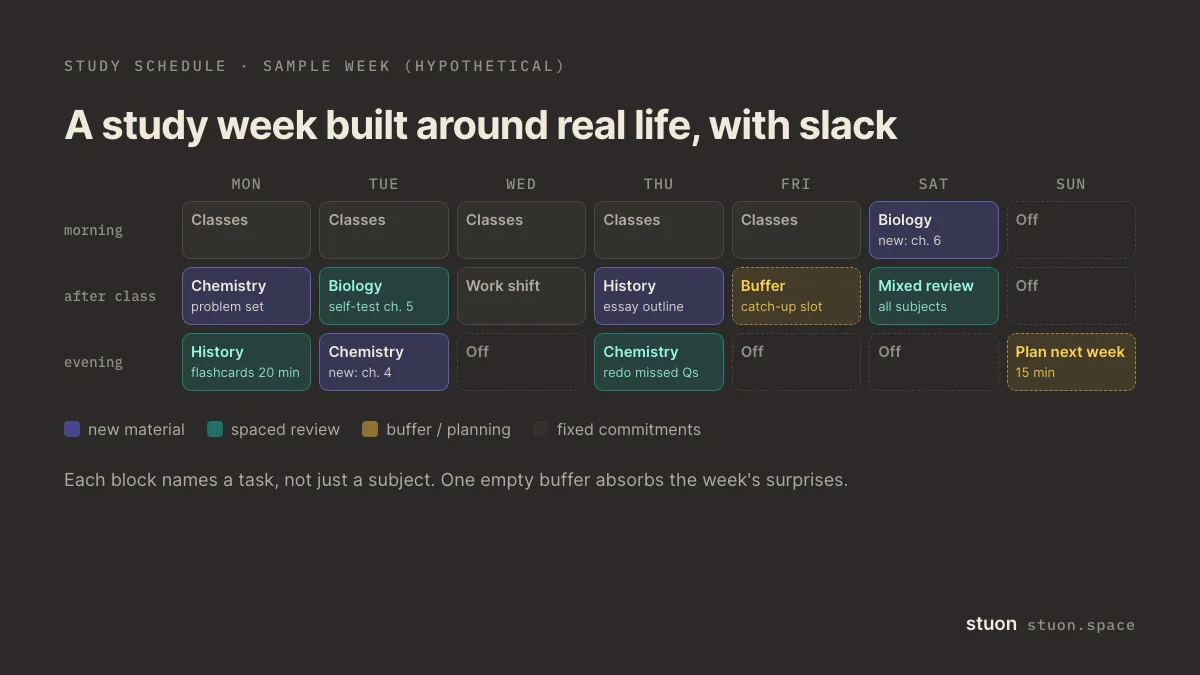
Say you are a first-year student taking biology, chemistry and history, with a part-time job on Wednesday afternoons. Last week you managed about nine focused hours.
- Fixed blocks: classes every weekday morning, work on Wednesday afternoon, Sunday kept free.
- Realistic total: plan for ten or eleven hours, a little more than last week, not double.
- Tasks: each subject gets one "new material" block and one review block. History gets an extra block for the essay outline.
- Spacing: biology chapter 5 was new last week, so Tuesday is a self-test on it. Chapter 6 is new on Saturday and gets reviewed next Tuesday.
- Buffer: Friday after class is left empty. Sunday evening has a 15-minute planning slot.
The figure at the top of this post shows the result. It has fewer hours than an ambitious plan. That is why it has a chance of surviving the week.
When you miss a block
You will. The question is what happens next. Do not try to fit the missed block on top of tomorrow's plan. Move it into the buffer, or drop the least important task of the week. If you miss blocks often, the plan is too full. Cut it back until you hit most of what you plan, then add time slowly.
If you have fallen behind by weeks rather than days, a schedule alone will not fix it. Read how to catch up after falling behind in a class first, then rebuild the plan.
Tools that help
- Study session planner: plan the length and breaks of a single session.
- Revision timetable generator: lay out subjects across the days before an exam.
- Exam countdown timer: see how many days you have left, which keeps the plan honest.
Frequently asked questions
How many hours a day should a study schedule include?
Start from what you have actually managed recently and add a little. A plan you hit most days builds a habit. A plan you miss teaches you to ignore it.
Should I study the same subject every day?
Not necessarily. Returning to each subject every few days, with active review, tends to work better than long single-subject days followed by long gaps.
What should I do if I keep missing study blocks?
Make the plan smaller and the tasks more specific. Check whether the missed blocks share a cause, such as being late in the evening or right after work, and move them.
Is a weekly or a daily schedule better?
A weekly outline with daily tasks works well for most students. The week gives you balance across subjects. Each day tells you exactly what to start with.
Related reading
Sources
- Buehler, R., Griffin, D., & Ross, M. (1994). Exploring the “planning fallacy”: Why people underestimate their task completion times. Journal of Personality and Social Psychology, 67(3), 366–381. doi:10.1037/0022-3514.67.3.366
- Gollwitzer, P. M., & Sheeran, P. (2006). Implementation intentions and goal achievement: A meta-analysis of effects and processes. Advances in Experimental Social Psychology, 38, 69–119. doi:10.1016/S0065-2601(06)38002-1
- Cepeda, N. J., Pashler, H., Vul, E., Wixted, J. T., & Rohrer, D. (2006). Distributed practice in verbal recall tasks: A review and quantitative synthesis. Psychological Bulletin, 132(3), 354–380. doi:10.1037/0033-2909.132.3.354
Know your real study hours
A schedule is only as good as the number it starts from. Time your sessions for a week with the free timer, then plan from what you actually did.
Start the free study timeror use the free version without an account