
Your heart is fast, your hands are cold, and the first question looks like it was written in another language. Then you blank on something you knew yesterday. Exam anxiety is common, and it is not a sign that you are bad at the subject.
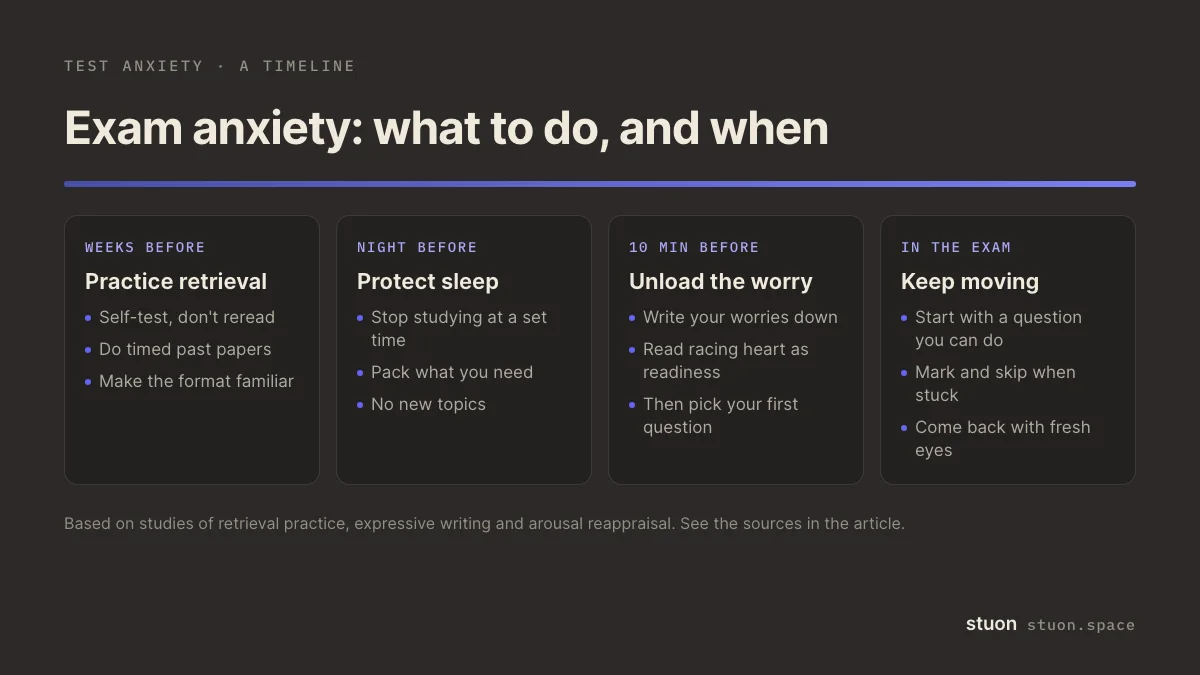
It does matter, though. A large meta-analysis of 238 studies found that higher test anxiety was linked to lower scores on standardised tests, entrance exams and grade averages, with small to moderate effects (von der Embse et al., 2018). This post covers what has evidence behind it, sorted by when to use it: weeks before, the night before, the minutes before, and in the exam room.
This post is about the ordinary nerves most students feel around exams. If anxiety is stopping you from studying, sleeping or attending exams, talk to your school's counselling service or a doctor. That is what they are there for.
Why anxiety makes you blank
A popular explanation, supported by work from researchers such as Sian Beilock, is that worry uses up working memory. Working memory is the mental space you use to hold a problem in mind while you work on it. If part of it is busy with "I'm going to fail", there is less left for the question. That fits a common experience: anxiety hurts most on questions that need several steps held in mind at once.
It also suggests two kinds of fix. You can make the material so well practised that it needs less working memory. And you can reduce how much space the worry takes up on the day.
Weeks before: practise retrieval, not rereading
The best long-term fix for exam nerves is to have answered questions like the exam's many times already. Self-testing does this. Agarwal and colleagues (2014) surveyed 1,408 middle and high school students whose classes used regular low-stakes quizzes. 72% said the quizzes made them less nervous for unit tests and exams. This is self-report from a survey, not a controlled experiment, but it fits what retrieval practice is known to do for learning.
In practice:
- Replace some rereading with active recall: close the notes and write what you remember, then check.
- Sit at least one past paper under timed, closed-book conditions. The format becomes familiar, so there are fewer surprises on the day. An exam countdown timer helps you practise the pacing.
- Spread your revision out so you are not learning things for the first time the night before. See how to study for finals in one week for a short plan, or the revision timetable generator for a longer one.
The night before: protect your sleep
Anxious students often try to calm themselves by studying more. Late-night studying costs sleep, and sleep loss makes attention and new learning worse the next day. The research is in why all-nighters backfire. Set a stop time, pack your bag and your ID, check the exam room and start time, and do not start new topics.
Ten minutes before: write the worry down
This is one of the simplest techniques with experimental support. Ramirez and Beilock (2011) asked students to spend about ten minutes before an exam writing openly about their thoughts and feelings on the test. In their lab and classroom studies, students who were highly anxious and did this writing performed better than anxious students who sat quietly or wrote about something unrelated. The proposed reason is that writing the worry down frees working memory. The studies were small and the result has been debated, so treat it as a cheap thing worth trying rather than a guarantee.
How to do it: take a sheet of paper before the exam. For ten minutes, write exactly what you are worried about, as honestly as you can. Nobody will read it. Then fold it up and put it away.
Ten minutes before: call it readiness
A racing heart before an exam is your body getting ready to perform. The same physical signs can feel like threat or like readiness, and how you read them seems to matter.
Jamieson and colleagues (2010) told one group of students preparing for the GRE that arousal before a test can help performance. That group scored higher on the maths section of a practice test than a control group, and the pattern held on their real GRE scores later. In separate experiments, Brooks (2014) found that people who said "I am excited" before a stressful task, including a maths test, performed better than people who said "I am calm".
You do not have to feel calm. You can tell yourself something like "my body is getting ready for this" and start.
In the exam: a plan for when you blank
Decide in advance what you will do if your mind goes blank. Having the plan is half its value. For example:
- Start with a question you can do. Read through the paper quickly, then begin with one you are confident about. Early marks steady you.
- Write something down. On a hard question, write the formula, definition or first step you do know. Seeing it on the page often brings the next step.
- Mark and move on. If you are stuck for more than a couple of minutes, mark the question and skip it. Come back once the rest is done.
- Reset your body briefly. Put your pen down, sit back, and take a few slow breaths before you go back to the paper.
A worked example
Say you have an organic chemistry final in three weeks and you tend to blank on mechanism questions. Three weeks out, you start doing one mechanism question from memory each day, and sit two past papers with a timer. The night before, you stop at 10 p.m. Outside the exam room you write for ten minutes about the fear of blanking on mechanisms, then fold the page away. When you sit down, you start with the nomenclature section you know well. When a mechanism question stalls you, you draw the starting molecule and the arrows you are sure of, mark the question, and come back to it at the end.
None of these steps removes the nerves. Together they leave you more room to think. Students facing high-stakes tests can find more on our pages for medical students and law students.
Frequently asked questions
Is some exam anxiety normal?
Yes. Most students feel nervous before important exams, and some arousal can help you focus. It becomes a problem when it stops you preparing or performing, and then it is worth getting support.
How do I stop my mind going blank in an exam?
Practise retrieving the material many times beforehand, so it is easier to reach under pressure. On the day, start with a question you know, write down whatever you can recall, and skip and return to questions that stall you.
Does writing about worries really help?
In studies by Ramirez and Beilock (2011), ten minutes of writing about test worries helped highly anxious students perform better. The studies were small, but the technique is free and takes ten minutes, so it is worth trying.
Related reading
Sources
- von der Embse, N., Jester, D., Roy, D., & Post, J. (2018). Test anxiety effects, predictors, and correlates: A 30-year meta-analytic review. Journal of Affective Disorders, 227, 483–493. doi:10.1016/j.jad.2017.11.048
- Agarwal, P. K., D’Antonio, L., Roediger, H. L., McDermott, K. B., & McDaniel, M. A. (2014). Classroom-based programs of retrieval practice reduce middle school and high school students’ test anxiety. Journal of Applied Research in Memory and Cognition, 3(3), 131–139. doi:10.1016/j.jarmac.2014.07.002
- Ramirez, G., & Beilock, S. L. (2011). Writing about testing worries boosts exam performance in the classroom. Science, 331(6014), 211–213. doi:10.1126/science.1199427
- Jamieson, J. P., Mendes, W. B., Blackstock, E., & Schmader, T. (2010). Turning the knots in your stomach into bows: Reappraising arousal improves performance on the GRE. Journal of Experimental Social Psychology, 46(1), 208–212. doi:10.1016/j.jesp.2009.08.015
- Brooks, A. W. (2014). Get excited: Reappraising pre-performance anxiety as excitement. Journal of Experimental Psychology: General, 143(3), 1144–1158. doi:10.1037/a0035325
Make the exam format familiar
Set the real time limit and sit a past paper with no notes. The more often you have done it, the less the day itself can surprise you.
Open the exam countdown timeror use the free version without an account