
Most students study math by reading the chapter, looking at the worked examples, and then doing the homework problems in order. The homework goes fine. Then the test mixes everything together, the problems look unfamiliar, and the methods that felt easy a week ago will not come.
The gap is not usually intelligence. It is the kind of practice. Math is a skill you show by producing solutions, so it has to be studied by producing solutions: from a blank page, on mixed problems, with your mistakes revisited. This post lays out a practice cycle that does that.
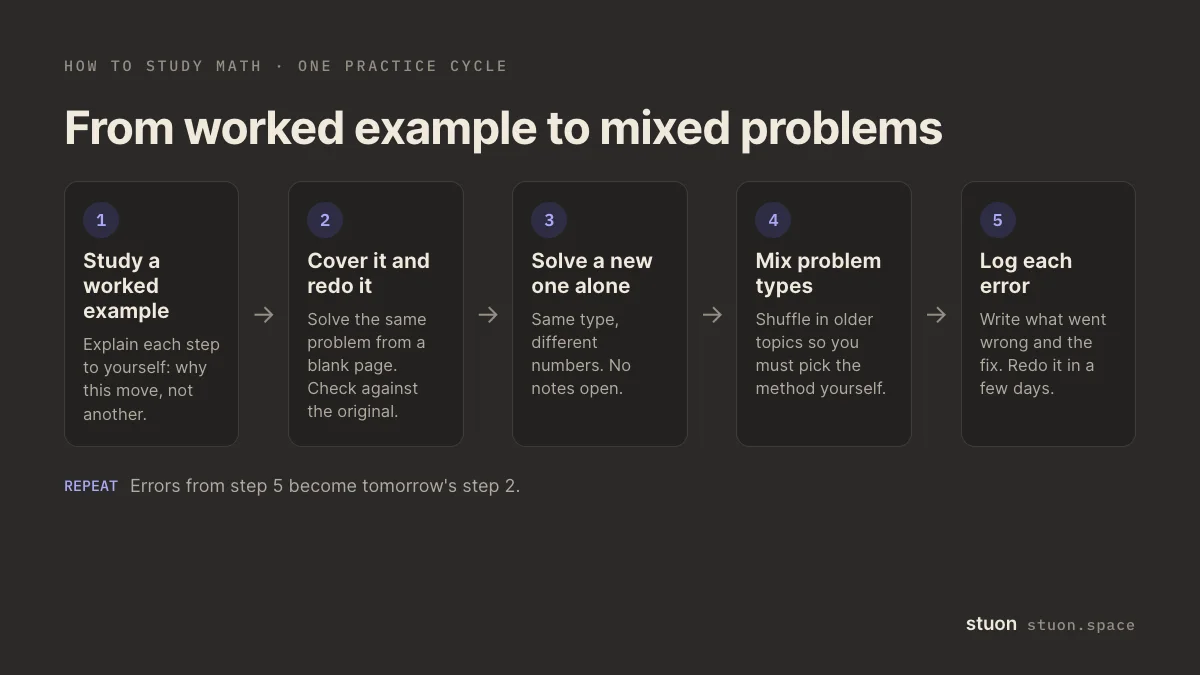
Step 1: study worked examples properly
Worked examples are a good way to start a new topic. A research review by Atkinson and colleagues (2000) found that studying worked examples helps beginners more than solving problems straight away, particularly when the examples are well designed and students think about why each step is taken.
That last part is where most students fall short. They read the example, nod, and move on. Instead, for each line, ask: what changed from the line before, and why was that the right move? Say it out loud or write it in the margin. Psychologists call this self-explanation, and a large review of study techniques rated it moderately useful, with good evidence in math and science problem solving (Dunlosky et al., 2013).
Step 2: cover the example and redo it
Close the book. Solve the same problem on a blank page. Then compare. This is retrieval practice applied to procedures: you are checking whether you can produce the method, not just follow it. Where you got stuck shows you which step you did not understand.
Step 3: solve a new problem alone
Pick a problem of the same type with different numbers. Do it with no notes open. If you get stuck for more than a few minutes, look at only the next line of the example, then close it and continue.
Step 4: mix problem types
This step is the one most textbooks leave out. Homework sets usually group problems by topic: twenty problems on the chain rule, then twenty on the product rule. You always know which method to use, because it is in the section title. On a test, you have to decide.
Mixing, or interleaving, makes you practise that decision. In a lab study, Rohrer and Taylor (2007) had students learn to find the volumes of different solids. Students who practised the problem types mixed together did worse during practice, but much better on a test a week later, than students who practised each type in a block. A later classroom study with seventh graders found the same pattern for algebra and graphing problems: interleaved practice led to higher scores on a delayed test (Rohrer, Dedrick & Stershic, 2015).
Note the cost. Mixed practice feels harder and you will make more errors while doing it. That is expected. It is one of the desirable difficulties that make practice feel slower but last longer.
To build a mixed set yourself, take two or three problems from each of the last few sections, write each on a card or a separate line, and shuffle. Cover the section headings.
Step 5: keep an error log
Every wrong answer is useful information, but only if you keep it. Use a notebook or a document with three columns:
- The problem (or its page and number).
- What went wrong: wrong method, algebra slip, misread the question, did not know a formula.
- The fix: one line you would tell a friend.
Then, a few days later, redo the logged problems from a blank page before starting new work. This brings spacing into your math practice, which supports longer retention (Cepeda et al., 2006). If you made the same kind of error three times, that is your next topic to relearn.
A worked example of one study session
Say you are in a first calculus course and have a test on derivatives in ten days. You have covered the power rule, product rule, quotient rule and chain rule. A 60-minute session might look like this:
- 10 minutes: redo three problems from your error log, from a blank page.
- 15 minutes: study one worked chain rule example from the textbook, explaining each line. Cover it and redo it.
- 15 minutes: solve three new chain rule problems with no notes.
- 15 minutes: solve a shuffled set of six problems, mixing all four rules, without headings.
- 5 minutes: log every error with its cause and fix.
Run this every second day and the shuffled set will grow to include each new topic. By test day you will have practised the exact thing the test asks: choosing the method and carrying it out without help.
Other habits that help
- Learn formulas by deriving or using them, not by staring at them. If you need to memorise a formula, quiz yourself on it. Write it from memory, then check. Flashcards in the free spaced repetition tool work well for this.
- Explain a concept in plain words. If you cannot explain why the derivative of a constant is zero without symbols, the Feynman technique will show you where the gap is.
- Work in focused blocks. Math needs uninterrupted attention because you hold several steps in mind at once. Use a Pomodoro timer and keep your phone in another room.
- Do not skip the reading. Read the section before the lecture, even briefly. It makes the lecture easier to follow and your notes better.
Students in engineering, physics or other quantitative courses can find more subject-specific tips on our page for STEM students, and SAT takers can see SAT study tips.
Frequently asked questions
How many practice problems should I do?
There is no fixed number. What matters more is the type of practice: problems done from a blank page, a mix of problem types, and a return to the ones you got wrong. A handful of mixed problems often teaches more than a long block of identical ones.
Is it bad to look at the answer when I'm stuck?
Not if you use it well. Look at only the next step, close it, and keep going. Then redo the whole problem later without help, and log it as an error.
Why do I understand it in class but fail the test?
Following a solution and producing one are different skills. Class and homework often tell you which method to use. Tests do not. Practising mixed problems from a blank page closes that gap.
Related reading
Sources
- Atkinson, R. K., Derry, S. J., Renkl, A., & Wortham, D. (2000). Learning from examples: Instructional principles from the worked examples research. Review of Educational Research, 70(2), 181–214. doi:10.3102/00346543070002181
- Rohrer, D., & Taylor, K. (2007). The shuffling of mathematics problems improves learning. Instructional Science, 35, 481–498. doi:10.1007/s11251-007-9015-8
- Rohrer, D., Dedrick, R. F., & Stershic, S. (2015). Interleaved practice improves mathematics learning. Journal of Educational Psychology, 107(3), 900–908. doi:10.1037/edu0000001
- Dunlosky, J., Rawson, K. A., Marsh, E. J., Nathan, M. J., & Willingham, D. T. (2013). Improving students’ learning with effective learning techniques. Psychological Science in the Public Interest, 14(1), 4–58. doi:10.1177/1529100612453266
- Cepeda, N. J., Pashler, H., Vul, E., Wixted, J. T., & Rohrer, D. (2006). Distributed practice in verbal recall tasks: A review and quantitative synthesis. Psychological Bulletin, 132(3), 354–380. doi:10.1037/0033-2909.132.3.354
Run one practice cycle today
Set a 60-minute session: error log, one worked example, three solo problems, one mixed set. The timer keeps the blocks honest.
Start the free study timeror use the free version without an account