study method
Memory palace (method of loci)
what is a memory palace?
A memory palace is a memory technique, also called the method of loci, in which you picture a familiar place and put a vivid image of each item you want to remember at a fixed spot along a route. To recall the items, you walk the route in your mind.
by Vusal Imranli updated 10 Oct 20265 min read
How the memory palace works
The method works because people are good at remembering places and routes, and poor at remembering lists of unrelated items. Linking each item to a location gives you an ordered set of cues. You do not have to search for the next item; you only have to walk to the next spot.
The evidence for lists is reasonably good. A meta-analysis of 13 randomised trials found a medium-sized benefit for the method of loci over control conditions, although the authors noted a high risk of bias in many studies (Twomey and Kroneisen, 2021). In another study, people with no memory training who practised the method for six weeks improved their word-list recall, and the gains were still visible four months later (Dresler et al., 2017).
There is a limit. The method helps you remember items in order. It does not help you understand them, and building images takes time. Dunlosky et al. (2013) rated related mnemonic techniques as low utility for most course material for that reason.
How to build a memory palace, step by step
- Choose a place you know well. Your home, your route to school, or a building you visit daily. You should be able to walk it in your mind without effort.
- Fix a route with stops. Pick 5 to 10 distinct spots in a fixed order: front door, coat hook, kitchen table, sink, window. Always walk them the same way.
- Turn each item into an image. Make it concrete, odd and active. "Mitochondria" might become a power station spinning on your doormat.
- Place one image at each stop. Picture it clearly in that spot, interacting with it. Spend a few seconds on each.
- Walk the route and recall. Close your eyes, walk the route and name each item. Check against your list, then walk it again the next day.
When to use a memory palace
- Ordered lists: the stages of a process, the planets, a sequence of kings or key points of a speech.
- Items with no natural link between them.
- Oral exams and presentations where you cannot use notes.
Benefits of the memory palace
- Recall comes out in order, so you notice when an item is missing.
- One well-known route can be reused for many different lists.
- It can make dull lists easier to practise, because the images are memorable.
Common mistakes with the memory palace
- Using a place you only half know. The route has to be automatic.
- Making images that are vague or ordinary. A plain apple on a table fades fast.
- Using it for ideas that need understanding, such as a proof or an argument.
- Building the palace once and never walking it again. Images fade like anything else.
Memory palace example
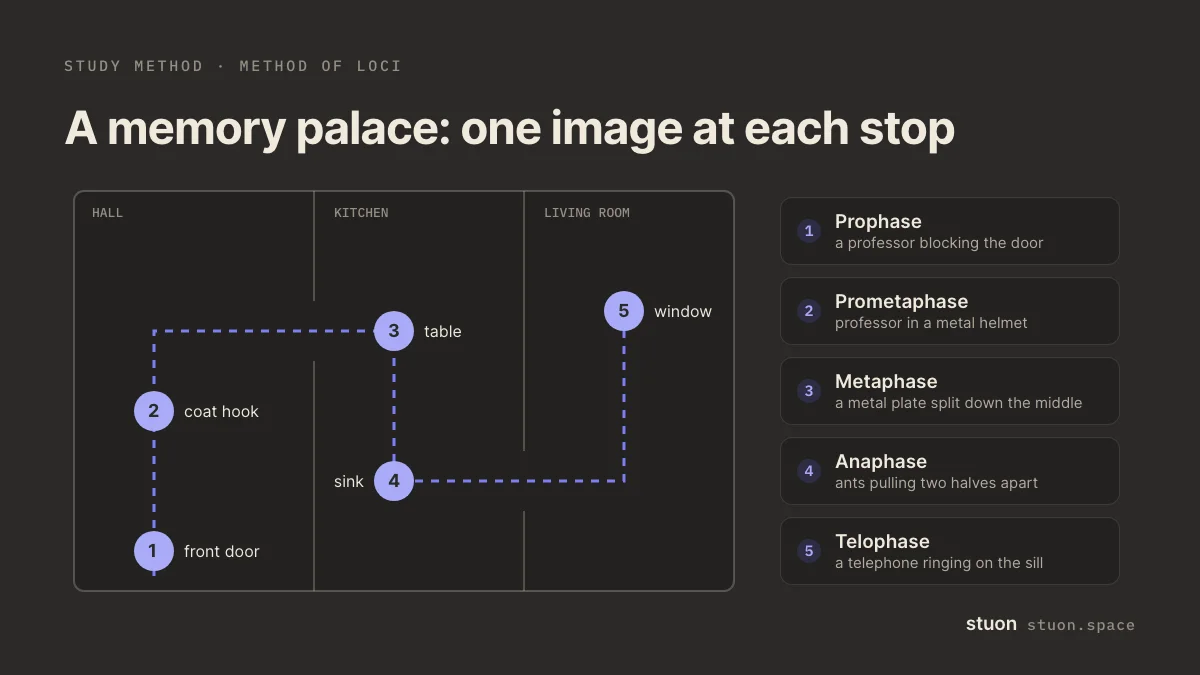
List: prophase, prometaphase, metaphase, anaphase, telophase.
Front door: a professor ("pro") blocking the door. Coat hook: a professor in a metal ("meta") helmet hanging there. Kitchen table: a giant metal plate splitting in the middle. Sink: ants ("ana") pulling two halves apart. Window: a telephone ("telo") ringing on the sill.
In the exam you walk from the front door to the window and read off the stages in order.
Combining it with other methods
Use the memory palace for the order, and use active recall and elaborative interrogation for the meaning. For example, after recalling the five mitosis stages from your route, explain what happens in each without notes.
Review routes on a schedule, as in spaced repetition. A route walked after a day, three days and a week stays usable for months. For breaking a long list into groups first, see chunking.
Frequently asked questions
Does the memory palace really work?
For remembering lists in order, yes: a meta-analysis found a medium-sized benefit. For understanding course material, other methods such as practice testing do more.
How many items can one memory palace hold?
As many as it has stops. Start with five to ten. Memory athletes use routes with hundreds of stops, built over years.
Can I reuse the same palace?
Yes, but old images can interfere with new ones for a while. Keep separate routes for things you need at the same time.
Is the method of loci the same as a memory palace?
Yes. "Loci" is Latin for places. "Memory palace" is the more common modern name.
Is the memory palace good for exams?
It helps with ordered lists and key points. Most exam marks come from explaining and applying ideas, so use it alongside retrieval practice.
Sources
- Twomey and Kroneisen (2021), The effectiveness of the loci method as a mnemonic device: meta-analysis. Quarterly Journal of Experimental Psychology.
- Dresler et al. (2017), Mnemonic training reshapes brain networks to support superior memory. Neuron.
- Dunlosky et al. (2013), Improving students' learning with effective learning techniques. Psychological Science in the Public Interest.
Related methods
Practice it, then keep a record
Stuon has a timer, a blurting space and flashcards, and it logs the time you spend on each.
Track this in StuonAdd to Chrome, freeor use the free version without an account