guide
How to study with ADHD
how do you study with ADHD?
To study with ADHD, make starting tiny, work in short timed blocks with planned breaks, keep the plan and the timer visible, remove distractions before you begin, and use active methods such as self-testing. Many students also find studying alongside someone else helps.
by Vusal Imranli updated 10 Oct 20265 min read
Before you start: what this guide is and is not
ADHD is a condition that affects attention, activity and impulse control (NHS). Diagnosis and treatment are for a clinician. This guide is practical study advice written by the Stuon team, not medical advice, and it does not replace support from your school, university or doctor.
Most of the advice here also helps students without ADHD. Research specifically on study techniques for students with ADHD is limited, so treat each tip as an experiment: try it for a week and keep what works.
Structure a session around your attention
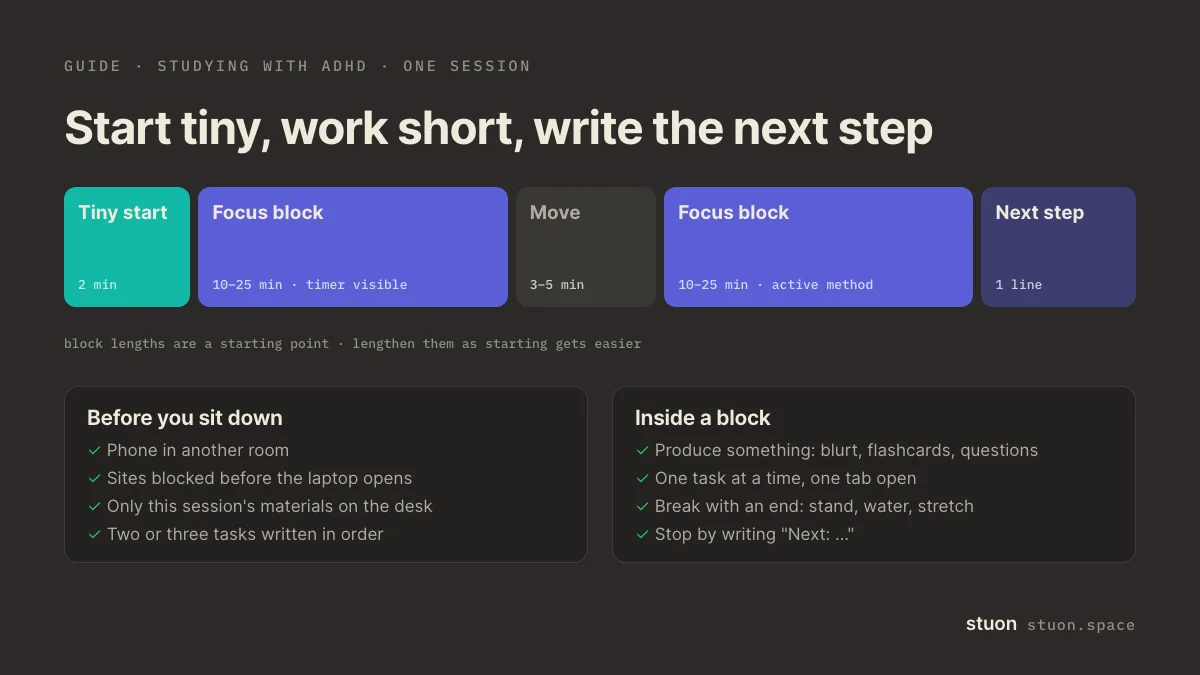
- Make the first step tiny. Not "revise biology" but "open the notes and read the first heading". Start a 2-minute timer and only commit to that.
- Use short, timed blocks. Try 10 to 25 minutes. A visible countdown, such as the ADHD focus timer, makes time concrete.
- Plan the break before it starts. Stand up, move, drink water. Avoid breaks that have no end, such as short videos.
- Write the next step before you stop. One line: "Next: questions 4 to 6." It makes the next start easier.
Make studying active
Passive reading is hard to sustain for anyone and harder with ADHD. Methods where you produce something give your attention a job:
- Blurting: write everything you remember on a blank page, then check.
- Flashcards in Leitner boxes: quick, short, with a clear end.
- Practice questions under a timer, one at a time.
- Explaining out loud, as in the Feynman technique.
- Drawing the topic as a diagram (dual coding).
Self-testing is also one of the best-supported techniques in general (Dunlosky et al., 2013), so you are not trading effectiveness for engagement.
Set up the room before the session
- Phone in another room or in a locked box. Willpower is the worst blocker.
- Block distracting sites with a website blocker before you open the laptop.
- Only the materials for this session on the desk.
- A written plan in sight: today's two or three tasks, in order.
Writing a specific plan for unfinished tasks can also reduce how much they intrude on your thoughts (Masicampo and Baumeister, 2011). If-then plans such as "If it is 4 pm, I open the chemistry questions" help people act on intentions (Gollwitzer and Sheeran, 2006).
Study with someone else
Many people with ADHD describe working better with another person present, often called body doubling. Research on it is early and mostly based on interviews (Eagle et al., 2024), so the evidence is descriptive rather than experimental. It is cheap to try: a friend at the same table, a library, or an online room. See body doubling for studying and study with me videos.
For more routine ideas from the Stuon blog, read an ADHD study routine.
Frequently asked questions
What is the best study method for ADHD?
There is no single best one. Short, active methods with a clear end, such as flashcards, blurting and timed questions, tend to be easier to start and finish.
Is the Pomodoro technique good for ADHD?
Many students find timed blocks helpful. The standard 25 minutes can be too long at first; start with 10 or 15 and build up. See the Pomodoro technique.
Does music help with ADHD studying?
Some people find steady background sound helps and others find it distracting. Test it on a task you can measure, such as a set of questions.
How long should study sessions be with ADHD?
Start shorter than you think: 10 to 25 minutes of focus with a planned break. Several short sessions often beat one long one you never start.
Should I tell my school or university?
Many schools and universities offer support such as extra exam time or study skills help. Your school's student support or disability service can explain what is available.
Sources
- NHS, Attention deficit hyperactivity disorder (ADHD).
- Dunlosky et al. (2013), Improving students' learning with effective learning techniques. Psychological Science in the Public Interest.
- Gollwitzer and Sheeran (2006), Implementation intentions and goal achievement: a meta-analysis of effects and processes. Advances in Experimental Social Psychology.
- Masicampo and Baumeister (2011), Consider it done! Plan making can eliminate the cognitive effects of unfulfilled goals. Journal of Personality and Social Psychology.
- Eagle, Baltaxe-Admony and Ringland (2024), "It was something I naturally found worked and heard about later": an investigation of body doubling with neurodivergent participants. ACM Transactions on Accessible Computing.
Related pages
Practice it, then keep a record
Stuon has a timer, a blurting space and flashcards, and it logs the time you spend on each.
Track this in StuonAdd to Chrome, freeor use the free version without an account