exam plan
LSAT study plan
how do you make a LSAT study plan?
Take an official practice test first, then drill Logical Reasoning and Reading Comprehension by question type, with every miss in an error log. Move to timed 35-minute sections, then full practice tests in the last weeks. Practise Argumentative Writing a few times, because your score is not released until it is done.
by Vusal Imranli updated 10 Oct 20265 min read
What the LSAT tests
| Part | What it tests | Minutes | Scored? |
|---|---|---|---|
| Logical Reasoning (two sections) | Analysing and evaluating arguments | 35 each | Yes |
| Reading Comprehension (one section) | Reading dense passages and answering questions on them | 35 | Yes |
| One more section | Logical Reasoning or Reading Comprehension questions being tried out | 35 | No |
| LSAT Argumentative Writing | An essay taken online, on its own day | 50 (15 prewriting, 35 writing) | No, but required |
The four multiple-choice sections have a 10-minute break after the second one, and LSAC puts the whole test at about three hours. Scores run from 120 to 180. LSAC has announced a new format from August 2027, with the unscored questions moved into the scored sections, so check LSAC for the version you will take.
How to build a LSAT study plan
- Take an official practice test. Use LSAC's official practice tests in LawHub, timed, as your baseline.
- Learn the question types. Logical Reasoning has recurring types such as assumption, strengthen, weaken and flaw. Learn what each one asks, then drill them in short untimed sets.
- Keep an error log. Write the question type, the answer you chose, why it was tempting and why the right one is right. Retry each one a week later.
- Read for structure in Reading Comprehension. For each passage, note the main point, the author's view and the role of each paragraph before answering.
- Move to timed sections. From around week 5, do full 35-minute sections and practise skipping hard questions and returning to them.
- Do the writing task early enough. Practise Argumentative Writing two or three times before test week. Scores are released only once it is complete.
A 12-week LSAT schedule
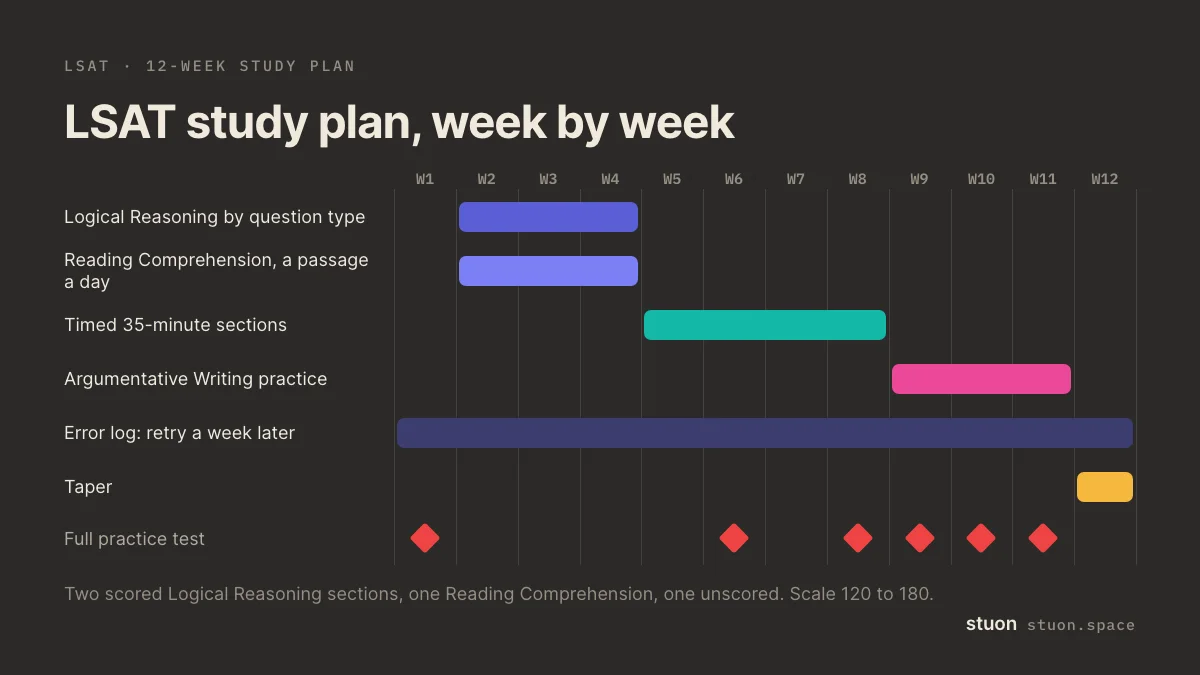
| Weeks | Focus | Main activities |
|---|---|---|
| Week 1 | Baseline | Official practice test under time, error log, list the weakest question types |
| Weeks 2 to 4 | Question types | Untimed Logical Reasoning sets by type, one Reading Comprehension passage a day, retry logged questions |
| Weeks 5 to 8 | Timed sections | Two or three timed 35-minute sections a week, full review of each, one practice test every other week |
| Weeks 9 to 11 | Full tests | One full practice test a week with the break, two days of review, targeted drills, Argumentative Writing practice |
| Week 12 | Taper | Short timed sections, error-log review, a light final two days |
With eight weeks, shorten the question-type block to two weeks and the timed block to three.
How many hours to plan
Set the weekly total from your test date and your current scores, as described in how many hours should I study. The study hours calculator turns hours per day into weekly and total hours.
| Per week | 8 weeks | 12 weeks | 16 weeks |
|---|---|---|---|
| 5 h | 40 h | 60 h | 80 h |
| 10 h | 80 h | 120 h | 160 h |
| 15 h | 120 h | 180 h | 240 h |
| 20 h | 160 h | 240 h | 320 h |
This is multiplication, not a recommendation. It assumes you study every planned week. Choose hours from your starting level and test date, then check them against a log.
Log what you actually do with a study time tracker. A plan of ten hours a week is only useful if the log shows ten hours.
Common LSAT study mistakes
- Taking practice test after practice test without reviewing the wrong answers.
- Timing every set from day one. Learn what each question type asks first, then add the clock.
- Neglecting Reading Comprehension because Logical Reasoning has two scored sections. It is still a full scored section.
- Leaving Argumentative Writing until after the test. Your score is held until it is complete.
Why the error log matters most here
LSAT questions repeat their logic, not their content. A flaw you missed in one argument will come back in another argument about a different subject. That is why the review of a wrong answer, written down and retried later, is worth more than another fresh set.
Retrying logged questions after a gap is retrieval practice, and mixing types once you know them is interleaving. The random question picker can shuffle your logged question numbers for a retry session.
Frequently asked questions
How many sections does the LSAT have?
Four 35-minute multiple-choice sections: two Logical Reasoning and one Reading Comprehension that are scored, and one unscored section of either type. LSAT Argumentative Writing is taken separately.
Is there still a Logic Games section?
No. The current LSAT has no Analytical Reasoning (Logic Games) section. The scored sections are Logical Reasoning and Reading Comprehension.
How long should I study for the LSAT?
It depends on your baseline and target. Take an official practice test first and set the schedule from the gap. The plan here uses twelve weeks as an example.
How do I track LSAT study hours?
Log sessions as Logical Reasoning, Reading Comprehension or review with a study timer, and check the weekly total in the study heatmap.
Sources
- LSAC, Frequently asked questions about the LSAT (sections, timing, break).
- LSAC, LSAT scoring (120 to 180 scale).
- LSAC, LSAT Argumentative Writing.
- LSAC, The LSAT will look a little different starting August 2027.
- Dunlosky et al. (2013), Improving students' learning with effective learning techniques. Psychological Science in the Public Interest.
- Cepeda et al. (2006), Distributed practice in verbal recall tasks: a review and quantitative synthesis. Psychological Bulletin.
More on Stuon about this topic
Related pages
Turn your study time into progress
Levels, streaks and a heatmap give your hours a visible shape.
Turn your study time into progressAdd to Chrome, freeor use the free version without an account