guide
How to study a textbook
how do you study a textbook?
To study a textbook, preview the chapter first, then read one section at a time. After each section, close the book and write or say what you remember, then check. Turn the key points into questions and answer them again over the following days.
by Vusal Imranli updated 10 Oct 20264 min read
Why reading is not enough
A textbook is written to be read, but reading it once, or twice, mostly builds familiarity. You recognise the pages without being able to explain them. The fix is to stop after each section and produce the content yourself. This read-recite-review pattern is the part of reading methods such as SQ3R with the strongest support (The Learning Scientists, 2021).
Highlighting and rereading were rated as low utility in a major review of study techniques; practice testing was rated high (Dunlosky et al., 2013).
A chapter plan, step by step
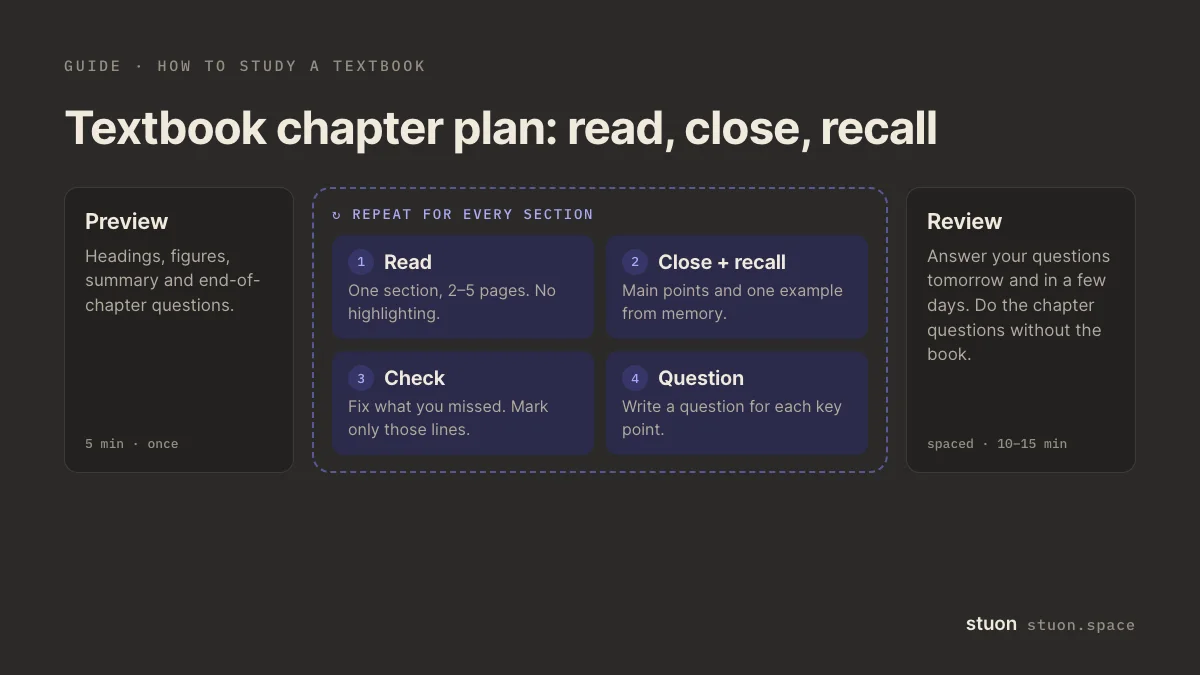
- Preview (5 minutes). Read the headings, the summary, the figures and the end-of-chapter questions. Write down what you expect to learn.
- Read one section. A section is usually 2 to 5 pages under one heading. Read it through once without highlighting.
- Close the book and recall. Write the main points from memory in a few lines, or say them aloud. Include one example.
- Check and correct. Open the book and fix what you missed. Now you may mark the one or two lines you got wrong.
- Turn gaps into questions. Write a question for each key point, especially the missed ones. These are your review cards.
- Review over the next week. Answer the questions the next day and a few days later. Do the end-of-chapter questions without the book.
Adjust for the kind of textbook
- Maths and physics
- Read the worked example, then cover it and solve it yourself. Then do the exercises; they are the real test.
- Biology and chemistry
- Redraw key diagrams from memory and label them. Processes suit flowcharts (dual coding).
- History and social sciences
- Recall arguments and evidence, not only dates. Ask "why did this happen?" (elaborative interrogation).
- Law and humanities readings
- Summarise the argument in three sentences from memory, then list the main cases or sources.
Pace and time
Reading with recall is slower than reading alone, often by a third or more. Plan for it. The pages per day calculator helps when you have a lot of chapters before a date, and the reading timer keeps sections to a set length.
If you take notes while reading, the Cornell method turns them into a self-test. Log reading sessions in a study tracker to see how long a chapter really takes you.
Frequently asked questions
Should I highlight my textbook?
Only after you have recalled the section, and only the lines you missed. Highlighting while reading tends to replace thinking.
Should I take notes while reading a textbook?
Take short notes after each section from memory, not while reading. That way the notes are a recall exercise.
How fast should I read a textbook?
Slow enough to recall each section afterwards. If you cannot, the section was too long or you read too fast.
Do I need to read the whole textbook?
Not always. Check the syllabus or reading list and focus on the chapters that are assessed.
What is the SQ3R method?
A five-step reading method: Survey, Question, Read, Recite, Review. See SQ3R.
Sources
- The Learning Scientists (2021), SQ3R or Read, Recite, Review? Blog post reviewing the evidence for SQ3R.
- Dunlosky et al. (2013), Improving students' learning with effective learning techniques. Psychological Science in the Public Interest.
- Roediger and Karpicke (2006), Test-enhanced learning: taking memory tests improves long-term retention. Psychological Science.
Related pages
Practice it, then keep a record
Stuon has a timer, a blurting space and flashcards, and it logs the time you spend on each.
Track this in StuonAdd to Chrome, freeor use the free version without an account